
Galushchenko’s “Dirty” Collateral: 21 Banks, 85 Accounts, and “Envelopes”—How the System Was Duped
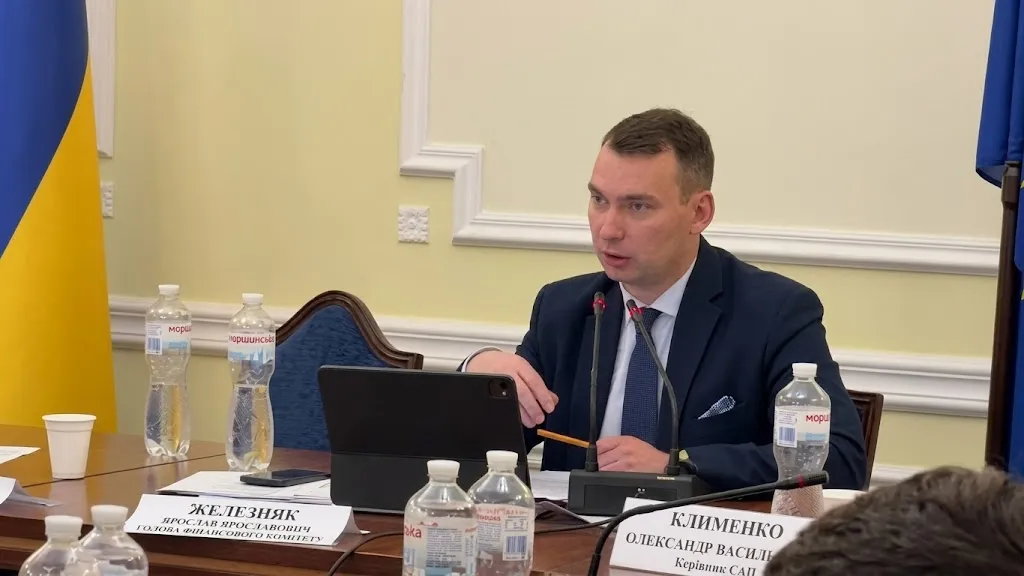
03 September 2026 16:35At a meeting of the Verkhovna Rada’s Temporary Investigative Commission, chaired by People’s Deputy Yaroslav Zheleznyak, officials from the NBU, the Ministry of Finance, and state-owned banks answered questions about the appointment of the supervisory board of Sens Bank, telephone agreements regarding candidates, million-hryvnia deposits, and decisions the regulator had made over the years regarding the bank. The responses constantly included the phrases “I don’t know,” “I don’t remember,” and “I cannot comment,” but documents, correspondence, and journalistic records gave the deputies far more reasons to ask questions.
Recruiters did not recommend them—yet the candidates were still put forward for approval
One of the key moments of the hearing was the testimony of Vjesturs Liegis, the head of Amrop Ukraine. It was this international HR firm that conducted the selection process for candidates to the supervisory board of the state-owned “Sens Bank.”
According to Liegis, the company evaluated 111 applicants and compiled a shortlist. However, after that, the then-chair of the Nomination Committee, Iryna Mudra—who was also the deputy head of the Office of the President—called and asked to expand the list with Ukrainian candidates from the “long list.” The recruiters themselves had not recommended these candidates.
On April 16, Amrop submitted the profiles of the updated list and specifically noted that it did not recommend, in particular, Mykola Hladyshchenko and Oleksandr Shchur due to their lower scores compared to the finalists. And the very next day, these candidates were invited to the final interviews.
During the meeting, TSC Secretary Vadym Ivchenko drew attention specifically to this discrepancy:
“As a company, you provide a service to the nomination committee, and as part of this ‘service,’ you submitted a candidate who scored the lowest number of points. In other words, the service consists not only of submitting strong candidates but also those about whom officials from the Office of the President personally call you,” stated Vadym Ivchenko.
Separately, the Temporary Investigation Commission discovered that preliminary data on the candidates had been forwarded to the National Bank even before the competition concluded. According to meeting participants, representatives of the IMF and the Ministry of Finance opposed this. As a result, the question arose as to why the regulator received information about the candidates even before the procedure was completed and whether this information could have influenced the subsequent selection process.
A particular point of contention was the case of Eva Defalk—a foreign candidate who received the highest ratings from Amrop and was approved by the Cabinet of Ministers, but later withdrew her candidacy. According to TSC participants, Defalk may have been informed that the NBU would not approve her. There was no official decision to reject her—the candidate simply withdrew from the process. Against this backdrop, Hladyshchenko, whom the recruiters had not recommended, became chairman of the supervisory board.
“I don’t remember”: What Katsion said about the conversation regarding the candidates
Next to appear before the TSK was Yuriy Katsion, chairman of the board of Oschadbank. Lawmakers examined his ties to the individuals involved in the case separately. Katsion has worked at Oschadbank for over 20 years, where he crossed paths with Andriy Pyshny and Iryna Mudra. In addition, from January to November 2025, he served as a freelance advisor to Andriy Yermak, then-head of the Office of the President.
Katsion himself stated that he joined the Office of the President based on his professional experience, not on recommendations from Mudra or Pyshnyy. Audio recordings released by investigators were then played in the courtroom. In one of them, a person identified as “Yuriy” discusses candidates for the supervisory board of “SENS Bank” with businessman Vasyl Veselyi. Among them is Oleg Mistyuk. In the recording, the speaker describes Mistyuk as “a normal, reasonable person who will do everything right.”
After that, Vesely says: “We’ll go over it now—I think it’ll take 5–10 minutes—and we’ll come up with the final list: Novak, Shugaev, Eva, Shchurov, Gladyshchenko, and Mistyuk.”
Zheleznyak directly asked Katsion whether the voice on the recording was his and whether he had spoken with Vesely on May 12, 2025, about the candidates. Katsion did not confirm this. He acknowledged knowing Vesely and explained that their contact was related to business matters—Vesely had allegedly approached him regarding bank financing for the reconstruction of a destroyed meat processing plant in Brovary.
Regarding the conversation itself, he replied, “I don’t remember” or “I cannot comment on unverified and unidentified materials.”
Katsion also denied any collaboration with Timur Mindich and Oleksandr Zuckerman and stated that he had not received any instructions from the Office of the President or the NBU regarding personnel matters at “SENS Bank.”
Mistyuk: “Before the tapes surfaced, I didn’t even know about Veselyi”
Oleg Mistyuk—the very candidate whom people in the recordings referred to as the person who “will do everything right”—also arrived at the TSK meeting.
His position was unequivocal: he is not acquainted with Vesely or any of the other businessmen mentioned in the investigations.
“Until November or October, when the first recordings surfaced, I didn’t even know that Mindich, Zuckerman, Vesely, and all the others existed. It’s completely unclear to me who these people are and what influence they might have had.”
When asked about Vesely’s comments regarding his candidacy, Mistyuk replied:
“It’s very hard for me to say what he meant when I didn’t even know he existed. I’ll say it for the fourth time: I’m not acquainted with Vesely or anyone else.”
But he has known Katsion and Mudra well since his time at Oschadbank, which was headed by Pyshnyy at the time.
“That’s where I met Yuriy Katsion. That’s where I met Iryna Mudra. Andriy Hryhorovych Pyshnyy was the bank’s head at the time. I worked there as an advisor on international affairs and corporate reform.”
Today, Mistyuk serves simultaneously on the supervisory boards of “SENS Bank,” the “Settlement Center,” the National Depository of Ukraine, and the “Ukraine” Polygraph Plant.
“As for my appointment to ‘Sens Bank’—no, I didn’t discuss it with anyone. I may have spoken with Ms. Mudra about economic policy… but it was more of a friendly conversation.”
According to Mistyuk, the supervisory board of “Sens Bank” decided back in early May to conduct an external forensic audit to investigate the possible influence of Mindich, Vesely, and others on the bank. But the audit has not yet begun: the supervisory board lacks a quorum.
The state owns the bank but cannot quickly dismiss its executives
After discussing the personnel issues, the lawmakers turned their attention to the Ministry of Finance—the body that represents the state as the owner of “Sens Bank.” Deputy Minister of Finance Yuriy Draganchuk effectively acknowledged that the bank’s supervisory board is paralyzed.
“At this time, the supervisory board of ‘Sens Bank’ is incapacitated because it lacks a quorum and cannot fully exercise its powers... We will conduct another selection process in the near future. Our task now is to place ‘SENS Bank’ under management in a lawful manner.”
At the same time, the state lacks a straightforward mechanism to terminate the powers of a supervisory board member based solely on suspicions or even criminal proceedings.
“We have no grounds to demand the return of any remuneration already paid. Civil law contracts have been concluded with the members of the supervisory board; these are not ordinary employment relationships, and the contract does not provide for such a thing... Under this law, it is not so easy to remove a person from the supervisory board—even if they are imprisoned—as long as they have access to the internet and are able to perform their duties. In English law, there is the concept of “common sense.” Here, we follow the letter of the law, so it’s worth incorporating this common sense into Article 7, because right now the shareholder’s hands are truly tied,” stated Yuriy Draganchuk.
According to him, the Ministry of Finance also sent a request to the supervisory board regarding possible violations. The ministry deemed the response unsatisfactory.
“Unfortunately, we did not receive a sufficiently detailed and adequate response from the supervisory board to our inquiry. From our perspective, it was essentially a form-letter response.”
NBU: 52 million in fines and 21 letters to law enforcement
The National Bank’s position was different: the regulator insisted that a significant number of inspections had been conducted regarding “SENS Bank” in recent years.
“Sens Bank has been the subject of decisions by the Supervisory Committee 100 times. There were three on-site inspections, six financial monitoring audits, nearly 52 million hryvnias in fines were imposed, and 21 letters were sent to law enforcement agencies. No other bank has received such attention from the NBU,” said Andriy Pyshny.
Lawmakers also asked why the regulator did not intervene earlier in the situation involving Supervisory Board Chairman Mykola Hladyshchenko. Dmytro Oliinyk, head of the NBU’s Supervisory Committee, explained that the regulator does not rely on ratings from a recruitment firm but instead reviews candidates nominated by the government.
“Fortunately or unfortunately, we do not have a preliminary approval procedure. Ms. Mudra did not contact us either officially or in any other way… We do not work with a list from a recruitment firm. I don’t even know how much they’re paid or who selects them. My answer is that I work with the list submitted by the government.”
Regarding Gladyshchenko, according to Oliinyk, the NBU consulted with law enforcement agencies and conducted an interview.
“We asked all law enforcement agencies, and they all said, ‘Okay.’ We conducted an interview; the candidate knows what he’s talking about, so we approved him. As for how his supervisory board elected him as chairman—I have no idea.”
As for his ties to Vesely: “We saw that he had crossed paths with Vesely, who has been mentioned here many times. We addressed these questions to him. He assured us that there has been no connection over the past four to five years,” explained Dmytro Oliinyk.
This is precisely what the deputies questioned: how does the regulator verify information that may be available in open sources but is not reflected in the candidate’s official responses?
Why some candidates were rejected while another was approved
Separately, the lawmakers compared Gladyshchenko’s case with that of Eva Defalk and other foreign candidates. MP Anastasia Radina raised a complaint against the NBU:
“You didn’t see any issues with Mr. Hladyshchenko being effectively pushed onto the shortlist and his ties to Mr. Vesely, which are readily available in open sources. You didn’t see that. But as soon as rumors surfaced about Ms. Eva, you suddenly saw some issues. How did such an unfortunate coincidence happen? Why don’t you see what’s obvious, yet everyone—the dead, the living, and the unborn—knew you’d see something that doesn’t exist?”
The NBU responded that the regulator does not participate in the work of the Nomination Committee and receives candidates only after the government’s decision.
“In the course of carrying out its duties, the National Bank does not interact with the Nomination Committee or the recruiting firm. For us, the government’s decision is the only relevant source. Internal discussions within the Nomination Committee are not accessible to the National Bank.”
The NBU does not remove members—it requires the owner to terminate their powers
Regarding Gladyshchenko, Pyshnyy explained that the NBU cannot independently dismiss members of the supervisory board.
“The decision determined that Hladyshchenko did not meet the qualification requirements for an independent director and that his powers should be terminated. It is important to note here: this is not a suspension, but specifically the termination of his powers. And a second important point: the National Bank does not terminate his powers. The National Bank addresses the owner with a corresponding request.”
Just the day before the meeting, the NBU committee determined that Oleksiy Stupak, chairman of the board of “SENS Bank,” did not meet the qualification requirements regarding professional competence. The corresponding request was also sent to the owner.
“Secret” Management and 87 Million in Collateral
Another set of hearings focused not on personnel but on the bank’s operations themselves. The discussion centered on the posting of collateral in the high-profile “Midas” case. According to the State Financial Monitoring Service, funds related to the posting of collateral passed through various banks.
A representative of the agency stated: “In total, 21 banking institutions and approximately 85 accounts through which funds were transferred were involved in the process of providing this collateral.”
However, the State Financial Monitoring Service does not have the ability to stop bank transactions as they occur.
“The State Financial Monitoring Service physically lacks the technical and legal capacity to halt transactions directly as they occur, since they are not displayed in real time,” the agency representative stated.
At Sens Bank, a separate investigation was conducted to determine whether there was a special “window” in the control system during the processing of payments. Acting Chair of the Board Olena Zubchenko stated:
“Our investigation, conducted together with the IT department, shows that the system did not shut down. The bank had an internal filter in place for enhanced verification of collateral, which should have flagged such payments for further investigation into the sources of the funds. We are currently reviewing exactly how these payments were processed and why they were authorized.”
According to her, after the transactions took place, the bank terminated its business relationships with the two companies that made the payments.
Andriy Pyshnyy, in turn, noted that preliminary findings from the internal investigation indicate that the payments were manually authorized by financial monitoring staff.
“Preliminary findings indicate that the payments were authorized manually with the involvement of the relevant financial monitoring staff. It is my firm belief that, if these facts are confirmed, the bank will have every legal basis to terminate her employment.”
This refers to Lyudmila Snigur, director of the financial monitoring department, whom the bank has suspended pending the internal investigation.
“The entire collateral was not processed through Sens”
The NBU, however, denied that “SENS Bank” was the sole or primary channel through which the collateral passed.
“Not all of the collateral was processed through Sens. We conducted an analysis down to the fourth level—from VAKS and beyond—and found no cash in those four levels. There are other banks that raise just as many questions as Sense, and some even more,” stated Dmytro Oliinyk.
He also noted that the NBU has not identified a specific technical mechanism for circumventing controls.
“We have not identified any technological ‘loopholes’ at this time. The transfer of funds to the state (to VAKS) itself is not considered high-risk under international standards.”
At the same time, according to Oliinyk, the regulator does not monitor all banking transactions in real time.
“In Ukraine, 50 million transactions per month pass through the electronic payment system alone, not counting card transfers. We do not monitor anything online, but authorized personnel oversee compliance with regulations and risks to operational continuity.”
The NBU Speaks of Hidden Management Bodies
Pyshny’s most significant statement did not concern a single transaction, but rather the bank’s governance system itself.
According to him, as early as the spring of 2025, the NBU had identified signs of a parallel corporate governance system.
“The National Bank identified the first records indicating the existence of a secret corporate governance system as early as the spring of 2025. This implies the existence of a hidden composition of the credit committee, a hidden composition of the board of directors, and key individuals who are not declared to the National Bank but who, in fact, make decisions.”
According to the head of the NBU, certain transactions were also structured with additional safe-deposit guarantees and off-balance-sheet arrangements.
“The National Bank has no information”
At the same time, when lawmakers asked who exactly could influence personnel decisions and how, Pyshnyy reiterated the limits of the NBU’s authority.
“The National Bank is in no way involved in the work of the nomination committee. The National Bank has no representatives on the nomination committee... Because of this, we do not understand or see what is happening within the nomination committee. The National Bank only becomes involved once it receives a package of documents from the bank... I have no information regarding the substance of the question you have raised.”
When asked about Katsion, the recordings, and the possible loss of his impeccable business reputation, the NBU governor also cited the lack of official confirmation.
“If the National Bank receives relevant information regarding Yuriy Katsion from you or from any government agency, it will, of course, review it. If you have such information, please provide it.”
Katsion himself replied, “I want to state that I have never in my life participated in any illegal activity and have an impeccable reputation. I cannot comment on unverified, unconfirmed information.”
What Remained After the Interrogation
After several hours of questioning, the TSC was left with three major issues.
The first is a staffing issue. The recruiting firm may not have recommended certain candidates, but they still made it to the final stages of the selection process. Some participants in the process did not see this as a procedural violation, although the very manner in which these candidates were selected became one of the main topics of discussion at the TSK.
The second is a management issue. Sens Bank’s supervisory board lost its quorum, the external audit has not begun, and the state, as the owner, acknowledges that its ability to quickly change the situation is limited by law.
The third is financial. Collateral worth millions passed through the bank; some transactions were authorized manually; and at the same time, the National Bank of Ukraine (NBU) speaks of years of violations, tens of millions in fines, and the existence of a hidden corporate governance system.
At the same time, almost every issue ran up against the limits of another institution’s authority: The NBU cites the Ministry of Finance and the government; the Ministry of Finance cites the law and the supervisory board’s authority; the supervisory board cites its own procedures; and law enforcement agencies cite the confidentiality of the investigation.
The question now is not just who spoke to whom on the phone, but why the system of state oversight of the bank was able to overlook such warning signs for years—and yet lacked a clear mechanism for a rapid response.


