
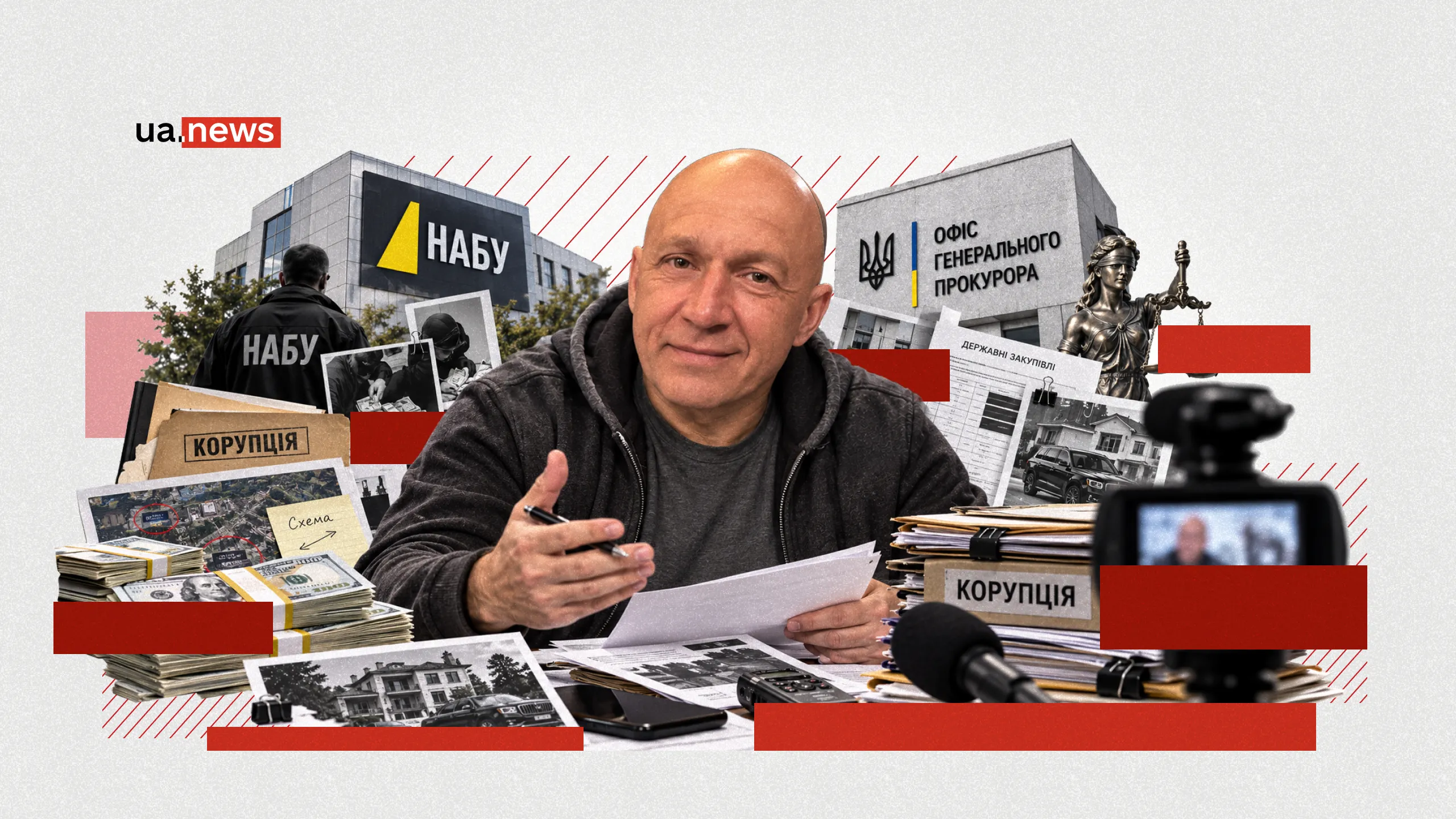
"Kryvonos should have been served with a notice of suspicion long ago" — Volodymyr Boiko on NABU, SAPO, and corruption in government.
14 September 2026 15:55A day before Prosecutor General Ruslan Kravchenko announced suspicion against NABU Director Semen Kryvonos, UA.News spoke with one of Ukraine’s most prominent whistleblowers, Volodymyr Boiko. The irony is that Boiko mentioned some of the very stories that eventually led to the suspicion against Kryvonos in this interview.
This includes the story of a fictitious adoption of a child which, according to investigators, helped Kryvonos avoid punishment, as well as criminal proceedings over an alleged demand for $120,000 in exchange for allocating a plot of land in the Obukhiv district. Both stories had already been circulating in the public domain for years, but they have now gained much more attention. So the conversation, which was initially supposed to focus on the new political season, anti-corruption investigations, and the prospects for NABU and SAPO in the autumn and winter, turned out to be somewhat different. Especially since Boiko speaks without diplomacy and does not particularly choose his words — he names people, schemes and the reasons why, in his view, Ukraine’s anti-corruption system has long operated differently from the way it is usually presented to the public.
We discussed forthcoming high-profile suspicions, the confrontation between NABU, SAPO and the Prosecutor General’s Office, the stories surrounding Semen Kryvonos and Oleksandr Klymenko, the possible involvement of senior officials from the Office of the President, leaks of criminal case materials, corruption in the military and the case of Vitaliy Shabunin. And separately — where, in Boiko’s view, the line of immunity for Ukrainian officials lies.
Let us emphasize once again: the conversation took place literally on the eve of the suspicion against Kryvonos. And therefore, some of the things said in it about the NABU director now sound in a completely different context.
Below is Volodymyr Boiko’s direct speech.
A New Political Season Against the Backdrop of War: What to Expect in Autumn and Winter
Let me point out that the new political season is beginning in a country that has been waging a full-scale war for the fifth year already. So, essentially, we have two Ukraines — one is opening political seasons, while the other is fighting.
The enemy is already 5 km from Sloviansk (DeepState reports 12 km, but we have to take into account the settlement of Semenivka, which is also part of Sloviansk — from there, the enemy is 5 km away). Kramatorsk is not the only frontline city anymore (I am not even talking about Kostiantynivka, Druzhkivka and Lyman); Zaporizhzhia and Pavlohrad have also become frontline cities. At the same time, Russia’s 700,000-strong army is opposed, according to my estimates, by 120,000–150,000 Ukrainian servicemen, of whom no more than 30,000 are actually on the line of contact. Another 100,000 or so are in headquarters, rear services and the Military Law Enforcement Service, while the rest are “fighting” in the same way that Zhadan, Butusov, Kipiani, Vakarchuk and, until recently, Shabunin and Sherembei “fought.”
The number of criminal proceedings over desertion is approaching half a million, mobilisation has turned into a pump for extracting money from the population, and no more than one-third of those forcibly mobilised actually reach military units. As a rule, these are people of pre-retirement age working in manual professions, homeless people and villagers; the rest flee along the way. Because, firstly, nobody intends to die for the sake of the prosperity of the participants in these “political seasons,” and secondly, military justice was abolished in Ukraine back in September 2019. There is currently no body responsible for maintaining law and order in the Armed Forces of Ukraine and other military formations — so there is no need to be surprised that some military units have turned into organized criminal groups.
As for corruption scandals, after the “cassette scandal” of 2000–2002, when recordings of conversations secretly made in President Kuchma’s office were made public, the very notion of a “scandal” in Ukraine has been hollowed out. The latest scandals have not taught us anything new either.
High-Profile Suspicions Do Not Mean a Fight Against Corruption
During Yanukovych’s time, a former prime minister and a former interior minister, the sitting head of the State Financial Services Commission, and sitting deputy ministers were convicted. I remember Yanukovych saying: “I will under no circumstances allow corrupt officials to run politics. I will burn this phenomenon out with a hot iron.” We subsequently heard similar phrases many times from presidents, prosecutors general, two NABU directors and two SAPO heads. But what does any of that have to do with fighting corruption?
As for Stefanishyna, she was first served with a suspicion back in 2019, when she was working as an adviser at the law firm Illiashev & Partners. So when the Verkhovna Rada voted in June 2020 to appoint Olha Vitaliivna Stefanishyna as Deputy Prime Minister, she was already a suspect. In 2023, the case against Stefanishyna and former Justice Minister Lukash was sent to court by a SAPO prosecutor. Therefore, this is not about NABU’s achievements, but about the morality and legal awareness of the people who appointed a suspect to a senior government position and then, while she was facing charges, sent her as ambassador to the United States.
The Dismissal of the Prosecutor General and His Deputy: Has NABU Really Started Going After Corrupt Officials?
The first Prosecutor General to lose his position as a result of a corruption scandal was Svyatoslav Piskun — Kuchma dismissed him in October 2003 after, so to speak, an artillery preparation campaign conducted by Olha Kolinko, then head of the Coordination Committee for Combating Organized Crime and Corruption under the President of Ukraine. Olha Mykhailivna revealed a great deal about the sources of Svyatoslav Mykhailovych’s unearned income, but the real reason for his dismissal was not Kuchma’s high level of legal awareness. It was Piskun’s flirtation with the opposition, his obvious unwillingness to send Tymoshenko to prison, his assistance to Poroshenko’s businesses in their confrontation with the tax authorities, and the arrest of Pukach on charges of destroying official documents containing information about surveillance of Gongadze.
There have also been many cases of deputy prosecutors general involved in corruption scandals being dismissed. As soon as Viktor Pshonka became Prosecutor General, the all-powerful Viktor Kudriavtsev, whose dealings were legendary, was dismissed within 15 minutes. Another example: more than two years ago, NABU created a corruption scandal around Deputy Prosecutor General Verbytskyi, publishing information that Verbytskyi was living in a house worth half a million dollars that had been purchased for six times less, and that his common-law wife had acquired real estate and a Porsche worth a total of UAH 48 million. An apartment and a plot of land purchased by Verbytskyi in Turkey were also uncovered.
NABU registered criminal proceedings over the alleged illicit enrichment of Deputy Prosecutor General Verbytskyi, but there has been no result to date. And there will not be one. Because, according to malicious gossip, NABU Director Kryvonos and SAPO Head Klymenko staged the entire scandal merely to obtain financial assistance from Verbytskyi. Malicious tongues even name the person through whom Verbytskyi allegedly passed this assistance — supposedly Boris Indychenko, head of the Specialized Environmental Prosecutor’s Office of the Prosecutor General’s Office, whose father, also Boris Indychenko, heads NABU’s most secretive unit, known as D2.
The high-profile criminal proceedings with which NABU and SAPO have been shaking up the information space over the past year have nothing to do with fighting corruption. In this way, Kryvonos and Klymenko are saving themselves from prison. The SAPO head himself speaks openly in interviews about the reasons for his confrontation with Prosecutor General Kravchenko, who prepared written notices of suspicion against the NABU director and SAPO head last summer. So what we are now witnessing is the final stage of the struggle between Kravchenko on one side and Kryvonos and Klymenko on the other.
Suspicions Against Kryvonos and Klymenko: Why Were They Never Served?
Everything is obvious. No one denies that senior NABU detective Magamedrasulov was engaged in an illegal business and shared the proceeds with Klymenko — they are friends — and Kryvonos. When professional “civil society activists,” who use their mouths to service the dirtiest corruption schemes, shout that the “Magamedrasulov case” was fabricated, they are only arguing about which country the senior NABU detective supplied the cannabis grown by his father to. The SBU claims that a recording of a telephone conversation contains Magamedrasulov mentioning Dagestan, meaning Russia, while the “activists” scream that Magamedrasulov was trading with Uzbekistan.
There were other episodes as well — for example, Magamedrasulov allegedly organized an extortion scheme together with MP from the Opposition Platform — For Life party Khrystenko. In particular, they allegedly demanded money from Kyiv City Council member Slonchak in exchange for not bringing him to criminal responsibility. Clearly, part of the senior detective’s income went “upstairs” — to Kryvonos and Klymenko.
Why Were the Suspicions Against Kryvonos and Klymenko Not Served at the Time?
There are two reasons. First, Prosecutor General Kravchenko and the SBU were incapable of organizing a pre-trial investigation in accordance with the law. They can trade criminal cases, “cover” fraudulent call centres or smuggling — that too. But to investigate something competently, your head has to be occupied with something other than personal enrichment.
If there had been at least one intelligent person in the Prosecutor General’s Office involved in decision-making, the “Magamedrasulov case” would have been investigated in accordance with the law, rather than in the way we saw. Why, one might ask, was Magamedrasulov charged with treason? Even if he really did sell cannabis to Dagestan, that would only constitute a corruption-related crime, nothing more.
The treason charge was invented solely to ensure that Magamedrasulov would be held in custody with no alternative measure available. SBU Head Maliuk was convinced that as soon as the senior NABU detective was put behind bars, he would testify against Kryvonos and Klymenko. And who would call Maliuk an intelligent man after that? The second question is: where were Prosecutor General Kravchenko and his first deputy Khomenko, who oversaw the SBU?
Kravchenko and Maliuk should not have been holding insane press conferences. They should have calmly investigated the “cannabis case” in full compliance with the law, without inventing things that never happened.
Intelligent people would also never have initiated a law restricting the powers of NABU and SAPO. Instead, they would have brought to court as quickly as possible the criminal proceedings registered over the past 10 years against former NABU Director Sytnyk. During the tenure of Prosecutor General Lutsenko, the General Inspectorate of the Prosecutor General’s Office investigated criminal proceedings over the purchase by Sytnyk of an apartment in Brovary with money he allegedly took as a bribe from a woman named Vinokurova in exchange for closing a criminal case concerning land fraud in the Obukhiv district. All the evidence had been collected and a draft suspicion notice had been prepared. After learning about this, Sytnyk allegedly went to Poroshenko’s home at night and reached an agreement that Prosecutor General Lutsenko would close the case in exchange for Sytnyk closing criminal proceedings concerning alleged illicit enrichment by Yurii Vitaliiovych.
And although the statute of limitations for prosecuting Sytnyk has already expired, he should have been served with a suspicion and the case sent to court to be closed due to the statute of limitations. The entire country would then have seen that the former NABU director was a bribe-taker, NABU detectives would have become convinced that the Prosecutor General was determined to fight corruption and would have stopped following Kryvonos’s illegal orders. I have no doubt that in that case former NABU detectives would have gone to the Prosecutor General’s Office in droves to cooperate with investigators.
And who prevented Sytnyk and former NACP Head Novikov from being served with suspicions in the “Shabunin case”? It was they who, in 2022–2023, sent letters to military unit A7376 asking that soldier Shabunin be seconded to the NACP. And why is there no investigation into detective Biriukov, who passed Shabunin materials from criminal proceedings concerning Sytnyk and Novikov over alleged abuse of office in the interests of soldier Shabunin?
And only after that should they have gone after Kryvonos and Klymenko, who have put the sale of criminal cases on an assembly line and are engaged in extorting money from suspects, including by making agreements with prosecutors to transfer funds to private foundations of Sternenko and Chmut in exchange for avoiding punishment.
But no one did this because Sternenko is a businessman close to the Office of the President, whose accounts are allegedly used not only by the heads of NABU and SAPO but also by SBU deputy heads.
Fictitious Adoption, Land and Kryvonos’s Old Criminal Cases
Ukraine is a feudal state with power that is not divided among independent branches. The Prosecutor General’s Office is merely one of the departments of the Office of the President; therefore, in reality, the prosecutor’s office is not run by the Prosecutor General, but by the court minister and the monarch himself. They decide whom to punish, whom to pardon and what preventive measure to choose for whom. By the way, in August 2025, Zelensky directly banned the imposition of a preventive measure against Shabunin, who is now on trial for fraud and evasion of military service, at a meeting of the Staff of the Supreme Commander-in-Chief. Therefore, feudal justice cannot operate on legal grounds by definition — it exists to serve the whims of the monarch.
If there were intelligent people in the Office of the President, instead of drafting a law restricting the powers of NABU and SAPO, they would have focused on destroying Kryvonos and Klymenko in the media. It would be enough to publish in Western media the details of the criminal case in which Kryvonos was prosecuted in 2009 and, most importantly, the details of how he avoided prison by falling under an amnesty. Since the amnesty applied to defendants and accused persons who had minor children in their care, defendant Kryvonos allegedly fictitiously adopted a boy named Maksym, paying his mother UAH 500. Then, in 2019, he had his paternity cancelled by court order, citing a DNA test.
I am not even mentioning the criminal proceedings investigated in 2014 against Kryvonos, who at the time headed the registration service of the Obukhiv City and District Department of Justice, on suspicion of attempting to receive $120,000 in an illicit payment for allocating a plot of land. And, in general, Semen Yuriiovych is such a colorful character that one could talk about him for hours without getting bored. For example, about the fact that Kryvonos’s family — his wife, his wife’s sister and even his mother-in-law — allegedly serviced the Kryvyi Rih criminal group known as the “Dvadtsiatyvski,” one of whose leaders is Eduard Samotkal, who has been wanted by NABU. Companies belonging to Samotkal, whom NABU has unsuccessfully been searching for abroad, were allegedly registered in the names of Kryvonos’s wife and mother-in-law.
But the Office of the President prefers not to disseminate any of this information. And this is hardly surprising — along with Kryvonos’s wife, her sister, who is married to current head of the Kyiv Regional Military Administration Tymur Tkachenko, also allegedly took part in Samotkal’s dealings.
As for SAPO Head Klymenko, he is a figure in the so-called “Svynarchukgate.” Let me recall the background: in 2016–2017, NABU Director Sytnyk, his godfather Kaluzhynskyi — at the time a NABU detective who later headed NABU’s Main Detective Unit — detectives Borysenko and Lytvynenko, through “secret NABU agent” Shevchenko, allegedly helped the son of the first deputy secretary of the National Security and Defense Council, Hladkovskyi, also known as Svynarchuk, steal from Ukroboronprom. The “Svynarchuks’” business allegedly consisted of selling smuggled military equipment parts to Ukroboronprom through a fictitious company called Optimumspetsdetal. NABU management’s alleged role in the business was selling the businessmen certificates stating that their company, Optimumspetsdetal, showed no signs of being fictitious.
At the time, Klymenko was the head of the NABU department where all of this allegedly took place; he is now the head of SAPO. The role of “secret NABU agent” Shevchenko consisted of passing kickbacks and gifts purchased by the “Svynarchuks” to NABU — for example, newly released mobile phones. Even the coffee machine in Sytnyk’s reception area was allegedly purchased with money obtained from the theft of Ukroboronprom funds.
In March 2019, then-SAPO Head Kholodnytskyi registered criminal proceedings over the alleged involvement of NABU employees in the theft from Ukroboronprom and sent the case to the State Bureau of Investigation for pre-trial investigation. In those proceedings, the deputy prosecutor general managed to serve a suspicion on NABU detective Zavhorodnii, while SBI investigators prepared draft suspicion notices for Main NABU Detective Unit Head Kaluzhynskyi and detective Lytvynenko. But after anti-corruption activist Riaboshapka became Prosecutor General, the criminal proceedings were closed.
If decisions in the Prosecutor General’s Office were made by an intelligent person, the decision to close the criminal proceedings in the “Svynarchuk case” would have been overturned long ago, and current SAPO Head Klymenko, SAPO prosecutor Lytvynenko, and former detectives Zahorodnyi, Borysenko and Kaluzhynskyi would have been served with suspicions.
That is why, as soon as Kryvonos and Klymenko saw the complete helplessness of their opponents, they went on the offensive. For a NABU director and SAPO head allegedly mired in corruption, the only guarantee of immunity is to have a trusted person from among NABU detectives or SAPO prosecutors appointed Prosecutor General. The minimum program is to intimidate the future Prosecutor General so that he deals only with his own corruption schemes and does not interfere with the “anti-corruption fighters” lining their pockets.
NABU, SAPO and the Struggle for Influence: What Really Lies Behind the High-Profile Proceedings
Of course, Mr. Kropyva would add some colour to any detention centre. It is a shame that former First Deputy Prosecutor General Maria Vdovychenko got away with merely submitting her resignation from the prosecution service — I am not only convinced that prison has been crying out for Maria Serhiivna for a long time, but I also recently described her “professional achievements” in an attempted raider takeover of land.
But the public interest lies not in dismissing several corrupt prosecutors, but, above all, in shutting down fraudulent call centres. And they continue to operate exactly as before. The only difference is that now they no longer pay tribute to Kropyva — that is all.
The main thing for society is for this fight to be mutual. Corrupt NABU employees should expose corrupt prosecutors, and vice versa. Because if either of these two groups monopolizes the corruption flows, Ukraine as a state will very quickly cease to exist as a result of a military and economic catastrophe.
The Shootout in Berezniaky Between the HUR and the SBU — A War Over Fraudulent Call Centres?
This is far from the first shootout between high-ranking officials. Let me remind you that in December 2015, officers of the SBU’s Special Operations Centre “A” stormed a covert HUR apartment in Obolon. As a result of the shootout, both HUR covert operative Oleg Muzhchil and SBU Special Operations Centre “A” officer Andrii Kuzmenko were killed. In July 2020, SBU officers detained Andrii B aidala in Kyiv’s Pozniaky district — the head of a HUR sabotage and reconnaissance group, who was charged with illegal handling of weapons. In March 2022, officers of the SBU’s 5th Directorate of the Counterintelligence Department shot dead HUR covert operative Denys Kiriiev. So there is nothing new here — it is business as usual.
The criminal business of the high-ranking parties at war with each other could be discussed at length. But, as far as I understand, this time the clash was caused by the position of former HUR chief and current head of the Office of the President Budanov, who is blocking the appointment of his long-time enemy Oleksandr Poklad as full-fledged SBU chief. Poklad is the former head of the same 5th Directorate of the SBU Counterintelligence Department that shortened Kiriiev’s life. To make Budanov more compliant, the descendants of Dzerzhinsky allegedly abducted HUR serviceman Stepan Kaplunov, a Russian citizen who knows a great deal about Budanov’s business.
To understand what HUR servicemen are like, let me note that this Kaplunov, together with two accomplices — Oleksandr Ladik and Denys Tkalych — has been on trial since February 2020 in Kyiv’s Dnipro District Court for banditry and illegal drug trafficking. In May 2025, the proceedings were suspended because the defendants had been mobilized. However, on August 27, 2026, one of Kaplunov’s accomplices, who is currently fictitiously listed in the National Guard as a reconnaissance instructor, was arrested by the Khmelnytskyi City and District Court for extortion.
After Kaplunov gave evidence against Kyrylo Oleksiiovych during interrogations, the descendants of Dzerzhinsky allegedly took Kaplunov to a HUR safe house on Yurii Shumsky Street. But an ambush was already waiting for them there — a HUR unit that took Kaplunov back. In short, ordinary gang warfare.
Budanov, Mudra and the Line of Immunity for High-Ranking Officials
Even the protocols of covert investigative operations that have been transcribed and attached to the motion seeking a preventive measure for Mudra and Mykytas are enough to send Budanov to a detention centre. I have these protocols and am gradually publishing them on my Telegram channel.
The funniest episode is where Mudra tells Mykytas how Budanov, who was appointed head of the Office of the President in January 2026, gave her an unofficial salary for the first time. He did not give it to her in an envelope — such an amount would not fit — but put the money in a hat. Under Yermak, Mudra received $30,000 a month “for pins” — in addition to the official salary received by Office of the President employees. After Budanov was appointed head of the Office of the President, Mudra agreed to reduce the amount to $20,000. But Budanov forgot about this and, when giving her the money for the first time, put $30,000 in the hat.
Mudra, being an honest person, counted the money and, upon discovering the mistake, went to Budanov to return the excess. But Kyrylo Oleksiiovych, being a gentleman, told her to keep the extra “ten grand” and said that the following month he would give her $20,000 instead of $30,000. All of this was recorded by NABU; Mudra’s story about “Kyrylo” was even submitted to the High Anti-Corruption Court when a preventive measure was being chosen, but in NABU materials the Office of the President employee named “Kyrylo” or “Kyrylo Oleksiiovych” appears as an “unidentified person from among employees of the Office of the President of Ukraine.”
This is because Kryvonos and Klymenko currently have no need to bring Budanov to criminal responsibility. Since these corrupt dignitaries are not engaged in fighting corruption — they are only concerned with their own pocket interests — Budanov does not get in their way. It would be a different matter if they wanted to replace the neutral Budanov with the loyal Tatarov. At least, I have long heard that Kryvonos, together with his troubadour Shabunin, goes around embassies saying that there is only one real manager and decent person in the Office of the President — Oleh Yuriiovych Tatarov — and that he should be appointed head of the Office of the President.
Budanov may also receive a suspicion if he runs in the next presidential election. For Kryvonos and Klymenko, a strategic priority is to bring to the presidency someone who would guarantee their immunity. That candidate is currently believed to be Mykhailo Fedorov. If Budanov also tries to run, he will learn who the Office of the President employee known as “Kyrylo Oleksiiovych” in the covert investigative operation protocols really is.
Can an Anti-Corruption Investigation Reach the President?
The incumbent president cannot be a subject of criminal proceedings. Under Part 5 of Article 216 of Ukraine’s Criminal Procedure Code, NABU detectives conduct pre-trial investigations into criminal offences provided for by certain articles of the Criminal Code if the offence was committed by the President of Ukraine whose powers have been terminated. In other words, the monarch must first somehow be removed from power. The Constitution does provide for impeachment as a means of removing the president, but given that Ukraine is an absolutist monarchy and the Constitution plays a purely decorative and ceremonial role, there can be no impeachment.
But Kryvonos and Klymenko do not even need criminal proceedings against Zelensky — they need the covert investigative operation protocols solely for blackmail. For example, they are currently demanding that Zelensky submit to the Verkhovna Rada a nomination of Klymenko for Prosecutor General.
NABU Leaks as a Tool of Political Blackmail
To investigate criminal proceedings lawfully, law enforcement officers do not need any “leaks.” If NABU stages public spectacles, publishing pre-trial investigation materials through its own correspondents, who for some reason call themselves “journalists,” it means that the NABU director is using this to blackmail someone — either to obtain money for closing cases, as allegedly happened with former Deputy Prosecutor General Verbytskyi, or to obtain a favourable political decision.
It has long been known how, on Kryvonos’s instructions, criminal case materials are taken out of NABU and handed over to “activists.” For example, when senior NABU detective Biriukov copied and handed over to Shabunin in July 2025 materials from criminal proceedings being investigated by NABU based on my complaint, I not only established exactly to the minute how it happened, but also succeeded in having criminal proceedings registered with the State Bureau of Investigation over the disclosure of pre-trial investigation data.
In January 2026, the SBI closed the case against Biriukov. Following my complaint, the court overturned the decision to close the case as unlawful, but no investigation is being conducted. This is all a consequence of the fact that Ukraine has had no Prosecutor General for many years — that is, no person responsible for maintaining law and order in the state. The last one was Bohdan Vasylovych Ferents, who served as acting Prosecutor General from April to July 1998.
Corruption in the Military: Why Soldiers Are Afraid to Speak About Their Commanders
Such statements by the Ministry of Defence provoke nothing but laughter. Back in September 2019, a law was adopted abolishing the only body that provided at least some degree of law and order in the Armed Forces of Ukraine and other military formations — the military prosecutor’s office. The bill was prepared by the now-deceased Portnov — abolishing the military prosecutor’s office was Andrii Volodymyrovych’s idée fixe. He first achieved this during Yanukovych’s time; in 2014, the military prosecutor’s office was restored, but after Zelensky’s inauguration, Portnov managed to bring his team into the Prosecutor General’s Office — Riaboshapka, Kasko and Chumak — and, through then-head of the Office of the President Bohdan, push through amendments to the Law of Ukraine “On the Prosecutor’s Office” abolishing the military prosecutor’s office. Therefore, the Ministry of Defence now forwards all complaints from servicemen to the commanders of the military units being complained about — for them to investigate. There simply is no other option.
However, even if the military prosecutor’s office is restored, it will not have the tools to prevent offences. In Ukraine, prosecutorial supervision over compliance with the law by public-law entities — including officials and military officials — was abolished at the initiative of the same Portnov, with the help of professional “civil society activists,” back in October 2014. On that occasion, Proshenko came to the Verkhovna Rada and urged MPs to support the bill abolishing prosecutorial supervision, saying that it was supposedly a presidential bill. Petro Oleksiiovych simply forgot to name the president who had submitted it — the bill had been drafted by Portnov and submitted to the Verkhovna Rada by Yanukovych in November 2013.
Shabunin’s Fictitious Military Service and Those Who May Have Protected His Immunity
I do not merely write about Shabunin’s fictitious military service. First and foremost, I am the complainant in criminal proceedings registered over the evasion of military service by Shabunin, a serviceman mobilized into the Armed Forces, and over fraud. Since November 29, 2025, the indictment against Shabunin and former battalion commander Lieutenant Colonel Yushko has been heard by the Pechersk District Court. I am on the list of witnesses to be questioned by the court.
Only one episode has been referred to court so far: according to the case narrative, soldier Shabunin of the 207th Separate Battalion did not appear at his military unit for five months, lived at home and engaged in business activities. In case of an inspection, he allegedly submitted letters every month signed by his friends — NACP Head Novikov and NACP Deputy Head Sytnyk — asking that soldier Shabunin be seconded to the NACP to perform military service there. On the basis of these letters, Lieutenant Colonel Yushko allegedly issued orders for fictitious secondments and paid Shabunin his military salary and even additional remuneration for performing combat missions.
The remaining episodes are not being investigated — they concern Shabunin’s unauthorized absence from his place of service, fictitious secondments to other civilian institutions, such as the Kharkiv and Mykolaiv humanitarian aid centres, where Shabunin allegedly served, and the use of an allegedly forged certificate confirming participation in combat operations, among other things. However, even the investigation of the single episode sent to court was blocked by the Office of the President for more than a year. The reason became apparent when Shabunin’s phone was allegedly hacked: he is a close friend of former Deputy Head of the Office of the President Andrii Smirnov, who is currently being tried by the High Anti-Corruption Court for illicit enrichment. In addition, Shabunin’s immunity was allegedly protected by Defence Minister Rustem Umerov, whose corruption schemes Shabunin and his associate Daria Kaleniuk allegedly serviced through their public statements.
There are dozens, if not hundreds, of thousands of people like Shabunin in the army. People are fictitiously listed as serving in the military, receive military pay and even combatant status, but live at home, lead peaceful lives and pay commanders for the opportunity to evade service. For example, in the 207th Separate Territorial Defence Battalion, in addition to Shabunin, more than 20 “soldiers” were allegedly fictitiously listed as serving, including “activist” Sherembei, who had been convicted three times for apartment burglaries. But no one investigates anything. Following my complaint, criminal proceedings concerning Sherembei were registered as far back as May 9, 2024. As it turned out, neither the squad commander nor the platoon commander had ever seen this “warrior” in person. To this day, not a single investigative action has been carried out in the case.
And all because so-called “civil society activists” are a link in corruption schemes. They not only embezzle international aid allocated to Ukraine by Western partners, but also service schemes run by corrupt Ukrainian authorities. At the same time, under agreements with the authorities, they stage public spectacles criticizing corrupt officials — officials to whom they themselves allegedly belong.
Which Case Could Prove That NABU and SAPO Have Truly Become Independent?
There are dozens of such cases: criminal proceedings over alleged abuse of office by NACP Head Novikov and Deputy Head Sytnyk in the interests of soldier Shabunin of the 207th Separate Territorial Defence Battalion; criminal proceedings concerning an alleged criminal group consisting of Ukrainian Parliament Commissioner for Human Rights Lubinets, his Secretariat Head Verveiko and State Service of Special Communications and Information Protection Head Poti; criminal proceedings concerning former Deputy Prosecutor General Verbytskyi, and so on. All these criminal proceedings have been registered with NABU but are not being investigated because they have allegedly been sold and squandered. And there are hundreds of cases that have been closed — concerning Deputy Head of the Office of the President Tatarov, former MP Deineha and the judges and prosecutors who allegedly made him “conviction-free,” and the so-called “Avakov backpacks case,” allegedly unlawfully closed by NABU at the request of the US Embassy, among others.
In its 11 years of existence, NABU has never once undergone the audit required by law; it is completely beyond control. While the prosecutor’s office, police and SBI at least partially, and at least occasionally, perform socially useful functions, including thanks to public criticism and elements of parliamentary oversight, NABU operates solely to enrich two people — the NABU director and the head of SAPO. Therefore, there can be no doubt that there will be no positive changes in NABU’s activities.
Who Will Become the Next Anti-Corruption Sensation of Autumn 2026?
No one knows which case may become the basis for the next “anti-corruption scandal,” including the NABU director, because Kryvonos and Klymenko investigate criminal proceedings depending on the political situation and their own needs. For example, in October–December 2025, NABU suddenly became “interested” in Yulia Tymoshenko. In January 2026, searches were conducted in her office and the office of MP Serhii Vlasenko, and Tymoshenko was served with a suspicion over allegedly intending to make some unknown MPs an offer of an illicit benefit — supposedly, she expressed this intention in a conversation with a person whose identity NABU does not disclose and who was clearly acting under NABU’s control in order to provoke a crime.
This sudden interest of NABU in Tymoshenko and Vlasenko is explained by the fact that in June 2025, a Temporary Investigative Commission of the Verkhovna Rada of Ukraine was established to investigate possible corruption or corruption-related offences in law enforcement agencies, courts and judicial authorities. It was headed by MP Vlasenko. The TSC was supposed to investigate corruption by the leadership of NABU and SAPO, which seriously frightened Kryvonos, who was repeatedly summoned to its meetings but never appeared.
To neutralize the TSC, a provocateur was sent to Tymoshenko, a search was conducted in Vlasenko’s office at the party headquarters, after which Yulia Volodymyrivna and Serhii Volodymyrovych understood what was expected of them — the TSC wrote some formal report and ceased its work.
If one overlays the dates of investigative actions in other high-profile proceedings — concerning Mindich, Mudra and others — with the dates of political events, an obvious correlation is easy to see. Therefore, guessing who will be next in line for a suspicion from NABU is a pointless exercise. There are almost no honest people in Ukrainian politics, and it is impossible to predict whom Kryvonos and Klymenko will choose as their next target, because it will depend either on the person’s ability to share their unearned income or on whether the criminal proceedings can be used to politically destroy an opponent.




