
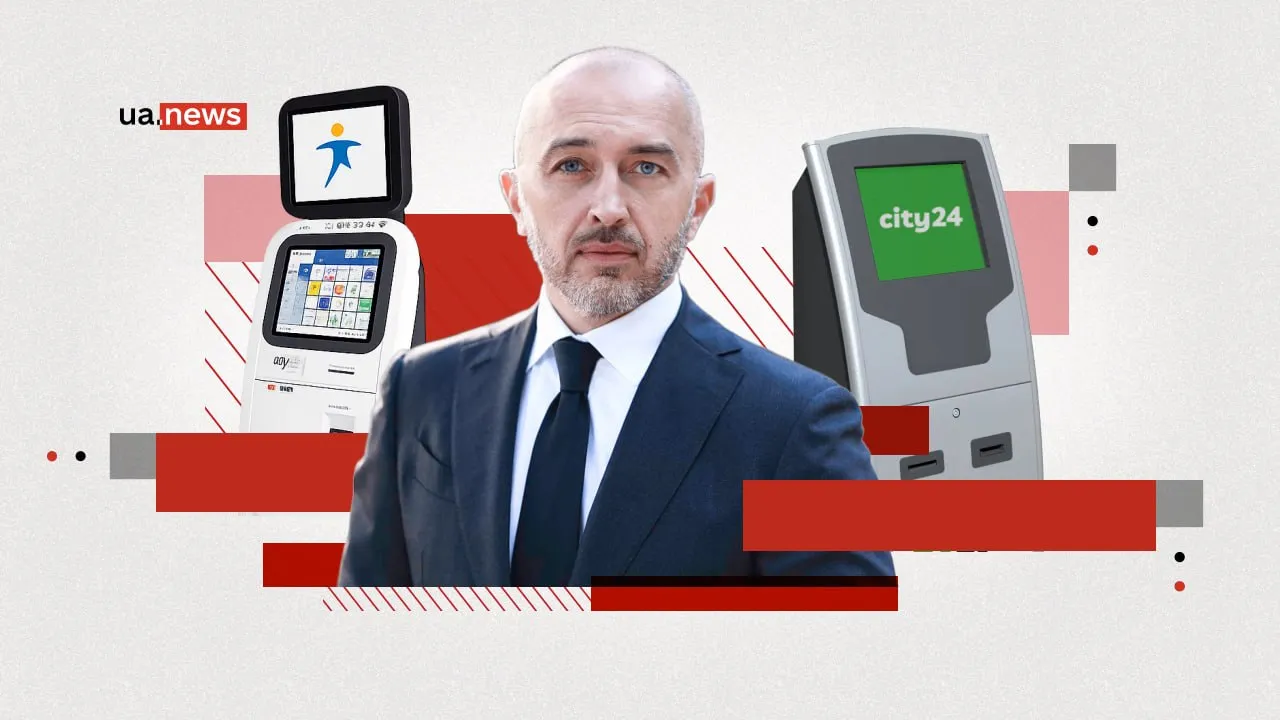
A personal decision by NBU Governor Pyshny: Ukraine’s all-time record—fines totaling 135 million hryvnia for EasyPay and City24
30 June 2026 14:18Following the results of inspections conducted in May, the two largest payment terminal networks—EasyPay (FC “Kontraktovy Dom” LLC) and City24 (Swift Garant LLC)—were hit with massive fines: 135 million hryvnias each. The official reason sounds complicated: “inadequate organization of primary financial monitoring.” Simply put, the National Bank believes that the companies failed to properly verify the origin of the funds passing through their terminals.
However, if we look at the technical nuances and market realities, the situation doesn’t seem so clear-cut. It appears that the high-profile statements about the “fight against dirty cash” totaling 270 million hryvnias may be part of a larger administrative and media game.
Could such harsh measures by the NBU indicate that the regulator is overstepping the bounds of normal supervision?
Artificial Links: Why Is the “Mindich Case” Irrelevant Here?
Before the fines were announced, the press actively circulated information alleging that these terminal networks were linked to businessman Timur Mindich and the high-profile “Midas” case. However, the actual facts indicate that there is most likely no legal or financial connection between EasyPay, City24, and the individuals involved in the investigations.
This whole story seems to have been built on conspiracy theories and the “six degrees of separation” principle:
- Who owns EasyPay: The company is completely transparent; it was founded and is controlled by Ukrainian businessmen Oleksiy and Anton Avramenko (also known for the confectionery brand “AVK”). There are no indications of any involvement by Mindich’s organizations here.
- Who is behind City24: The network belongs to the well-known Ukrainian group “Askania” (the Gorbani brothers), which has also not been linked in any way to companies involved in the “Midas” case.
- The story about the addresses: The argument that some debt collection firm once rented an office in the same building where Mindich’s factory is located seems weak. In a large city, neighbors in the same office complex are hardly likely to be criminal accomplices. Such addresses are often used simply as mailboxes.
As of now, neither the “Askania” group nor the City24 network are parties to any criminal cases involving this businessman, and the regulator has not provided clear evidence of their illegal coordination.
Legal Precedents: When the NBU Loses Due to Subjectivity
The astronomical fines give the impression that the National Bank is always right. However, Ukrainian judicial practice shows that the regulator often loses to financial institutions when its inspectors are guided by their own assumptions rather than the letter of the law.
According to our sources at the NBU, lawyers within the agency itself are well aware of the risks: if they act purely on emotion or based on internal instructions that contradict the law, the courts will completely overturn such decisions.
There are plenty of examples:
- The “RVS Bank” case: The Supreme Court at the time completely overturned the NBU’s fine for alleged violations of financial monitoring, ruling that officials had not acted in a manner prescribed by the Constitution.
- The dispute with the “International Investment Bank”: The National Bank attempted to collect 20.5 million UAH from it for “shortcomings in customer verification,” but the appellate court found the auditors’ claims to be biased and overturned them.
- The WayForPay case: The popular payment system also had to go to court to defend its license against discriminatory actions by regulatory authorities.
These cases clearly demonstrate that vague “financial monitoring” rules can sometimes be used as a tool to exert selective pressure on the private fintech sector.
Technical Contradictions: Where the Regulator’s Logic Falls Short
A 135-million fine for a non-bank company is effectively an attempt to cripple the business. If we examine the National Bank’s claims in more detail, numerous technical questions arise.
For example, on the day the sanctions were announced, a detailed article with the audit results appeared in the media at 8 a.m., while the NBU did not publish its official statement until 3:00 p.m.
As our sources at the NBU note, this time gap may indicate a simple leak of confidential information intended to launch a preemptive information attack against the companies.
Analysts also point to several obvious technical manipulations:
- Shifting the blame: The NBU accuses the terminals of failing to properly identify people. But a terminal is simply a metal box for depositing money. Most transactions there involve card top-ups (for Monobank or PrivatBank, for example). When a person deposits funds, they enter their phone number, receive an SMS or a call, and confirm their identity. The final financial monitoring and income verification are carried out by the very bank that issued the card and has a complete file on the customer. Requiring a terminal to duplicate this work—without access to bank databases due to banking secrecy—is illogical, to say the least.
- Legal limits up to 5,000 hryvnias: By law, small transfers of up to 5,000 hryvnias undergo simplified verification—a code sent to a mobile phone is sufficient. Attempts to penalize companies for such fast transactions appear to be a fine for operating within the law.
- “Geographical oddities”: The regulator is outraged that cards in different cities across Ukraine were topped up using the same phone number within minutes of each other (which would be physically impossible to do in that time). But in the digital age, it’s much simpler: a person stands at a terminal in Kyiv, while a relative or business partner in Lviv dictates the code that was sent to their phone. A terminal is not the police; it has no authority to track the geolocation of a mobile financial number—it merely verifies that the numbers are entered correctly.
- Cameras and “phantom lines”: The inspectors’ complaints about the speed of transaction processing on video cameras seem somewhat strange, since modern digital systems process data in milliseconds. Moreover, analyzing video footage to investigate crimes is the job of law enforcement agencies (the Security Service of Ukraine, the National Police), not civilian auditors from the National Bank during a routine document review.
- War-related force majeure: It is, at the very least, unfair to blame payment systems for the fact that in 2024–2026, due to blackouts and mobile network outages, some SMS confirmations were delayed. Businesses did everything possible to ensure that, even during power outages, people could still pay their utility bills or phone bills.
Who stands to gain: who could be the beneficiary
Independent payment terminals generate a massive cash flow—according to expert estimates, about $1 billion per month. If these networks (which control over 70% of the market) were to shut down, people would not stop using these services. The money would simply end up in different hands.
Therefore, there are likely three possible scenarios:
- Scenario 1. A monopoly by state-owned banks. If private networks are eliminated, millions of Ukrainians will turn to the teller windows and terminals of state-owned banks. This would allow them to dictate their own terms and raise fees for the public. And this, in turn, could indicate that the NBU is violating the IMF’s decision to reduce the state-owned banks’ share of the economy.
- Scenario 2. A spot for a “friendly” player. If EasyPay and City24 lose their prime locations in supermarkets and shopping malls, they could quickly be replaced by a new payment system, potentially one loyal to a high-ranking official.
- Scenario 3 (highly likely). Plain old pressure and “protection money.” Behind the scenes in the financial sector, there is active discussion of the theory that the real goal of such massive fines is not to shut down the companies, but simply to intimidate them. Perhaps they are simply trying to force businesses to pay a shadow “tribute” to their handlers in the corridors of power in exchange for the right to continue operating undisturbed. It seems that the 135-million fines serve as a kind of financial bargaining chip in these negotiations.
The Political Fallout Surrounding the NBU’s Leadership
This scandal is unfolding against the backdrop of other reputational crises within the National Bank itself. As a well-informed source in banking circles notes on condition of anonymity, the NBU today bears less and less resemblance to an independent, objective arbiter, transforming instead into a subjective player in financial and political power struggles.
First, amid attempts to artificially link the private payment systems EasyPay and City24 to the so-called “Mindichgate,” actual audio recordings reveal entirely different patterns of connections. The materials from the high-profile “Mindich tapes” directly mention the name of NBU Governor Andriy Pyshnyy, whom former top officials and shadow lobbyists refer to in the context of coordinating actions. This creates an obvious conflict of interest, as the regulator attempts to shift media attention toward legitimate businesses in order to dispel the toxic aura surrounding its own leadership.
Second, the situation is exacerbated by an open public conflict between the head of the Verkhovna Rada’s Finance Committee, Danylo Getmantsev, and Andriy Pyshnyy. The essence of the confrontation once again revolves around the “Mindich tapes” and questionable processes surrounding the nationalized “SENS Bank.” Lawmakers directly point out that appointments to the bank’s senior management were lobbied for and approved by the NBU leadership in circumvention of transparent procedures and regulations, which undermines trust in the entire banking system.
Third, the NBU’s ongoing public war against “Ukrposhta” and its head, Ihor Smilianskyi, is telling. The National Bank systematically attempts to block the development of the national postal operator’s financial services by leveling baseless regulatory claims against it. However, Ukrposhta’s detailed rebuttals appear far more well-reasoned than the National Bank’s written demands, which only confirms that: the regulator is waging a selective campaign against all players who do not fit into its own backroom model of the market.
When, under the guise of “European regulations,” the public is shown selective punishment of some and complete disregard for the violations of others—this is an alarming signal. The transformation of the NBU from a technocratic regulator into an instrument of administrative pressure directly threatens the country’s financial stability and jeopardizes our prospects for European integration, since international partners expect Ukraine to follow transparent rules of the game, not a return to practices of manual economic control.
And who are these judges? Why is the NBU’s “punitive” financial monitoring unit headed by a person with a tarnished reputation?
When, under the guise of “European regulations,” society is shown selective punishment of some and complete disregard for the transgressions of others—a logical question arises: who actually makes these decisions? Do National Bank officials have the right to make harsh demands regarding the transparency of private business when law enforcement agencies and courts have raised questions worth billions about their own backgrounds? Just look at the stories surrounding the notorious Kateryna Rozhkova.
Instead of an epilogue
When we see record fines of 270 million hryvnias imposed on the legal Ukrainian payment systems EasyPay and City24 for “minor technical glitches during blackouts,” it becomes clear: this is not about financial transparency.
Therefore, UA.News continues to closely monitor the development of this situation. The editorial team has already sent official requests to the press offices of the National Bank of Ukraine and the International Monetary Fund, asking them to comment on the rapid increase in the share of state-owned banks and state-controlled payments in Ukraine.
Separately, we asked the parties to assess whether such trends contradict Ukraine’s commitments to the IMF regarding the development of a competitive financial sector and the reduction of the state’s role in the banking system. According to a number of experts, further growth in the share of state-owned banks could call into question the fulfillment of one of the key structural benchmarks of the IMF’s stabilization loan program.


