
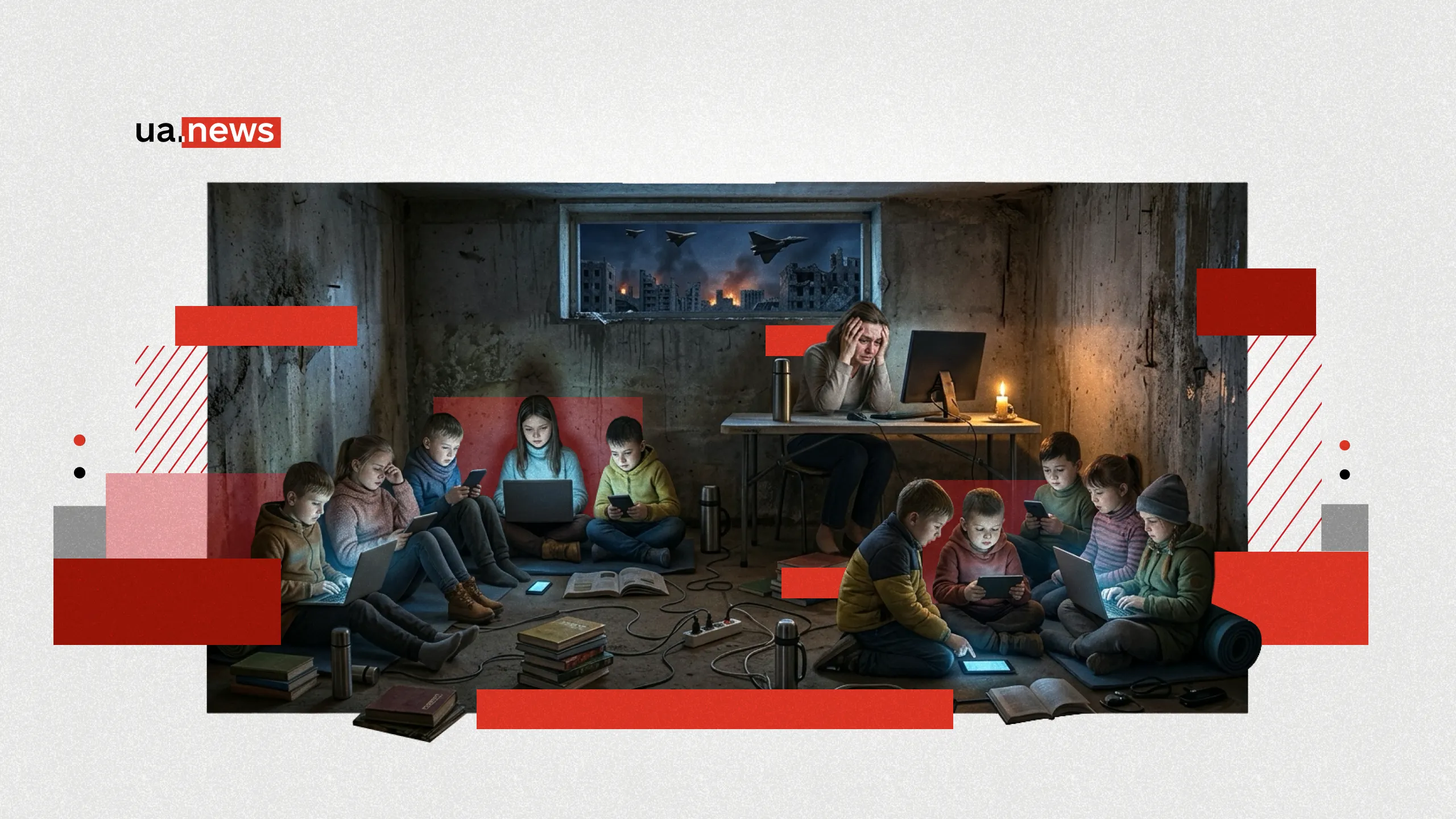
Six Years Out of the Classroom: How Online Learning, War, and NMT Transformed Ukrainian Education
01 September 2026 17:16«If this student had come to class, he wouldn't have gotten his 12 points. But as it is, some kids who used to get 5–6 suddenly started receiving 9–10. Have they become wiser in their knowledge? No. Their grades simply went up».
Tetiana K. describes one of the consequences of distance learning. A teacher of Ukrainian language and literature with over 10 years of experience, she works at a school in Sumy Oblast where, due to the security situation, in-person classes are simply impossible for many children. And not only in Sumy Oblast, but for the majority of schools in Ukraine, a lesson on a monitor has become a familiar form of education. Tetiana agreed to talk about what is happening to the school during remote learning on condition of anonymity, without the mandatory «blessing» of the local education department, which is used to reporting a «fully secured educational process». The educational process indeed continues. But the reality described by teachers at an ordinary school differs greatly from official reporting. According to Tetiana, over the past six years, teachers have learned to work online much better than at the start of the pandemic. But along with this, the children themselves and their attitude toward learning have also changed.
«Send the assignment via Viber» and ChatGPT
When schools suddenly switched to distance learning in 2020 due to COVID, nobody had a ready-made algorithm.
«When everything suddenly shut down in 2020 due to COVID, it was a shock for everyone. In an instant, we were told: everyone is going remote. What is it, where did we go, who was doing what? Nobody understood anything: a 65-year-old teacher with a feature phone, parents without a pedagogical education, children who needed integrals explained to them. Back then, we were just trying to survive: sending assignments via Viber, explanations of rules recorded on a voice recorder, some YouTube videos», — Tetiana recalls.
In six years, from the first quarantines to the full-scale invasion, evacuations, air alerts, and blackouts, distance learning has undergone a colossal evolution. Google Classroom, video lessons, and educational platforms emerged. Teachers learned to edit lessons and search for quality content. But along with this, students quickly realized another feature of distance learning: good grades can be obtained without even understanding the material.
«A child is sitting at home; nobody is urgently questioning them at the blackboard. And next to them is mom, an older brother or sister, and in the monitor tabs — Google, homework solver sites, and now ChatGPT. The kid wrote it, mom sent it — here's your 12 points. Which they would hardly have received with personal presence at an offline lesson. Previously, a child wrote an essay, and there were a couple of sites. Sometimes several children handed in identical works, and you wrote to them: copied, rewrite. And now ChatGPT is simply wonderful. No matter how many times you ask it, it yields a different version of the essay every single time».
The teacher finds herself in a strange situation: she knows the student's real level, but proving that the work was not written by them is often impossible. «You've been teaching this child since fifth grade, and now they are finishing ninth. You realize the child can't string two words together; they are very illiterate. But the essay is ideal. You understand where it came from, but you didn't catch them red-handed and can't prove anything». This is how a whole generation of teenagers was formed in Ukraine whose basic education fell during Zooms, online assignments, and canceled lessons under the pretext of «waiting for parents in the school shelter». Children learned to look for algorithms to maintain good academic performance, but in reality, they suffered a catastrophic loss in basic skills.
«Children read mournfully poorly»: when the curriculum lives a life of its own
The problem is not only that children have learned to cheat, Tetiana claims. They are losing the ability to work with complex texts and maintain attention for long periods.
«Do they read literature during the holidays? Virtually not anymore. Children nowadays read very, very mournfully. I tell them human-to-human: "Children, in 7th grade we have the wonderful "Ivanhoe", read it in the summer, because in winter, during other assignments and lessons, it will be hard for you to read another long novel. A select few read it. The rest say: "If I read it in the summer, I'll forget it by winter." And what am I supposed to give them in September? A failing grade for not reading in the summer? They read it later during the year, or break down summarized versions», — the educator sighs.
Educational losses not visible on report cards
A 10 or 11 in an electronic gradebook does not mean at all that the child has actually mastered the material. If an assignment is completed using ChatGPT, with hints from parents, or simply copied from the internet, the only result is a good grade. No knowledge is gained from this.
The results of the international study PISA-2022 show how serious this problem is. Ukrainian 15-year-old school students lost the most precisely in reading literacy. It is not about whether a child can put words into sentences. Reading literacy is the ability to understand a complex text, find the main idea in it, distinguish fact from the author's subjective opinion, draw conclusions, and evaluate information critically. According to PISA results, Ukrainian teenagers lag behind the average level of OECD countries by approximately 2.5 years of schooling in this metric.
Figures from official monitoring by the State Service of Education Quality (SSEQ) confirm this conclusion. During testing of 6th–8th graders in the Ukrainian language, it turned out that more than 65–70% of children can find a fact or remember a rule. But when it comes to analyzing subtext or formulating their own conclusions, only every fourth student handles the task. The situation with mathematics is worse — children know formulas, but get lost in word problems and geometry that fell during the period of «fragmented» learning.
At the same time, SSEQ recorded a dependency: students in offline learning perform complex test tasks 15–20% better than those who have been sitting online for years. And the worst results are demonstrated by children whose learning was reduced to an asynchronous mode — independent study of textbook sections without live analysis with a teacher. Distance learning here is part of the problem. In Ukraine, it often follows the scheme: the teacher posted material in Google Classroom or Viber, gave exercise numbers, and the child must figure out everything on their own and submit the work on time. For a high school student, such a model might still work. For a child aged 10–14, it is a formidable task because there is no opportunity to immediately ask the teacher. It is much easier to find a ready-made answer on the web. As a result, the child does not learn to solve problems or think, but rather to search effectively for correct templates.
What else is lost behind distance learning For example, the ability to concentrate on one task for a long time. When learning occurs between air raid sirens, breaks, phones, videos, and messages, focusing on a large text or a complex task becomes harder. Similarly, a child must learn to work with others: discuss assignments, debate, explain their position, negotiate. In class, this happens naturally during collaborative work, answering at the blackboard, and communicating with classmates. Online, a significant portion of this disappears. Another problem is independence. If during learning mom, an older brother, Google, answer keys, or ChatGPT are constantly nearby, the child quickly gets used to it: if you don't know, you don't necessarily have to figure it out yourself, you can simply find a ready solution. Hence, we have normal grades in the register, but a lack of real knowledge. Which becomes noticeable when the child can no longer look it up on Google or ask someone to do the assignment for them — for example, on the NMT or during university admission.
An expert blow to the head: School as a conveyor belt for NMT Professor, educator, and former director of the Ukrainian Center for Educational Quality Assessment (UCEQA) Ihor Likarchuk believes that today's school is increasingly focusing on preparing for a single test — the NMT (National Multi-Subject Test). The professor is convinced that subjects and skills not needed for the admissions test fall into the background. «The school has ceased to be a temple of knowledge and has transformed into a prep center for the NMT, — Ihor Likarchuk states. — An absolute fetishization of the NMT has occurred, and the Ministry of Education and governing bodies share considerable «credit» for this. Look at the news: those who scored maximum points on the NMT are awarded prizes, scholarships, and called «stars». But let's be frank: back in 2008, when the External Independent Testing (ZNO) was introduced, sociology showed that 70% of students prepared with tutors. Today this figure is even higher. So whom are we rewarding and what are we proud of? The financial capabilities of parents who hired tutors?» At the same time, the expert emphasizes that the problem applies not only to public schools. He cites the example of a graduate from one of Kyiv's expensive private lyceums who told journalists that the last two years of study were effectively dedicated solely to preparing for the NMT.
«At the beginning of summer, I read an interview with a graduate of one of Kyiv's most prestigious private lyceums who scored 200 points in two subjects on the NMT. When the journalist asked him about studying at this institution for huge amounts of money, he honestly answered: «For the last two years, we were prepared purely for the NMT. And since I needed Ukrainian language, history, and mathematics, we didn't study physics, biology, and chemistry at all». The person received a document of complete general secondary education stating that he mastered the state standard. But that's not true. The NMT is merely an external exam for university entry, not the summary of the entire school system's work».
Distance learning: a new form or old lessons through a screen
The Doctor of Pedagogical Sciences also has grievances regarding how distance learning was organized in Ukraine. In his opinion, throughout the years of the pandemic and full-scale war, genuine distance education never emerged in Ukraine.
«What we call «distance learning» is a banal transfer of the classroom-lesson system into a phone or laptop. With the exact same lessons, a 45-minute schedule, explanations, and monitoring. This is a rather illiterate transfer of an old form into digital. It's like calling an old «Zaporozhets» a cutting-edge automobile: giving it a new name won't make it a super-cool car. Real distance education works differently all over the world. It is a high-quality educational course and self-study organized by a teacher, not 6 consecutive hours in front of a screen. A child shouldn't sit continuously in Zoom. Over the years of COVID and war, the Ministry of Education should have created a solid national platform for distance learning — similar to how Prometheus or courses from leading global universities operate. Rather than forcing teachers to simply deliver lectures via video link».
The consequence of such an approach was precisely the formation of a generation deprived of fundamental knowledge and the ability to think independently: «We are raising children who are incapable of self-directed learning. For whom school has ceased to be a center of intellectual development. What did we use to call school? A temple of knowledge. And what do we call it now? A place where they feed kids, provide «educational services», or simply detain children — almost forcibly, because attendance must be reported. A place where children are entertained, but definitely not a temple of knowledge. Remember the main message of last year's August conference of the Ministry of Education? «Preparation for life in a changing world». That is, the preparation of a creature capable of adapting to any conditions. What animal in nature adapts to everything? A chameleon. There is your answer to whom we are preparing. Over the last five years, we have practically stopped talking about the school's duty to prepare a citizen of Ukraine — capable of protecting the state, rebuilding it, and fighting for its independence. We need a Ukrainian national school where a triad will prevail: a citizen of Ukraine, knowledge, and practical skills».
However, the problem lies not only in what children are taught, but also in who is teaching them. Ukrainian schools simultaneously face a shortage of educators and an aging workforce.
Who will work at school: youth won't go, older staff can't cope
Indeed, it is becoming increasingly difficult to find teachers, especially in STEM and natural science disciplines. In many schools, a single specialist must be shared among several institutions. A physics or chemistry teacher might work at three, four, or even five schools simultaneously to gather enough hours and earn a more or less normal salary. But the main problem is not just the current shortage of educators. Youth are in no rush to replace them. According to the service «Vstup.Osvita.ua», physics and astronomy turned out to be among the least popular majors during the admissions campaign: fewer than a thousand applications were submitted in total.
Even more telling is the situation with future physics teachers. In Kyiv, where two universities train such specialists, only 14 applications were submitted for the corresponding educational programs. As a result, only two people were enrolled — one tuition-free and one tuition-paying.
«And in Kyiv, only two people enrolled to become physics teachers, two! And you tell us about educational reforms, about NUS (New Ukrainian School), about quality, about everything… Any reform begins with respect for people. And respect for people begins with respect for their remuneration. Otherwise, we will have two physics teachers and three chemistry teachers for all of Ukraine. That's it. There are your educational reforms. Education has been dragged down to the floorboards», — stated Professor Serhiy Yahodzinskyi, Vice-Rector for Academic and Methodological Work at the European University, on TikTok.
Teachers with 30 years of experience note that schools are cutting hours for core subjects (for example, keeping two hours of physics instead of three in 9th grade), even though exact sciences are precisely what builds the state's defense capability. Retired educators admit they continue working for 14,000 UAH only because there is simply no one to replace them — youth refuse to join schools on principle.
Zoomers won't sign up for this: 5 thousand for burnout
Practicing teacher Tetiana K. believes there is another issue here: the younger generation simply refuses to accept the conditions that her peers once tolerated.
«Millennials are a generation of «endurers». 20 years ago, we were searching for that school job with a flashlight, agreeing to anything just to work. But when millennials in schools run out, Zoomers won't sign up for this. Either something must change drastically, or schools will remain empty. A student in their 4th year of pedagogical university or fresh out of college arrives at a school. They receive their 18-hour base rate, class guidance — and get a 5–6 thousand UAH salary for it. Meanwhile, parents look askance because she is «somehow young and suspicious», kids fool around in their own ways, and administration pokes its nose into everything. And at the end of every month, you get your 5 thousand. Meanwhile, the «prestige» allowance over the last 10 years has deflated from 20% down to 1%. It's very funny to read on the pay slip: «profession prestige — 150 UAH».
We've arrived. While a big city might top it up from its budget, a village council won't do that — they reallocate that money as if paying out of their own pockets. By the end of the year, that young teacher thinks: «Why the hell do I need this?». Her friend at a bar makes 15 thousand for three days a week, doesn't grade notebooks, and no mom calls with complaints about her «precious child». I know many young girls who came with a passionate desire to work, posting photos of «me with my little ones», their eyes glowing. In a year or two, those eyes went out, and they simply walked away. Because surviving on 5 thousand is impossible».
What will you become when you grow up? It is also quite telling how children themselves view their future. Tetiana says that the professions of teacher or doctor, which representatives of her generation dreamed of, are no longer popular today.
«The way we once dreamed of being doctors and teachers — that's gone», — Tetiana concludes. — «Children dream of being bloggers or say: «I'll go to Poland to earn money». Boys massively want to be long-haul truckers. I conducted a survey in my 9th grade class, trying to persuade them: «Boys, you need to study!». And one answers me: «Why do I need all this? I'll be a trucker and have a normal salary». And I stand there, blinking, realizing that this boy will have a salary five or even ten times larger than mine. Among female teachers, there is a popular joke from the internet that is completely true: «In school she was a top student, graduated from university, became a teacher, and realized that working at school is only possible if you found your favorite failing student who now supports you and your children»».
What is wrong with the system — and where do teachers fit in
However, former director of the Ukrainian Center for Educational Quality Assessment (UCEQA) Ihor Likarchuk is convinced that there is no point shifting responsibility for educational problems onto teachers. Educators themselves work within a system that has failed for years to address issues of pay, workload, and staffing.
«Regarding teachers — let's leave them alone. There are no bad armies, only bad commanders. We have driven the teacher to a state where only the most resilient remain in school, while youth don't go there at all», — Ihor Likarchuk stresses. — «According to my data from the EDEBO database, across all of Ukraine, a grand total of 15 people expressed a desire to become physics teachers! In my 52 years of work in education, I don't remember such a volume of job vacancy announcements. The teacher is not to blame in this situation. If they and the principal are told every day: «Your graduates didn't score 200 points, which means you work poorly», while the media construct absurd school rankings based on test results — what does the teacher have to do with it? We need to thank those teachers who are still left at all».
«Educational losses» and what children actually know
Professor Likarchuk is also skeptical of the very concept of «educational losses». In his opinion, this term is often used to describe ordinary gaps in knowledge that have always existed in schools.
«The term «educational losses» has never interested me because I don't understand how they differ from ordinary knowledge gaps, which Konstantin Ushinsky wrote about as far back as the late 19th century. Gaps were, are, and always will be. No person in the world can perfectly master the entire curriculum and know absolutely every formula, rule, and literary work. The phrasing «educational losses» was invented so that orbital «experts», consultants, project managers, and NGOs could receive grants from Western partners, raise an information wave, and improve their financial status. Gaps can only be eliminated when the student wants to close them. If a child has the drive, they will find a way: nowadays there are plenty of resources, and no decent teacher will refuse a student who comes asking to explain the material».
Separately, Ihor Likarchuk criticizes the format of NMT tasks. In his view, some of them test the ability to quickly recognize the required answer rather than actual understanding of the subject.
«Where else is the primitivism of the modern approach? Look at the NMT history tasks: they often show a low-quality portrait and ask who it is», — Likarchuk notes. — «I am a history teacher by training. When I look at these pictures, I feel like swearing. Is it really important to just guess a face? It's important to understand the historical process and that personality's role in it! The same applies to literature. What difference does it make whether a child recognizes Lesya Ukrainka or Marko Vovchok from a portrait if they don't understand their role in the Ukrainian literary and state-building process? Or if Ivan Dziuba is mentioned in history lessons, but the test simply asks to recognize his photo. This is an extremely primitive approach that didn't exist even in the Soviet school».
What to change: don't copy foreign models, build your own In Ihor Likarchuk's opinion, Ukrainian education needs a holistic system adapted to Ukrainian conditions rather than yet another standalone reform.
«Our modern education is fragmented remains of Soviet habits mixed with the mindless borrowing of isolated foreign practices. People traveled the world, saw something, and said: "We must implement this here!" I always use an analogy: beautiful palm trees grow in Africa, but if we dig them up and plant them in Ukraine, they won't grow. If you count how many of our educators traveled to Finland to gain experience — probably one in twenty visited. And what was successfully implemented? Nothing. Because there is a completely different mentality there, a different state attitude toward education, and a different parental attitude».
Another problem occurs when separate decisions are implemented without understanding how they should function across the entire system: «Our parochial approach: someone invented something somewhere, and off we go».
Meanwhile, Ukraine needs its own education model that will account for Ukrainian experience while remaining oriented toward European approaches.
«We need a Ukrainian national education system that will orient itself toward general European development trends, account for our domestic experience of system functioning — both pre-Soviet and Soviet. And most importantly: our graduate must be a citizen of Ukraine, ready to defend and rebuild the state. We need a school where a triad reigns: a citizen of Ukraine, knowledge, and practical skills».
Separately, the educator talks about distance learning. Simply transferring a regular lesson into Zoom is not enough. There must be a high-quality learning course rather than daily video lessons. The student should process a significant portion of the material independently, but with teacher support. Online meetings could take place several times a week or even less frequently — depending on the subject. Distance learning shouldn't mean six hours in front of a screen. Part of the work can be done with a book, notebook, maps, texts, and other materials. The computer in such a system is primarily a tool for communication and access to the educational course. And the teacher shouldn't turn into a TV presenter who simply reads one video lesson after another.
Their task is to organize learning, explain complex topics, see where the child encounters difficulties, and provide feedback. For this reason, Likarchuk believes, Ukraine has long needed a national platform for distance learning — structured similarly to Prometheus online courses or university educational platforms. Another issue is the motivation of students themselves: «Distance education requires significantly greater responsibility and motivation from the student. If parental responsibility were waived and 9th–10th graders were told they didn't have to attend school, about 70 percent would simply stop going, because right now they are just wearing out their trousers there. Thus, we don't have true distance learning yet. There is only classical "Greek school learning" transferred into a smartphone or laptop».
What lies ahead
The new academic year begins once again in conditions where schools must simultaneously solve issues of safety, educational format, and quality of education. In Kyiv, the first week of the academic year is planned to start in an in-person and distance format. At the same time, schools must be ready to adapt their learning model depending on the security situation. Among the options considered in the capital are classes in shelters for primary school students, blended and distance learning, as well as second-shift operations.
The specific model will be determined by each school considering its capabilities and shelter space, while parents will be able to choose from the proposed options. Thus, distance learning — which began as a forced solution due to the pandemic and later became part of wartime reality — is not going anywhere. The main question remains the same: what exactly will children receive in the end: real knowledge and skills, or just another set of grades in an electronic register.
The editorial team of UA.News has already submitted relevant inquiries to the Ministry of Education and Science of Ukraine and the Kyiv City Military Administration to determine how the educational process will be organized in the new academic year, how its results will be evaluated, and what measures are planned to overcome educational losses caused by the pandemic, war, and prolonged distance learning.


