
Key June Highlights from Binance Research: The crypto market fell to $2.13 trillion, tokenized stocks maintained price synchronization, and prediction markets reached record volumes

July, Kyiv — Binance Research, the analytics division of Binance, the world’s largest cryptocurrency exchange, has released its monthly market review for June 2026.
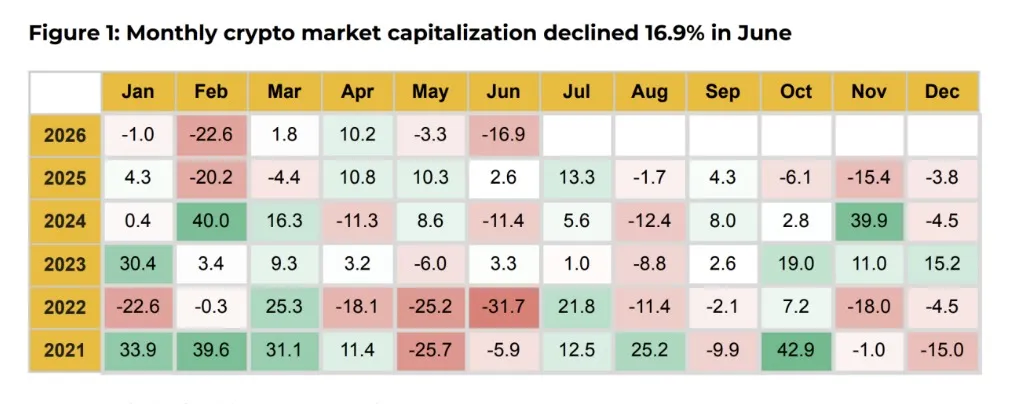
In June, the total market capitalization of the crypto market fell to $2.13 trillion. The market was weighed down by weak institutional positioning, the absence of expected inflows into Bitcoin spot exchange-traded funds, and increased selling of altcoins. Net outflows from Bitcoin spot funds remained at around $2.2 billion, while altcoin sales in the spot market reached a five-year high. Outflows from assets other than BTC and ETH have continued for 15 consecutive months, indicating signs of capitulation among retail investors and an increasingly selective rotation of capital.
Top 10 Cryptocurrencies for June
All ten of the largest crypto assets ended June in the red. In descending order of performance:
Key Events in June
In June, the macroeconomic backdrop remained a key factor for the market. U.S. inflation in May came in line with expectations: the headline rate was 4.2%, and the core rate was 2.9%. At the same time, the initial relief in the market quickly faded as Fed officials focused on the overall risk of inflation.
On June 17, the Fed shifted its communication toward a more hawkish stance: the median rate forecast for 2026 rose to 3.8%, and the probability of a rate hike in December rose to approximately 77%. At the same time, the first Fed meeting chaired by Kevin Warsh brought additional uncertainty: he did not provide a rate projection chart and changed the framework for assessing inflation, emphasizing trimmed mean metrics, which could send a softer signal to the market regarding inflation.
Against this backdrop, the cryptocurrency market remained sensitive to liquidity, inflows into exchange-traded funds, and geopolitical signals. Until institutional investors return to the spot market, a consolidation phase remains likely.
Decentralized Finance (DeFi)
In June, the total value locked in decentralized finance—that is, the amount of funds in DeFi protocols—declined by approximately 13.2% to $69.32 billion. The main reason was a drop in token prices, not a loss of confidence in the system.
Base and Tron showed strong growth in market share over the month: their combined share rose to 12.19%, while the “other networks” category shrank to 15.33%. After peaking at $644 million in April, the volume of losses in DeFi fell by approximately 89% to $71 million in June. The figure has returned to more familiar levels, and no significant escalation of AI-related hacks has been observed. This indicates that the market has stabilized following the crisis period.
Stablecoins and Tokenized Real Assets
The total supply of stablecoins in June fell to approximately $312.4 billion, representing a 2.2% decline for the month. At the same time, institutional adoption and the payment functionality of stablecoins continue to drive the segment’s growth.
Since the beginning of the year, among major networks, the BNB Chain (+13.9%) and Tron (+9.1%) blockchain networks have grown the fastest. Ethereum maintained its lead with a stablecoin supply of approximately $171 billion, although it has shown a moderate decline of about 5.4% since the start of the year.
Ripple’s dollar-pegged stablecoin, RLUSD, received approval from Japan’s Financial Services Agency under the Payment Services Act and became the first foreign dollar-pegged stablecoin licensed for distribution in Japan. Access to it will be provided by SBI VC Trade, the Japanese crypto platform of the SBI Group. With a market capitalization of $1.7 billion, RLUSD opens up a regulated Asian channel for corporate settlements, the likes of which Tether and Circle do not yet have.
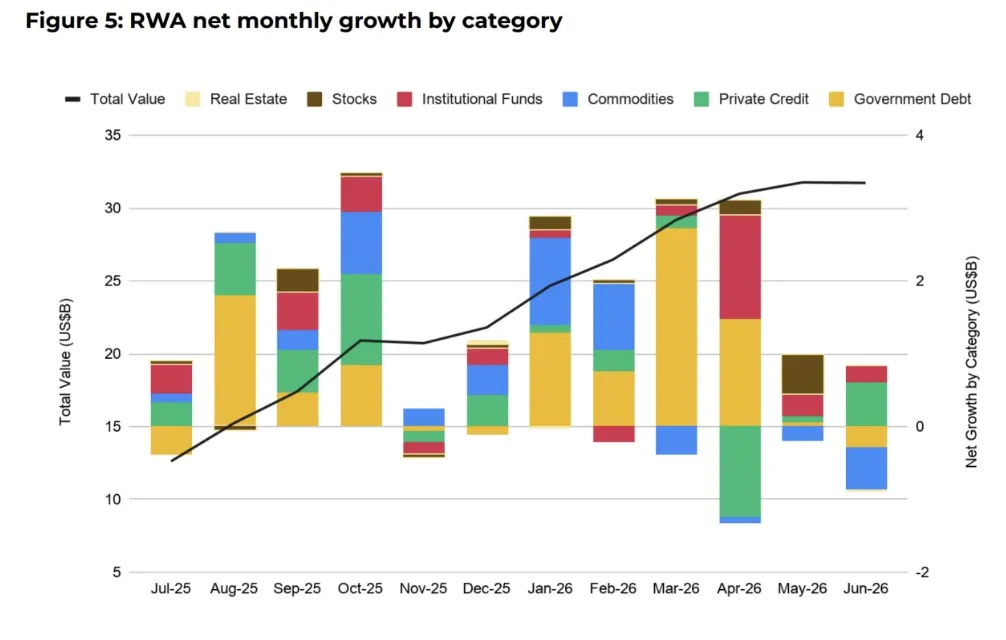
The total value of tokenized real assets—traditional assets represented as tokens on the blockchain—reached approximately $31.7 billion in June. The private lending segment saw the strongest growth over the month, adding about $883 million.
This growth was driven by renewed activity in private loan tokenization from Centrifuge, a platform for tokenizing real-world assets: the launch of JAAA, a $200 million tokenized private lending instrument on the Solana network, demonstrated that institutional credit assets can operate on the blockchain.
Binance also launched bStocks—tokenized stocks on the BNB Chain that represent real positions in U.S. stocks and allow for 24/7 trading on the blockchain. Eighty percent of trading in tokenized stocks occurs in emerging markets, and 93% of transactions are fractional, with a median size of $18.81. This provides access to expensive stocks in amounts of less than $20.
Under a conservative scenario, the market for tokenized real assets could grow to $661 billion with a penetration rate of just 0.4%, representing a 62-fold growth potential from current levels. Further expansion of platform participation and infrastructure development could support the growth of this segment’s market capitalization.
Structural Market Signals
Binance users who hold equity instruments are more actively allocating capital across several technology themes
Among the approximately 7,000 stocks and exchange-traded funds available on Binance, users have already traded over 700 instruments. This indicates early but already noticeable activity within the broader investment universe.
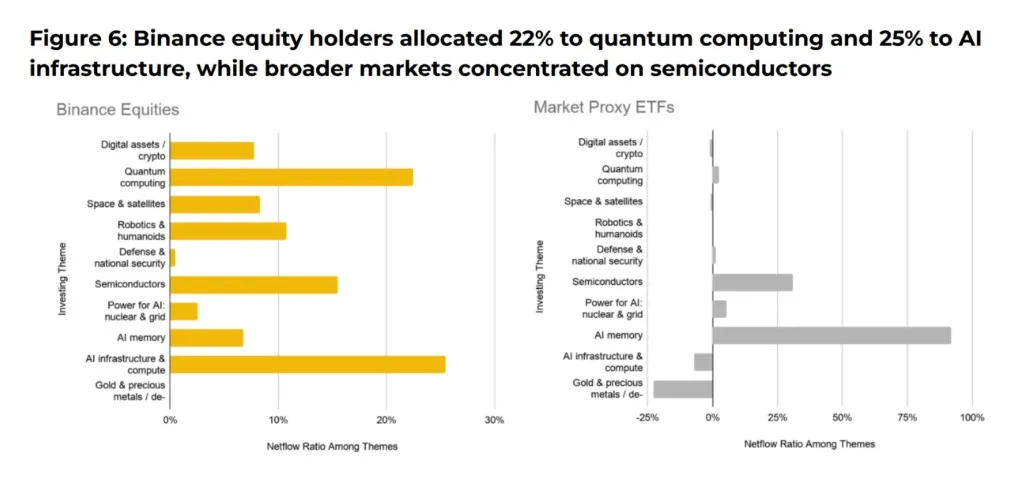
Binance users holding equity instruments allocate about 71% of their equity positions to the technology sector. Within this segment, approximately 48% of funds are allocated to semiconductors, and trading volume in this category is roughly 23 times higher than in other sectors.
At the same time, the thematic breakdown is broader than in the general market. AI infrastructure and computing account for 25%, while quantum computing accounts for 22%. By comparison, broader exchange flows are more concentrated on semiconductors and AI memory.
The SpaceX IPO boosted liquidity in pre-IPO instruments
In June, pre-IPO instruments for the company passed an important market test. SpaceX completed its IPO on June 12, raising approximately $75 billion, after which trading volume for perpetual SPCX contracts on Binance surged.
Prior to the IPO, the SPCX perpetual contract—pegged to SpaceX’s pre-IPO value—had an average daily trading volume of about $89 million. After the listing, daily volume stabilized at approximately $1.6 billion. Even excluding the peak day on June 12, when volume reached $5.92 billion, the volume remained approximately 18 times higher over the following two weeks.
Additional spikes in volume in the $2–5 billion range were recorded on June 16 and June 22–23. This confirmed that the asset continued to be actively revalued even after the listing.
This demonstrates that the interest building up to the offering can translate into sustained liquidity after the IPO. Under this logic, an IPO functions not as an endpoint but as a liquidity booster.
Prediction markets saw record volume thanks to the World Cup
The 2026 World Cup became the largest event category in the history of prediction markets. By the end of June, trading volume related to the tournament had exceeded $5.4 billion, surpassing the 2024 U.S. presidential election cycle, which had previously drawn significant attention to this segment.
Monthly trading volume in sports prediction markets already exceeds $20 billion, representing approximately a 200-fold increase over the past two years. Based on current trends, the annual volume of sports prediction markets could grow from about $248 billion in 2026 to a range of $554–923 billion by 2030. The base-case scenario is $739 billion.
This growth has been driven by the new 48-team World Cup format, which has increased the number of matches by 60%. Unlike traditional betting, where funds are typically locked up until the event concludes, in prediction markets, each match becomes a contract that can be traded continuously.
A key advantage of such markets is the lower cost of participation. Traditional betting platforms earn money through a margin on odds, which is actually around 10%. Prediction markets operate like exchanges where buyers and sellers interact with each other, and commissions are closer to 1%. Given current migration trends, this difference could leave over $200 billion in additional value for participants by 2030.
Sports remain the main driver of this segment, but political and cryptocurrency markets have also shown significant activity. Macroeconomic markets may be the next area of growth, while the regulatory environment will remain a key factor in long-term growth.bStocks’ tokenized shares maintained price synchronization during the U.S. market weekend. During the 65.5-hour closure of U.S. markets on Juneteenth — a federal holiday in the U.S. — bStocks’ tokenized stocks remained available for trading. This served as a test of whether such instruments can maintain price synchronization with their underlying stocks when the traditional market is closed.At the market close on Friday, the average spread between bStocks and regulated markets was 0.13%. By Monday’s opening, it had narrowed to 0.11%, and the average for the weekend was 0.12%.Trading volumes confirmed that the instruments remained active even without the traditional market open: SPCXBUSDT recorded $19.4 million in trading, while TSLABUSDT recorded $3 million across 140,887 trades. Assets with lower liquidity, notably NVDA and SNDK, also retained their ability to form prices, although their spreads were wider due to shallower market depth.For more liquid assets, spreads narrowed to nearly parity—less than 0.01%. Overall, across all six bStocks, spreads remained within institutional ranges, confirming the instruments’ ability to support continuous price discovery when traditional markets are closed, and global investors have no alternative access to repricing U.S. stocks.
What Does June Mean for the Market Going Forward
As of early July, the market remains in a wait-and-see phase. Key factors include Fed communications, the geopolitical situation surrounding Iran, inflows into Bitcoin spot exchange-traded funds, and further consideration of the CLARITY Act in the U.S. Until institutional demand returns to the spot market, a consolidation phase remains likely.
Separately, pressure on altcoins persists: spot market sales have reached a five-year high, and outflows from assets other than BTC and ETH have continued for 15 consecutive months. This indicates the capitulation of some retail participants and an increasingly selective rotation of capital. An additional factor for certain assets in July will be token unlocking—the release into circulation of assets that were previously locked up: PUMP accounts for the largest share—$130 million, or 26.8% of its market capitalization.
At the same time, June highlighted several areas that continue to grow despite the broader market correction: tokenized stocks, prediction markets, tokenized real assets, stablecoins as payment infrastructure, and continuous pricing via bStocks tokenized stocks. These segments remain key areas to watch in July, alongside macroeconomic and regulatory signals.
The full Binance Research Monthly Market Insights — July 2026 report is available here.
About Binance Research
Binance Research is Binance’s analytical division, which publishes research on the crypto market, digital assets, and the blockchain ecosystem. The report uses data from open sources and third-party providers, and the content is for informational purposes only.


