
Observations of a magnetar have strengthened the evidence for a quantum effect in a vacuum
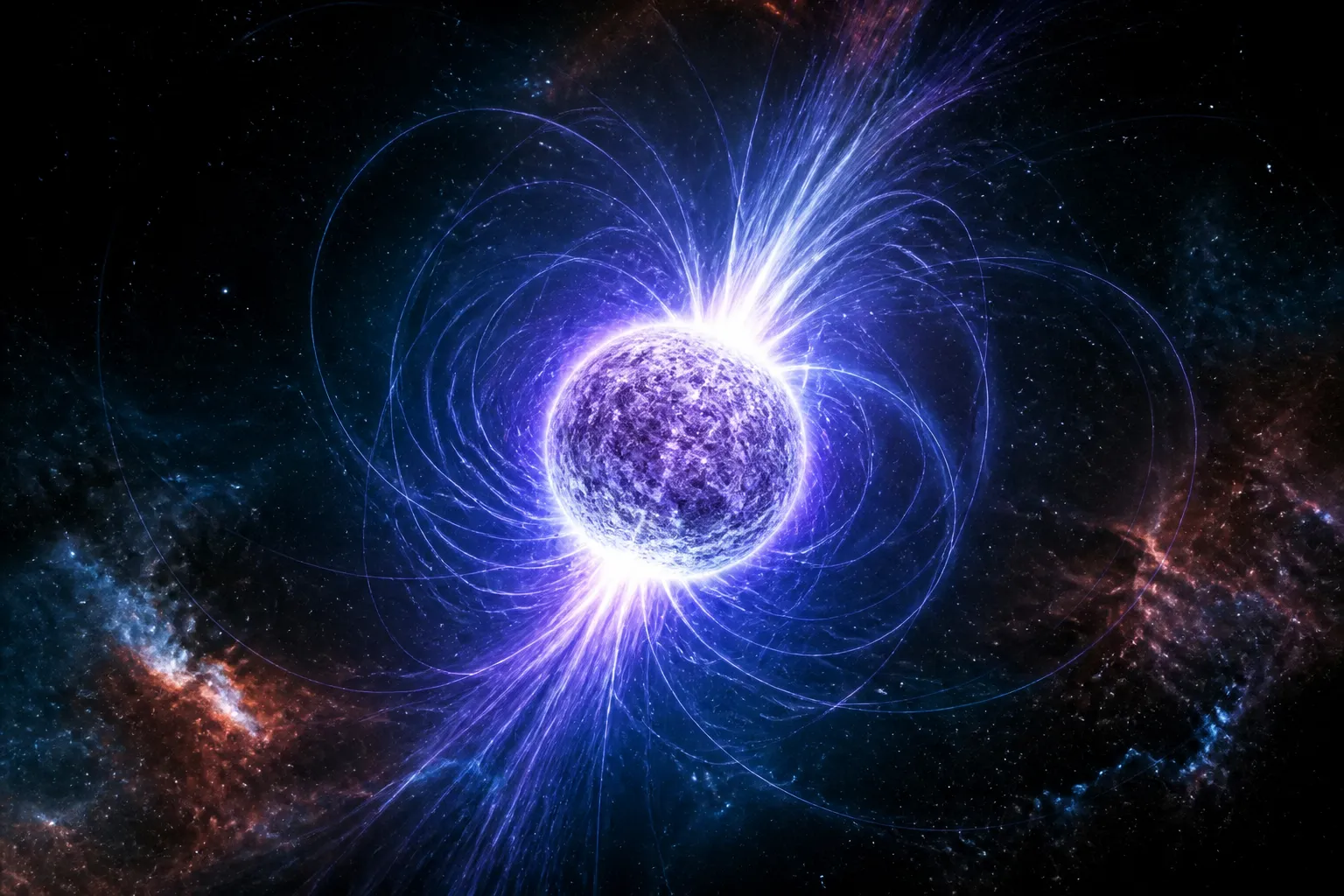
Observations of the magnetar 1E 1547-5408 have yielded, according to the authors of a new study, the most compelling evidence to date of vacuum birefringence—a quantum effect in which an extremely strong magnetic field alters the propagation of light in a vacuum. This was reported by Space.com.
The idea of this phenomenon was proposed in 1936 by German physicist Werner Heisenberg and his student Hans Euler. According to quantum mechanics, a vacuum is not completely empty: virtual particles, including electrons and positrons, briefly appear and disappear within it. The theory suggests that an extremely strong magnetic field can more strongly align light waves in a single direction.
Magnetars—dense remnants of massive stars following explosions, about the size of a city—have the most powerful known magnetic fields in the universe. Study co-author Markus Lover noted that detecting vacuum birefringence requires a field more than 100 million times stronger than any created on Earth.
For more breaking news, follow the UA.News Telegram channel.
In March and April 2025, the team observed 1E 1547-5408 using NASA’s Imaging X-ray Polarimetry Explorer (IXPE) space-based X-ray observatory. This magnetar rotates once every two seconds and emits radio waves steadily. The data were also supplemented by observations from the X-ray telescope on the International Space Station, the Australian Murriyang radio telescope, and the South African Radio Astronomy Observatory.
According to the study, the magnetar’s X-ray emission was nearly three times more polarized than that of similar sources, and the direction of polarization corresponded to the direction of the magnetic field and the pattern previously observed in radio waves. The team concluded that this combination of results is best explained by vacuum birefringence.
Previously, in 2017, astronomers had already detected signs of this phenomenon in optical observations of the neutron star RX J1856.5-3754; however, those data remained open to various interpretations. The authors of the new study plan to verify their findings using future missions and improved computer models. A description of the study was published on August 5 in the journal *Nature*.


