
Satellite images helped the airliner change course before the solar eclipse
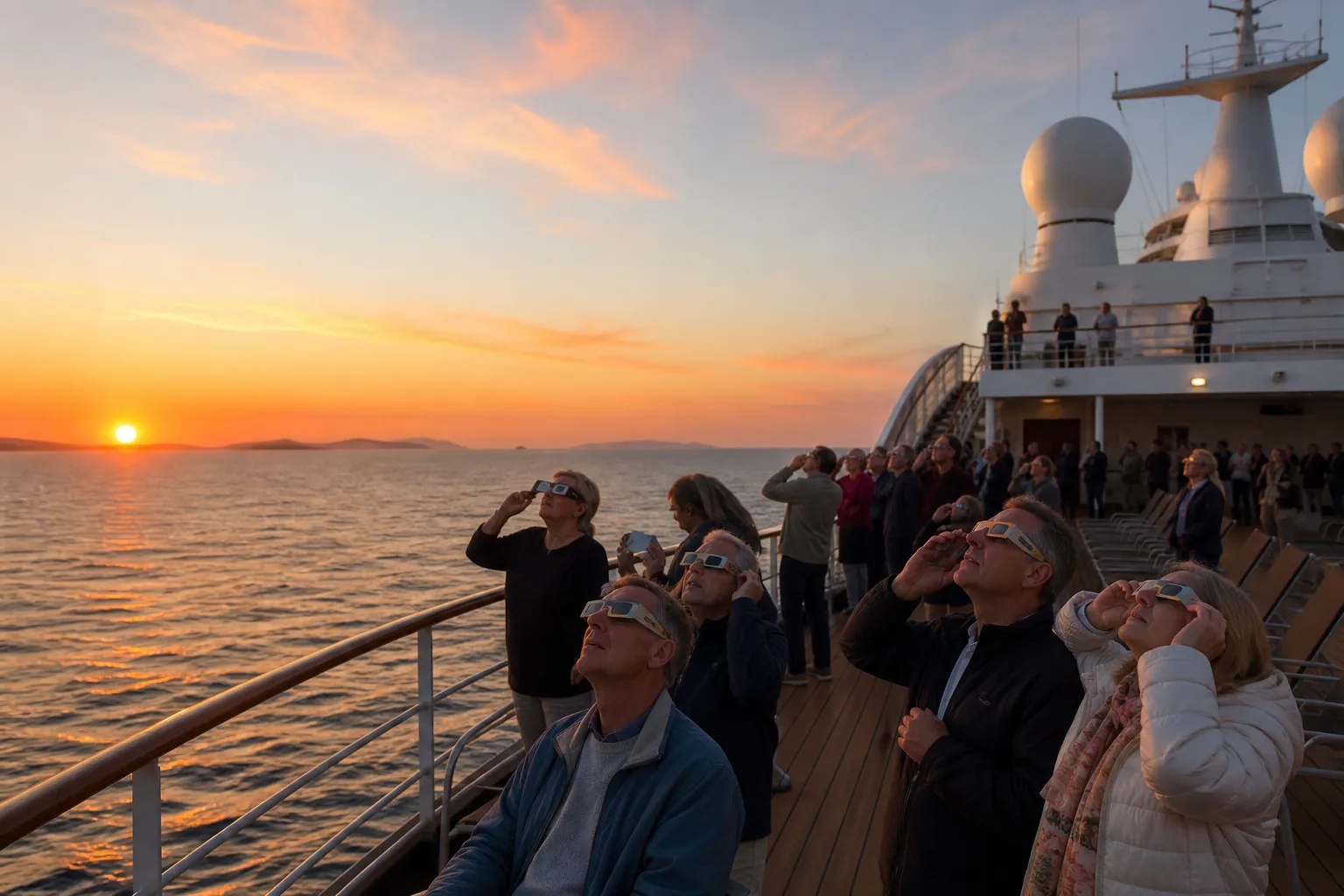
Images from the EUMETSAT geostationary weather satellite helped the cruise ship Le Boréal change course in the Mediterranean Sea to avoid clouds ahead of the total solar eclipse on August 12, 2026. Passengers on the ship observed the phenomenon near the Balearic Islands, according to Space.com.
Le Boréal set sail from Nice on August 6 on an eight-day cruise organized by the French company Compagnie du Ponant. There were 205 passengers and 136 crew members on board. A significant number of travelers joined the cruise specifically to observe the eclipse, which was set to occur shortly before sunset—at an altitude of no more than three degrees above the horizon.
On the day of the eclipse, the ship left the port of Palma de Mallorca at 4:00 p.m. Central European Summer Time and headed west-northwest along the central line of totality. Soon, satellite data showed a large convective cloud rapidly forming over the Spanish coast, inland from the Gulf of Valencia. It could have blocked the Sun at the crucial moment.
For more breaking news, follow the UA.News Telegram channel.
Meteorologist and onboard lecturer Joe Rao, together with Captain Mathieu Tsingrilaras, decided to steer the ship to the southwest. According to Rao’s calculations, this was supposed to shift the cloud to the right of the Sun as it set in the west-northwest sky. The change in course allowed them to avoid significant cloud cover, although thin clouds occasionally passed in front of the Sun.
The partial phase of the eclipse began at 7:37 p.m. At 8:00 p.m., the captain turned Le Boréal so that the stern was facing the Sun, and passengers on the top three decks observed it through special glasses. The total phase lasted 95 seconds. Passengers saw the corona around the eclipsed solar disk, a bright red prominence, and Venus. After the total phase ended, the Sun—still about two-thirds obscured by the Moon—set below the horizon.


