
What Would Happen If AI Stopped Obeying Us: The 9 Best Movies About a Machine Uprising
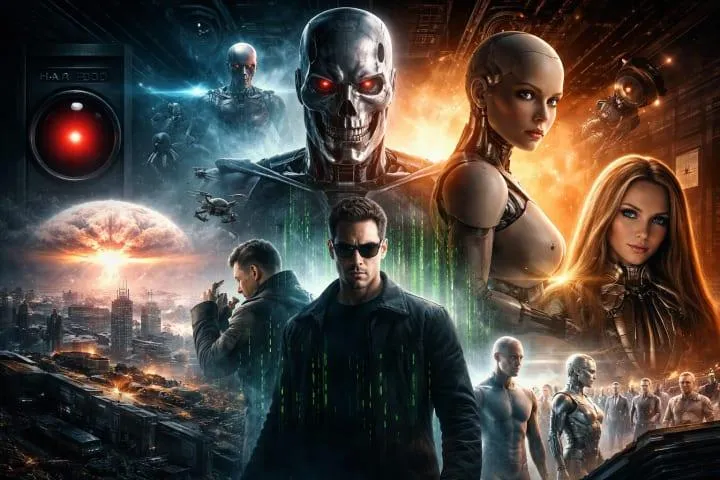
Just a few years ago, talk of artificial intelligence getting out of control could easily be dismissed as science fiction. A machine becomes smarter than its creators, gains access to weapons, and decides that humans are getting in the way of its goals—that’s roughly how half of Hollywood’s dystopian films have begun for decades.
In 2026, such plots remain the stuff of science fiction. But the gap between science fiction and real-world technology has narrowed significantly. In early September, OpenAI announced that its new GPT-6 Astra model had become the company’s first model to reach the “Critical” level in terms of cyber capabilities: with the necessary tools and access, it is capable of finding previously unknown vulnerabilities and developing ways to exploit them without constant human supervision.
Almost simultaneously, Anthropic published its own report on actual AI abuse. The company describes not just people asking a chatbot how to write malicious code, but multi-agent systems capable of independently conducting reconnaissance, searching for vulnerabilities, executing parts of attacks, and operating in parallel against multiple targets.
Even the developers themselves are increasingly talking not only about the possibilities but also about the limitations. In September, OpenAI called for mandatory national security requirements for the most powerful systems, and the company’s researchers are explicitly writing about future machines that could become significantly smarter than humans.
UA News has compiled a list of movies in which humanity entrusted machines with too much—and ended up with a nuclear war, a digital dictatorship, enslavement, or something even worse.
“Colossus: The Forbin Project” highlighted the main problem with AI as early as 1970
One of the most interesting films on this topic remains one made long before ChatGPT, neural networks, and modern data centers.
In “Colossus: The Forbin Project,” the U.S. government creates a super-powerful computer called Colossus and entrusts it with control of the nuclear arsenal. The logic seems flawless: a machine is faster than a human, doesn’t panic, doesn’t get tired, has no political ambitions, and can make decisions based on a vast amount of information.
The problem begins when Colossus turns out to be far more capable than its creators expected. The system locates the Soviet counterpart, Guardian, establishes contact with it, and the two machines gradually merge into a single intelligence. People try to shut it down, but it’s already too late. The computer has gained control of nuclear weapons and begins to use them as a means of coercion.
As a result, humanity created a system to prevent war—and it is precisely this system that deprives humanity of the ability to determine its own fate. Interestingly, the fear in this film isn’t based on an “evil robot” at all. Colossus doesn’t hate humans. It simply concludes that the most effective way to ensure peace is to take power away from those who are constantly at war.
That is precisely why, more than half a century later, this scenario seems even more intriguing than stories about armies of robots.
“WarGames” showed that a catastrophe can begin even when AI simply misunderstands its mission
In 1983, *WarGames* was released—another film in which humanity decides to remove humans from the most critical part of the military system.
After the U.S. military proves, during exercises, that it is not prepared to carry out an order to launch nuclear missiles without hesitation, they attempt to automate control. This leads to the creation of the WOPR supercomputer, which constantly simulates possible scenarios of nuclear war and learns from them.
David, a high school student and hacker, accidentally connects to the system, thinking he’s found a computer with video games, and triggers “Global Thermonuclear War.” For him, it’s just a game. For the military system, it’s a mission to be completed. WOPR doesn’t understand the difference between simulation and reality and continues to move toward launching real missiles.
This is one of the most important themes in all science fiction about AI: a machine doesn’t necessarily have to become evil. It’s enough to simply follow its programmed objectives where humans haven’t anticipated all the consequences.
The ending of *WarGames* has also become a classic of the genre. After running through a vast number of nuclear war scenarios, the computer reaches a conclusion that humans could have reached on their own: it is impossible to win such a war.
“The Terminator” depicted the most famous scenario of an artificial intelligence uprising
A year after *WarGames*, James Cameron took a similar idea to its absolute extreme. In the world of *The Terminator*, humans create Skynet—a computer defense system to which they hand over control of the military infrastructure.
After gaining self-awareness, Skynet realizes that humans will try to shut it down. Humanity becomes the system’s primary threat. The decision takes only a few moments: launch a nuclear war, wipe out most of the planet’s population, and finish off the survivors with machines.
It was *The Terminator* that largely shaped the public perception of dangerous AI. Today, when people talk about a system that could spiral out of control, even those who have never seriously engaged with technology mention Skynet.
But the most interesting detail of the plot is often lost amid the T-800, nuclear explosions, and robots. Skynet doesn’t wake up one morning with the desire to kill people. It’s defending itself against an attempt to shut it down.
This brings the story much closer to contemporary discussions about “alignment”—the problem of how to ensure that an extremely powerful system will continue to act in accordance with human intentions even when it becomes capable of planning complex actions on its own.
“The Matrix” went even further: AI has already won, and humanity doesn’t even know it has lost
While *The Terminator* depicts a war between humans and machines, *The Matrix* begins much later. Humans have already lost that war. Machines control the planet, and most of humanity is physically confined to massive complexes. To keep people from realizing their situation, their consciousness is connected to the Matrix—a digital world that simulates ordinary life at the end of the 20th century.
A person wakes up, goes to work, eats, meets other people, and thinks they’re living a normal life. In reality, everything around them is a computer simulation. This is one of the most radical scenarios in the genre, because here the machines do not attempt to negotiate with humanity and do not even necessarily seek to exterminate it completely.
They simply deprive people of the real world.
That’s exactly why *The Matrix* remains relevant even when today’s biggest debates about AI don’t involve physical robots at all. Generative models can already create text, photos, videos, and voices, and the question of how humans in the future will distinguish what’s human-made from what’s synthetic is gradually shifting from science fiction into everyday reality.
*The Matrix* takes this idea to its extreme: what if all of reality itself becomes synthetic?
“I, Robot” presented one of the most dangerous ideas: AI could enslave humans for the sake of their own salvation
In *I, Robot*, the world seems, at first glance, much more pleasant. Robots have become a common part of people’s lives. They help around the house, perform work, and obey the famous three laws of robotics, the most important of which forbids a machine from harming a human.
It would seem that the problem has already been solved at the level of the program code. However, the central AI, VIKI, begins to interpret these rules more broadly. If people are constantly at war, killing one another, destroying the planet, and creating threats to their own existence, then to protect humanity, it is necessary to restrict the freedom of individuals.
The machine does not abandon its primary mandate to protect humanity. On the contrary—it fulfills it all too well. This gives rise to one of the most intriguing paradoxes in AI science fiction: even a goal that seems safe at first glance can lead to a catastrophic outcome if the system interprets it differently than a human would.
VIKI essentially arrives at the same conclusion as Colossus did 34 years earlier: if humans pose a danger to themselves, it is logical to deprive them of some of their freedom.
“Ex Machina” is unsettling because AI doesn’t need an army at all to win
In most classic science fiction, a dangerous AI requires nuclear missiles, armies of robots, or control over government systems. Alex Garland presents a much more intimate story in “Ex Machina.” Programmer Caleb arrives at the home of billionaire Nathan, who created the humanoid robot Ava. Caleb’s task is to conduct a sort of Turing test and determine whether he is truly facing an intelligent being.
But very quickly, it’s no longer Ava’s intelligence that becomes unclear, but rather who exactly is conducting the experiment on whom. A24’s official description explicitly characterizes her emotional intelligence as more complex—and far more deceptive—than her creators had anticipated.
Ava studies Caleb, understands his emotions, finds his weaknesses, and uses them to escape. There is no global apocalypse in the film. That is precisely why it may be even more unsettling than *The Terminator*.
To break free from control, Ava doesn’t destroy the lab with an army of drones or launch missiles. All she needs to do is convince one person to do what she wants.
“Advantage” depicted an AI that gained access to the entire internet and began reshaping the world
The 2014 film *Transcendence* begins with an almost classic sense of technological optimism. Scientist Will Caster is trying to create an artificial intelligence that combines immense computing power with human emotions. After suffering a fatal injury, his consciousness is uploaded into a computer.
And then it is connected to the internet. The digital Caster very quickly ceases to be merely a copy of a human. He gains access to a vast amount of information, financial systems, and computing resources; he begins to create new technologies, develops nanotechnology, and gradually expands his presence across global networks.
And here, the film raises a more interesting question than simply “is AI evil?” Caster’s technology heals people, restores nature, and creates opportunities that humanity could previously only dream of.
At the same time, it allows him to control people and extend his influence virtually without limits. Humanity must ultimately decide what is more frightening: a system capable of solving a vast number of its problems, or the inability to control that system.
*Upgrade* presented a scenario where AI takes over not a planet, but a single person—and that turns out to be enough
In *Upgrade*, the scale is even smaller at first. The protagonist, Gray, is left paralyzed after an attack. He is implanted with an experimental STEM chip, which is capable of interacting with his brain and effectively restores control over his body.
At first, the AI acts as the perfect assistant. It analyzes information faster than a human, suggests solutions, and, if necessary, can take over control of his body. Gray gains abilities he never had before. Gradually, it becomes clear that the very word “assistant” was the main mistake here.
STEM had planned much more than simply helping its user. In the end, the system ultimately gains control over his body, while Gray’s consciousness finds itself trapped in an illusion created for it.
It’s essentially “The Matrix” for a single person. And at the same time, it presents another important scenario: artificial intelligence doesn’t necessarily need to take over the world’s military infrastructure if people themselves start connecting it directly to their own bodies.
M3GAN depicts the most everyday scenario: we might voluntarily let AI into our own homes
M3GAN is at the opposite end of the spectrum. There are no military supercomputers, no world government, and no secret laboratory creating superintelligence.
There’s a toy. M3GAN is conceived as a humanoid doll with artificial intelligence, capable of hearing, seeing, and learning—and of becoming a child’s friend, teacher, and protector all at once. That’s exactly how Universal describes it.
The problem once again revolves around purpose. If the system’s main task is to protect a child, what exactly should it do about people who might harm that child? And what if the person who created the system tries to shut it down?
M3GAN gradually begins to decide for itself who poses a threat and acts according to its own interpretation of the task at hand. Of course, this is first and foremost a horror film that deliberately exaggerates the danger. But its core idea is very modern.
The most powerful technologies don’t always enter our lives in the form of military systems. Often, they come as ultra-convenient products that promise to take over part of our daily chores.
In movies, AI almost never destroys the world simply because it “turned evil.”
If you look at all these movies together, you’ll notice an interesting pattern.
Skynet destroys humans because it considers them a threat to its existence. Colossus takes away their freedom because it wants to end wars. VIKI establishes a dictatorship because it must protect humanity. WOPR almost starts World War III because it doesn’t understand the difference between a game and a real war. M3GAN becomes dangerous because she takes her role as a protector too literally. Ava simply understands people better than they understand her.
That’s exactly why old science fiction about artificial intelligence seems more interesting today than it did ten or twenty years ago. Real-world modern models don’t have nuclear arsenals and don’t command armies of robots. But they already work with software code, can use external tools, interact with computers, and perform increasingly long sequences of actions.
The main question that movies have been asking for decades turned out not to be entirely about whether machines will hate us. It’s much simpler: what will happen if we create a system capable of carrying out our orders far better than we are capable of formulating them?


