
A pendant made from a human tooth dating back 6,500 years was found in Serbia

Archaeologists in Serbia have determined that a human tooth more than 6,500 years old is an ancient pendant that was likely worn on a string. For nearly two decades, the artifact was kept in a museum as a bead made from an animal’s tooth.
The artifact was discovered during field research at the Neolithic site of Vinča in Jablanić, located south of Belgrade.
The human tooth found was about 23 mm long. Initially, archaeologists mistakenly identified it as a bead made from an animal tooth. Fragments of the find were transferred to the Mladenovac Museum, where they were stored for nearly 20 years without further study.
Later, archaeologists Nemanja Marković and Ana Maričić reexamined the object using microscopy and X-ray analysis.
The researchers determined that a hole had been intentionally drilled into the tooth, and the nature of the wear marks suggests that the object may have been used as a pendant.
Based on the wear patterns, the scientists determined that the tooth belonged to a middle-aged person.
At the same time, the smooth surface of the root suggests that the tooth was likely not extracted while the person was still alive. This suggests that the ornament may have been crafted after its owner’s death.
Accurate dating of the find is complicated by the fact that the tooth was discovered not in an archaeological layer but on the surface. However, a comparison of the drilling technique with another ornament found in Yablanitsa provided grounds for dating the pendant to the Vincha culture period, approximately 6,500 years ago.
Scientists consider this find to be the first reliably documented ornament made from a human tooth from the Neolithic period in the central Balkans.
Researchers suggest that such objects may have had personal or symbolic significance. In particular, the ornament may have been associated with the memory of a deceased person.
Thus, a museum artifact that seemed ordinary at first glance—and had been mistaken for an animal tooth for years—turned out to be unique evidence of the burial and symbolic practices of the Neolithic inhabitants of the Balkans.
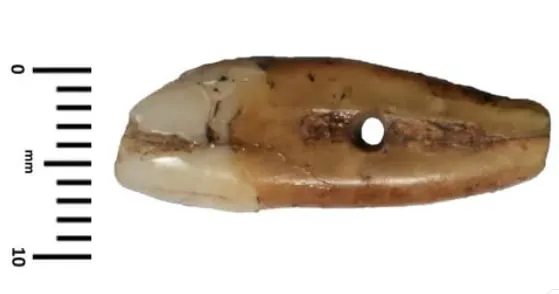
This was reported by Phys.org.
As a reminder, Chinese archaeologists are preparing to launch their first field project in South America in collaboration with Peruvian colleagues. The research will take place at the Caral archaeological site in Peru, home to the oldest known urban center in the Americas.
Archaeologists have also, for the first time, identified the name of a mathematician and astronomer from the Maya civilization who lived in the 8th century. His name was Sak Tan Vaash, which translates to “White-chested Fox.” The name was deciphered during a study of inscriptions in the ancient city of Chultún in Guatemala.


