
Genesis Sued in the U.S.: What Is the Ukrainian IT Corporation Accused Of?
19 June 2026 12:30One of Ukraine’s best-known technology companies has found itself at the center of a high-profile lawsuit in the United States.
The U.S. Federal Trade Commission (FTC) has filed a lawsuit against the Ukrainian IT corporation Genesis and its affiliated companies. They are accused of using deceptive online subscriptions with hidden fees that could have harmed millions of consumers.
It should be noted that the FTC is an independent agency of the U.S. government that protects consumer rights and prevents monopolies, unfair competition, and deceptive business practices. Its attorneys are authorized to conduct investigations and file lawsuits against companies that violate the law. As a market regulator, the FTC can also impose fines and seek compensation for defrauded users.
UA.News provides a detailed account of this case, which is striking in its scale, as well as how consumer rights are protected in the U.S. and why Ukrainians should take note of these practices.
What Genesis Tech Is Accused Of
On its official website, Genesis Tech is presented as an ecosystem of IT product companies focused on building global, innovative products that are launched worldwide. The U.S. Federal Trade Commission (FTC) has focused precisely on some of the company’s innovative products that have drawn the most complaints from American consumers.
Based on the evidence gathered, FTC lawyers concluded that “in practice, Genesis Tech provides its subsidiaries with the tools and methods—a systematic plan—to promote deceptive subscriptions to consumers and bill them without their consent.”.
The U.S. regulator found that users were offered access to services as cheap or free, but the terms regarding automatic subscription renewal and recurring payments were nearly invisible. The FTC claims that canceling a subscription was difficult, and charges could continue even after an attempt to cancel the service.
“The defendants defrauded consumers worldwide out of hundreds of millions of dollars, processing most of their transactions through a group of linked PayPal accounts. For example, during the 12 months ending in September 2025, the total volume of payments processed through Genesis Tech’s linked PayPal accounts approached $700 million,” the case documents state.
According to the FTC’s estimates, from early 2023 to mid-2025, Genesis Tech’s five main products generated nearly a quarter of a billion dollars in global revenue for the corporation. It should be noted that the corporation has removed the projects listed by the FTC from its official website. Specifically, the list included:
MadMuscles, Harna, and Unimeal (fitness and nutrition apps).
Wisey (self-help courses for ADHD/productivity).
PDF Guru and PDF Master (tools for editing PDF files).
Lumi (style consultations).
Nebula (horoscopes and sessions with psychics).
The U.S. regulator believes that Genesis Tech’s business practices likely violate the U.S. Federal Trade Commission Act and the Restoring Online Shopper Confidence Act (ROSCA). However, a final decision in this case has yet to be issued by a U.S. federal court.
How the Schemes Worked, According to the FTC
The case file details instances of the defendants’ unfair business practices. According to the lawyers, by operating a network of deceptive online subscriptions, the entrepreneurs maximized unauthorized charges to customers. To sell their products—including Wisey, PDF products, Lumi, Nebula, and Amo Products—they followed the same general pattern.
First, they advertised “personalized” products for free or for a low one-time fee, often with a money-back guarantee. In reality, if they were usable at all, the products were not personalized and automatically converted into expensive recurring subscriptions.
Second, the ads directed consumers to websites that engaged them in a task. This initial interaction created more incentives for users to continue so as not to waste the effort they had already put in. For example, Wisey, Nebula, Lumi, and Amo Products offered quizzes that reinforced the impression that the product would provide the user with personalized results; PDF products allowed the user to download and edit the document.
Third, payment pages diverted attention away from references to automatic subscription renewals or recurring payments. The pages created the impression of an inexpensive and low-risk transaction, falsely claiming that consumers were making a one-time payment and advertising money-back guarantees. At the same time, they failed to disclose material terms clearly and prominently, consistently relegating terms to the smallest font on the page or even omitting key terms entirely.
The complaint alleges that the companies were allegedly aware of the illegality of their actions due to numerous user complaints and warnings from service providers.
One of the telling examples cited in the FTC’s materials is the Wisey case. Since 2023, the defendants have promoted and sold the Wisey online program, which purportedly diagnoses and treats symptoms of ADHD (Attention-Deficit/Hyperactivity Disorder). Many consumers complained to the FTC that Wisey charged them for services they never intended to purchase. Specifically, it charged duplicate or recurring fees and ignored their requests for refunds or cancellations. FTC experts broke down how this scheme worked step by step:
Advertising. Wisey advertised on third-party websites and social media, attracting consumers’ attention with headlines such as “The Secret Tool to Crack the ADHD Code” and “How Rare Is Your Type of ADHD?”
Landing Page. Clicking on a Wisey ad directed users to a quiz on the Wisey website—Wisey’s landing page.
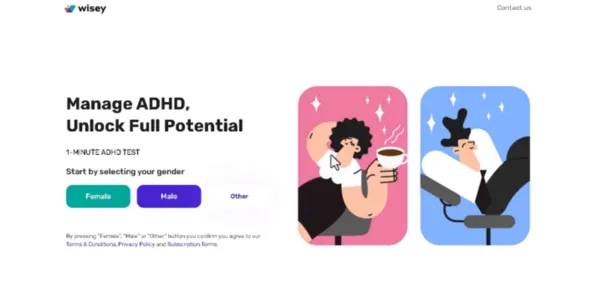
The quiz asked questions such as “How often are you distracted by activities or noise around you?” and “Have you ever found yourself in unpleasant situations due to ADHD-like symptoms?” These questions are interspersed with motivational slides and marketing claims about the Wisey plan.

Regardless of the answers, the test results consistently indicated that the user had certain difficulties related to ADHD. For example, even if a user indicates no symptoms, the website will still inform them that they have a low level of ADHD and that their life satisfaction and self-confidence are below average.
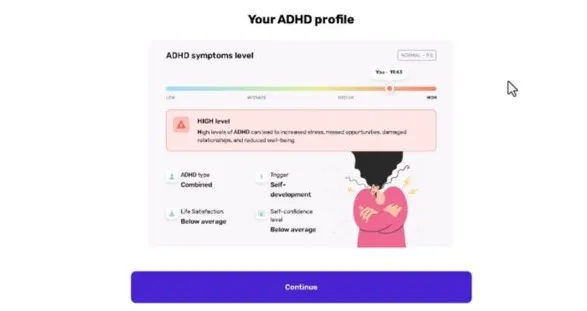
After presenting these results, the Wisey service would ask the user to enter their email address to receive a “personalized ADHD treatment plan.” Once the user entered their name and email address, the website announced that their “4-week RDUG treatment plan is ready!”
Wisey then predicted that the user would achieve “the life they wanted” by following Wisey’s plan for 30 days.
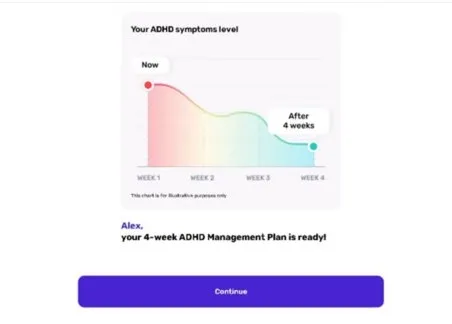
Payment pages. After the user clicked the “Continue” button, the next screen displayed a 10-minute countdown timer, creating a sense of urgency, alongside a large button labeled “GET MY PLAN.” The page also featured claims such as “83% of our users were able to manage their ADHD in 30 days” and purported testimonials like “SO MUCH USEFUL INFORMATION!” and “(Wisey) boosted my confidence to unprecedented levels.”
If a user hesitated, a pop-up window would prompt them to spin a wheel to get an additional discount. The wheel consistently offered the maximum possible discount—67%—and reset a countdown timer. This created the impression that the user had to act quickly to get the offered discount.
Clicking the “GET MY PLAN” button took the user to three options: a 3-month plan, a 1-month plan, and a 6-month plan. Each plan was displayed along with its calculated daily price—in every case, less than $1 per day. The 1-month plan, labeled “MOST POPULAR,” was preselected and highlighted in purple. Below these options was a larger “GET MY PLAN” button that was flashing.

This page also featured a 30-day money-back guarantee, highlighted in bold directly above the “GET MY PLAN” button. Below the larger “GET MY PLAN” button, in the smallest font on the page—gray text on a gray background—the following text appeared:
“To avoid any issues, you agree that your selected 1-month trial subscription plan for $19.99 will be automatically renewed at the full price for subsequent renewal periods, and you will be charged $59.99 each month. You can cancel your subscription by contacting our customer support via email…”
According to the FTC’s legal experts, the disclosure written in small print is neither clear nor conspicuous. Not only is it difficult to see—especially compared to the larger, more colorful, and higher-contrast elements above it—but it also contradicts other messages that imply the user is purchasing a single plan for a specified period of time.
In addition, the fine print includes a hyperlink to Wisey’s Subscription Policy, which states:
“If you do not cancel your subscription at least 24 hours before the end of the trial period, you will be automatically charged the amount shown on the payment screen for the selected subscription period.” The Subscription Policy also states that users can “cancel the trial period or subscription through the settings in their account or by contacting our support team.”
If consumers notice a hyperlink to Wisey’s Subscription Policy, there is no reason for them to click on it.
Clicking the large “GET MY PLAN” button opens a payment form showing the total price for the selected plan period. Users can pay via PayPal or credit/debit card. This form does not disclose information about automatic subscription renewal.

The investigation also analyzed additional offers related to the Wisey online program, such as subscriptions to e-books or memory training tools.

The U.S. regulator concluded that many users, realizing the content did not meet their expectations, closed the website, believing they had made a one-time purchase. Later, they discovered recurring charges of $59.99 or more, as well as additional charges for undisclosed upsells.
Failed to Respond to Warnings
The FTC’s legal team noted that the defendants received frequent consumer complaints and warnings from service providers. Therefore, they were aware of the illegality of their actions and the deceptive nature of their business practices. However, rather than correcting these violations, the entrepreneurs created new products and companies and opened new accounts to evade fraud monitoring.
“Instead of correcting their business practices in response to these warnings, the defendants are launching new and deceptive products, constantly registering new companies, and opening new merchant accounts to evade fraud monitoring programs. The result is an ever-expanding network of shell companies in Cyprus and Delaware that allows the defendants to continue defrauding American consumers out of tens of millions of dollars and funneling their illicit profits overseas,” the FTC’s complaint states.
Who Is Behind the Deceptive Schemes, According to the FTC
“Genesis Tech, together with its founders and CEOs, Vladimir Bagatorichny and Vasyl Ulyanov, has created and operates a wide range of subscription-based online schemes that mislead users,” the complaint states.
According to the FTC’s findings, 15 legal entities may be involved in the alleged scheme:
GM UNIVERSEAPPS LTD, also known as UNIVERSE GROUP, a limited liability company registered in Cyprus.
KOFLIMIN LTD, a Cypriot limited liability company.
GROWTHMIND LABS LTD, a corporation incorporated in the state of Delaware.
LOPOFIST LTD, a limited liability company in Cyprus.
GURUDOCS LTD, a corporation incorporated in the State of Delaware.
BRAMOL LTD, a Cyprus limited liability company.
VPN MOBAPPS LTD, a Cyprus limited liability company.
EVERTECH INC, a corporation incorporated in the State of Delaware.
OBRIO LTD, a Cyprus limited liability company.
GM UNICORN CORPORATION LTD, a Cyprus limited liability company.
SPIRITUAL NEBULA LTD, a Cyprus limited liability company.
YOLO BROTHERS INC, a corporation incorporated in the State of Delaware.
AMOMEDIA LTD, also known as AMO, a Cypriot limited liability company.
AMOAPPS LTD, a Cypriot limited liability company.
AMOAPP INC, a corporation incorporated in the State of Delaware.
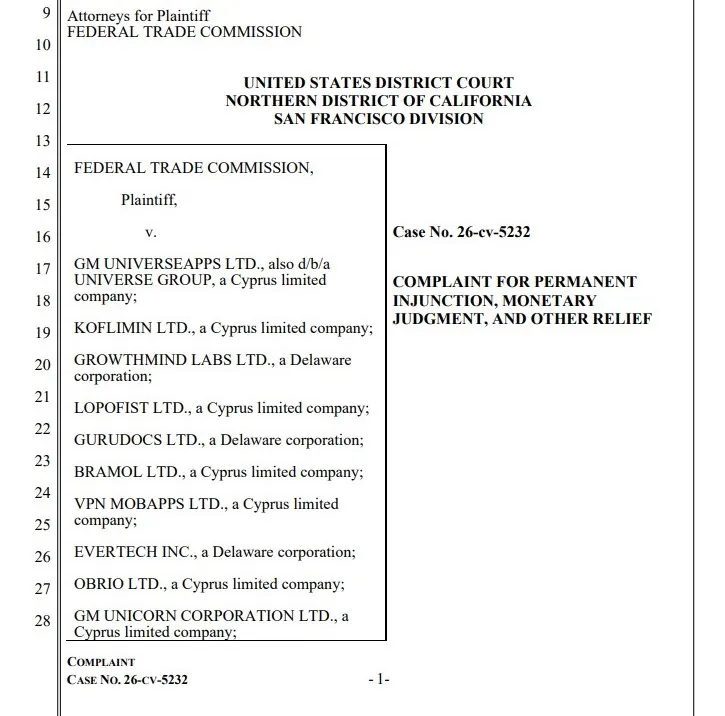
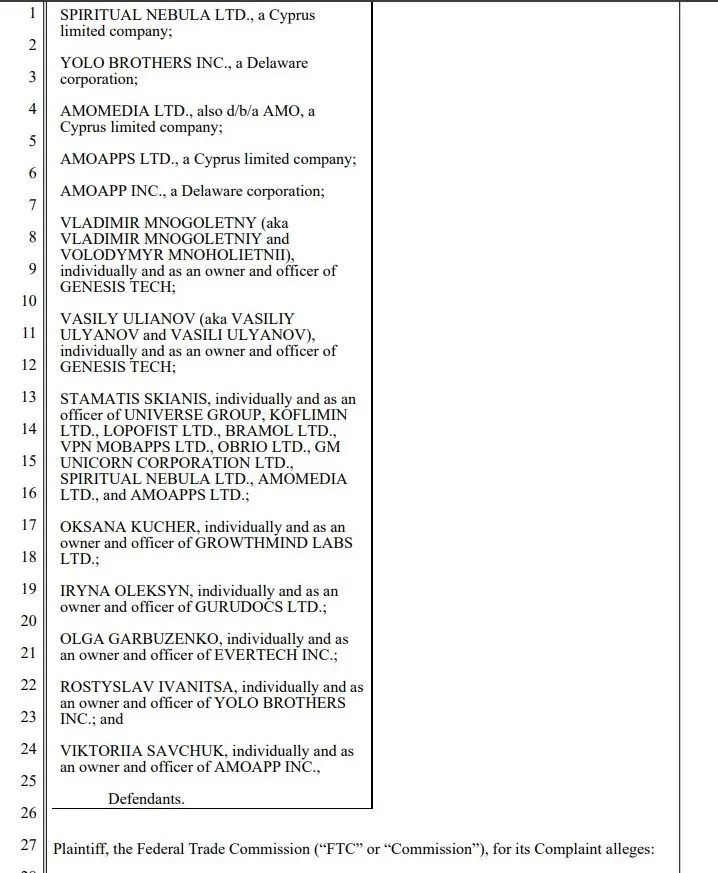
The case also mentions eight individuals involved. In addition to founders Volodymyr Mnoholetnyi and Vasyl Ulyanov, the case also involves Stamatis Skiadis, Oksana Kucher, Iryna Oleksyn, Olga Harbuzenko, Rostyslav Ivanitsa, and Viktoria Savchuk.
The Genesis Tech Ecosystem and Hidden Assets
The ownership structure of Genesis Tech companies and their transactions have also become the subject of an investigation by the U.S. Federal Trade Commission. The U.S. regulator found that, as of January 2026, Genesis Tech Corporation was registered under the name Matar Trade & Invest Limited, a limited liability company based in the British Virgin Islands.
“Matar was dissolved on January 23, 2026, following a voluntary liquidation, but Genesis Tech remains an ongoing issue. Genesis Tech currently has 13 companies in its ‘ecosystem’ and previously had seven additional companies that have since become independently managed affiliate companies… In total, Genesis Tech has released dozens of products that, according to Genesis Tech, have reached over a billion users worldwide,” the case materials state.
The FTC team highlights the scale of the abuses, noting that many companies in Genesis Tech’s portfolio follow a common pattern of misconduct, including fraudulent or deceptive subscriptions, which has led to a surge in consumer complaints.
Genesis Tech operates as a joint venture through an extensive network of organizations it controls, including a number of subsidiaries registered in Cyprus and those operating in Ukraine, U.S. lawyers note. The Cypriot subsidiaries target U.S. consumers and gain access to U.S. payment processing through partners registered in the state of Delaware. Each subsidiary in Delaware is headed by an individual residing in the United States.
According to the FTC’s findings, to promote their schemes, all of these companies work together to constantly launch new deceptive product offers, register new corporate identities, and open new merchant accounts. They channel their illicit profits through cross-border transfers between affiliated entities, thereby concealing the defendants’ true identities from consumers and hiding their assets.
Expert Comments

Galina Heylo, President of the International Payment Association (IPA)
“The very fact that the U.S. Federal Trade Commission (FTC) has filed a lawsuit is a very serious signal for any international company. The FTC is one of the key U.S. regulators in the field of consumer protection, and its lawsuits are typically filed only after a lengthy analysis and the collection of evidence. Therefore, regardless of the outcome of the legal proceedings, the mere filing of such a lawsuit already poses significant reputational risks for the business.
It is particularly important to note that this involves not just a single company, but a network of entities that the regulator identifies as the Genesis Tech enterprise. If the court does indeed find that a unified system of management or coordination of activities exists among these companies, this could significantly expand the scope of potential liability and affect the operations of the entire group.
Even if some of the allegations are not proven in the future, the consequences may already be felt now. This could affect relationships with banks, payment partners, advertising platforms, investors, and counterparties. For an international technology business, trust is one of its key assets, and regulatory claims of this magnitude almost always lead to additional scrutiny from partners.
Particular attention is drawn to the information regarding the temporary suspension of operations for a network of companies that the FTC links to Genesis Tech Enterprise. U.S. courts do not impose such injunctive relief in every case. This indicates that the court has preliminarily found the regulator’s arguments sufficiently compelling to prevent potential harm until the case is resolved on its merits. At the same time, this does not automatically confirm the defendants’ guilt—final conclusions will be reached only after a full trial.
From the perspective of the Ukrainian IT sector, this case will have implications far beyond the fate of a single company. It will serve as a test of the maturity of the Ukrainian tech industry in global markets, where increasing attention is being paid to issues of compliance, transparency of business models, consumer protection, and corporate governance. That is why the outcome of this process will be closely watched not only by lawyers and regulators, but also by investors, partners, and representatives of the entire technology industry.”




