
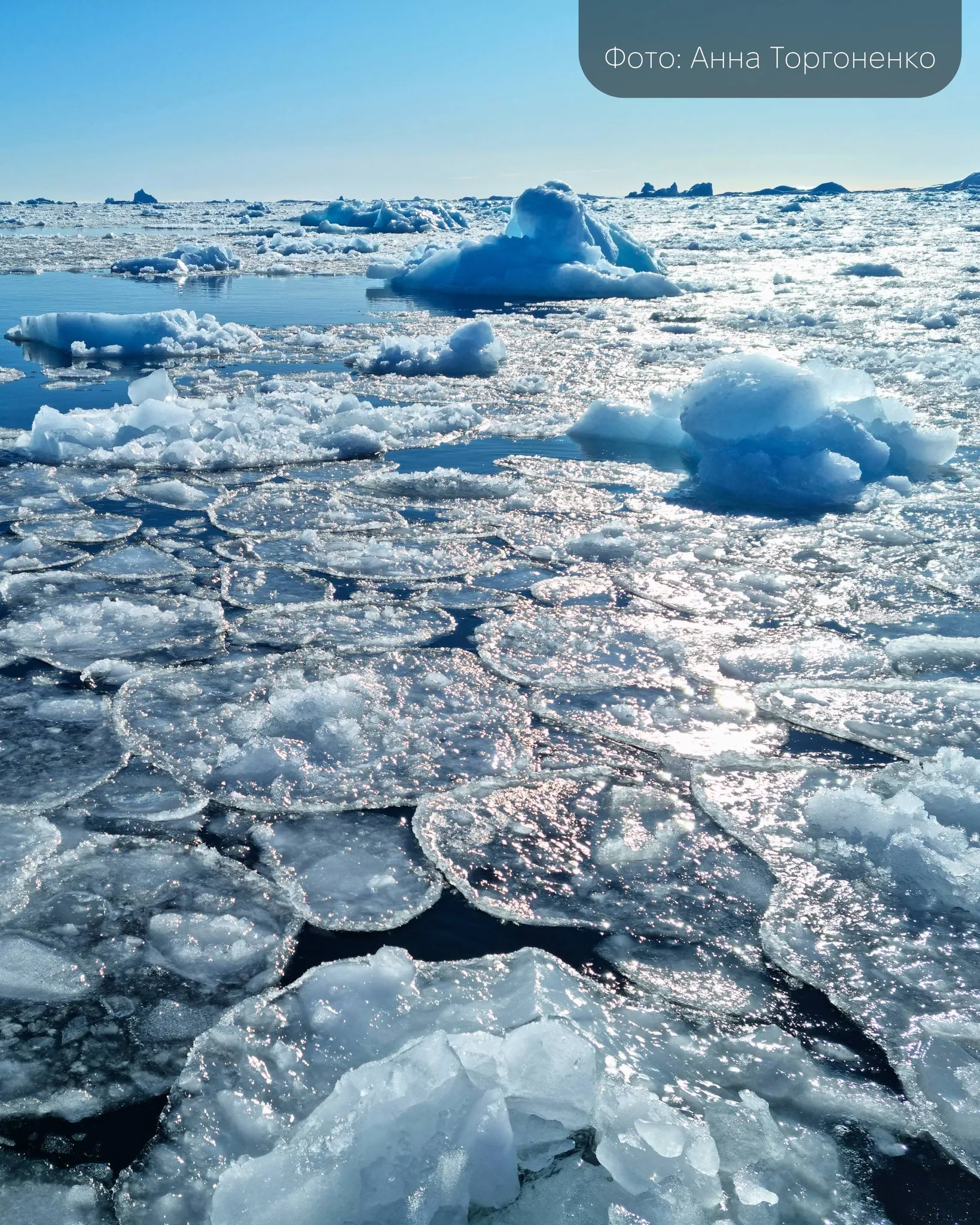
Ukrainian polar explorers showcased unique Antarctic pancakes

Ukrainian scientists from the “Academician Vernadsky” Station described a rare natural phenomenon in Antarctica—pancake ice. It is in winter, under the low sun, that it can be seen in all its glory in Antarctic waters.
According to the polar researchers, pancake ice often forms in Antarctic waters, although a similar phenomenon can also be observed in other bodies of water, primarily freshwater ones.
“In Antarctica, it’s not just the cook who makes pancakes—the ocean does too! True, they’re cold and salty, but at the same time very beautiful,” the scientists noted.
Experts explained that the ice “pancakes” are best seen in winter, when the sun appears above the horizon for only a few hours and does not rise very high.
“In winter, near the Vernadsky Station, the sun appears for only a few hours and doesn’t rise high above the horizon,” the polar researchers said.
The scientists described two main ways that pancake ice forms.
The first occurs when a thick mass of ice or snow accumulates on the water’s surface, which freezes into separate fragments under conditions of light frost, light winds, and gentle waves.
“The first occurs when a thick mass of ice or snow accumulates on the water’s surface. Under unstable, mild freezing conditions, with light winds and waves, it freezes not as a solid crust but in separate pieces. They grind against each other, taking on a round shape. Then, depending on the temperature, the ice chunks either melt or freeze into a thin (up to 10 cm) elastic ice crust—nilas,” the polar explorers explained.
The second scenario involves the breakdown of an already formed layer of nilas or young gray ice, which, under the action of waves, breaks into rounded fragments.
“The second scenario is when nilas forms initially, but under the influence of waves and wind, it breaks apart, is smoothed, and turns into ‘pancakes.’ This process can also occur with young gray ice, which is slightly thicker (up to 15 cm). The diameter of pancake ice ranges from 30 cm to several meters,” the report states.
The polar researchers also noted that ice “pancakes” and snow “donuts” are different natural phenomena.
According to them, the diameter of pancake ice can range from 30 centimeters to several meters, making it one of the most interesting winter phenomena that can be observed in Antarctica.
This was reported by the National Antarctic Scientific Center.


