
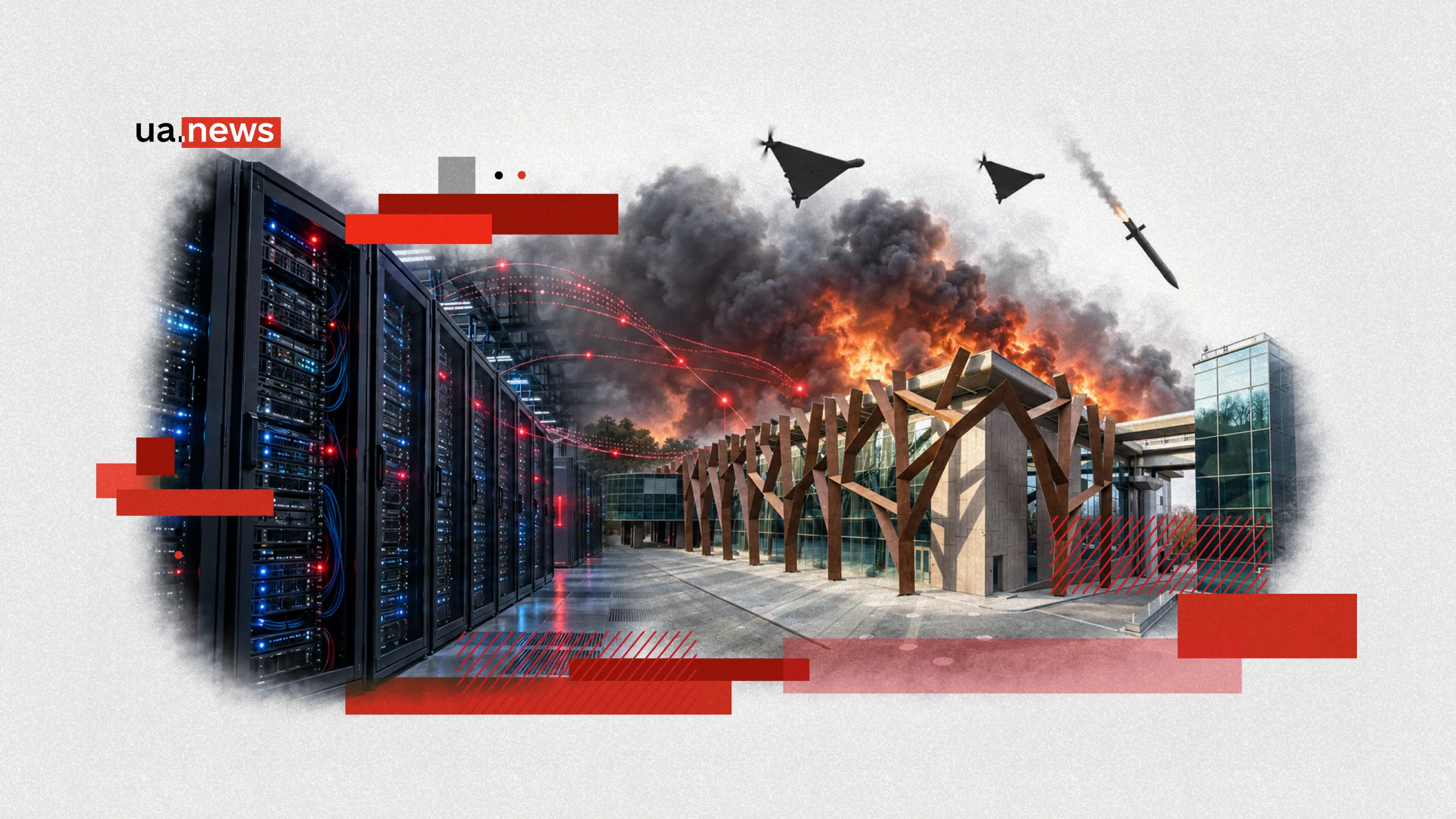
Wednesday, September 23, can officially be considered the day when the war in Ukraine finally entered yet another new phase—one that some experts had predicted several months ago, but for which the state was not prepared. Over the course of the day, Russia launched a series of strikes on data centers and telecommunications infrastructure in Kyiv and the Odesa region. Internet service providers in Kyiv reported widespread damage to their data centers. About 100,000 subscribers were left without internet access.
That same evening, Russia struck the “Parkovy” convention and exhibition center twice—one of Ukraine’s largest commercial data centers is located there. A missile struck the central traffic exchange node, causing intermittent service disruptions not only in Kyiv but also in Vinnytsia and the Khmelnytskyi region. The National Commission for Electronic Communications also warned of possible temporary service disruptions across the country.
The Russian Ministry of Defense later stated that the targets were the “Kyivstar” and “Parkovy” telecommunications centers, as well as logistics facilities in the Odesa region. However, the Ukrainian Ministry of Foreign Affairs emphasized that data centers are critical civilian infrastructure that has no connection to military targets.
These are no longer isolated incidents. As early as September 20, Russian strikes on Kyiv targeted data centers and telecommunications companies. At that time, one might have thought these were “one-off actions,” but now all doubts have been dispelled. What exactly are data centers, why are they needed, and should we prepare for an “internet blackout”? UA.News, together with experts, looked into the issue.
What Is a Data Center, and How Does It Relate to Your Internet?
When we say “the internet is down” or “there’s no internet,” most people imagine something abstract: some kind of “network” that was out there somewhere—and suddenly, for some reason, disappeared. In reality, however, behind every webpage in your browser, every social media post, and every message sent via a messaging app lies a vast and very tangible infrastructure—a sort of technical “organism.” And the data center is its heart.
A data center (or DC) is a specially equipped building or facility that houses servers, data storage systems, networking equipment, cooling systems, uninterruptible power supplies, and more. Simply put, it’s a “warehouse” for computers that store and process information. This is where websites, apps, banking systems, cloud services, government registries, and streaming platforms “live”—in other words, everything we use every day.
Data centers come in many forms. There are the massive “hyperscale” facilities operated by Amazon, Google, or Microsoft, which cover entire hectares of land. There are also smaller commercial data centers that lease space to dozens of companies. And there are small hub centers operated by internet service providers: these are the ones most often targeted because they’re located closer to subscribers and provide local connectivity.
The connection between data centers and the telecom industry is direct and inseparable. First, every provider has its own or leased server equipment, which is physically housed in a data center. These include routers, switches, and optical terminals—they are what “distribute” traffic from backbone networks to your home. Second, data centers house Internet Exchange Points (IXPs)—locations where the networks of different providers converge. If such a point is destroyed, traffic between operators begins to take detours, which leads to delays, congestion, and sometimes a complete loss of connectivity in certain regions.
Third, data centers are also crucial for mobile communications. Operators (Kyivstar, Vodafone, lifecell) have their own data centers, which house switches, billing systems, and platforms for calls and SMS. Hitting such a center means not just “shutting down the internet,” but crippling phone calls, mobile internet, and even the operation of bank terminals in parts of the country.

If the attacks intensify: Is Ukraine facing an “internet blackout”?
Given all of the above, a perfectly logical question arises: if Russia continues to strike data centers, will Ukraine be left completely without the internet? The answer for now is this: a complete “internet blackout” across the entire country is practically impossible to achieve. But there will be problems—and significant ones at that.
The fact is that Ukraine’s telecommunications market is one of the most diversified and competitive in Europe. Hundreds of providers operate in Ukraine, ranging from national giants to dozens of small local operators in every regional center. This means that the infrastructure is physically distributed: even if a major hub in Kyiv were taken out of commission, Lviv, Dnipro, and Kharkiv would still have their own data centers and channels. A failure in one segment does not “take down” the entire network.
Moreover, Ukrainian providers have long since learned to operate under wartime conditions. Since 2022, they have been actively duplicating channels, building backup routes, moving equipment to underground shelters, and stockpiling generators and fuel. Many companies have “mirror” servers in western regions and abroad—specifically in Poland, Romania, Germany, and elsewhere. This means that even in the worst-case scenario, some services will simply “relocate” to external sites.
However, this doesn’t mean everything will go smoothly. Real problems are expected, and they are already emerging.
First, there are local outages. As the example of Kyiv on September 23 showed, an attack on a single data center can leave 100,000 subscribers in several regions without connectivity at the same time. Second, network overload. When part of the traffic is routed through alternative paths, neighboring nodes may not be able to handle the load, causing systems that were previously functioning to go down. Third, a decline in speed. Even if internet access is technically available, it may be slow, prone to disconnections, and unsuitable for video calls, online learning, and so on.
A separate issue is the so-called “scheduled outages.” During massive attacks, energy and telecommunications providers may deliberately limit service to preserve the system as a whole. Unfortunately, this is already a very familiar practice for Ukrainians.
Therefore, an “internet blackout” in the sense of “the entire country is completely offline” is highly unlikely. However, an “internet blackout” in the sense of “I’ve been without internet for two days, but my neighbor, who uses a different provider, still has it”—that is a very real scenario. And that is exactly what we should be preparing for.

Expert
Opinions
Telecom technology expert Oleksandr Glushchenko noted in a comment to UA.News: “It is very difficult to orchestrate an ‘internet blackout’ in Ukraine.” The key sticking point here is electricity. If there’s no electricity for a week or two, then serious connectivity problems will arise.
“At the moment, the telecom sector in Ukraine is one of the most stable, because the government has never interfered in this industry, has not regulated it, and thousands of entrepreneurs have built their own networks. Ukraine’s resilience is very high because the market isn’t monopolized, and end users always have a choice of high-quality services. Also, over the past four years, almost all providers have secured their power supply, because if the internet depends directly on electricity, you’re not competitive. In Kyiv alone, there are dozens of market players, all with their own networks, their own connections and peering agreements, their own external channels, connections to backbone networks, and so on. The only pain points are electricity and the destruction of sites where active equipment is located. But given that there are many providers and they’re all working on decentralization, it’s very hard to imagine all providers “going offline” at once. As yesterday’s situation with the attacks on data centers showed, four providers in Kyiv experienced network issues, but even they didn’t go down completely—only in specific areas, meaning only where the cables were damaged. Today, everything has been fixed and is working. So in this regard, the internet is secure,” notes Glushchenko.
As for data centers—this is indeed a weak spot, the expert emphasizes. In the case of data centers, there may be temporary disruptions to the services hosted there.
“So today’s challenge is this: maximum decentralization and redundancy of equipment, changing locations, spreading operations across different cities, or establishing backup facilities in other parts of Ukraine or even abroad. Of course, this will lead to a slight increase in service costs, but not a significant one. I also advise consumers to have two SIM cards and always carry a certain amount of cash with them, as there may be issues with payment terminals. “I advise businesses to have at least a few service providers—at least two: a primary and a backup. And to rely on PON technology,” said Oleksandr Glushchenko.

Oleksandr Tepliuk, a UIP
expert on digital infrastructure and technologies, says it is premature to speak of an inevitable complete “internet blackout” in Ukraine today. The architecture of the Ukrainian internet is sufficiently decentralized: we have many independent operators, traffic exchange points, and international channels. Therefore, the destruction of a single data center does not mean the destruction of the internet in the country.
“But what is happening now is still very serious. We are already seeing a different pattern—local and regional outages, as well as the failure of individual providers and services. Following the attack on September 23, approximately 100,000 households in Kyiv and the surrounding region experienced internet problems; backbone nodes, hosting companies, and online services were affected. The worst-case scenario could occur if not just one data center but a large number of components were simultaneously compromised: backbone lines, operator nodes, power systems, and international channels. In that case, we could face serious regional blackouts and a severe degradation of connectivity. Therefore, I would not expect all of Ukraine to wake up one day without the internet, but rather periodic disruptions: today one operator is down, tomorrow a specific service is down, mobile internet goes down somewhere due to overload, and traffic is rerouted to backup routes.
For businesses, this demonstrates once again that a backup copy in the same data center is no longer a true backup. Critical systems must have geographically dispersed copies, preferably in different data centers and even different countries. For the average person, the bare minimum is xPON with a backup power supply for the router, SIM cards from two different carriers, and a power bank. “Starlink can also be a good backup, but it cannot replace a country’s entire terrestrial telecommunications infrastructure,” says Oleksandr Tepliuk.
In
summary, the most likely scenario for the coming months is a continuation of systematic attacks on telecommunications infrastructure, with a focus on major cities. Russia’s logic here is simple: data centers are relatively easy targets compared to military facilities or power plants, yet the impact of striking them is highly dramatic and visible. Attacks on data centers and servers paralyze all aspects of life in the country that rely on the internet. This is not a war against the army or the political regime, but specifically against society.
At the same time, it’s important to understand that Russia will most likely fail to achieve its strategic goal—that is, to completely cut off Ukraine’s internet connectivity. The infrastructure is too decentralized and extensive, there are too many players in the market, and there is too much experience operating under wartime conditions, among other factors. The most the aggressor can hope for are temporary, localized disruptions, which are certainly painful but not fatal.
What does this mean for Ukrainians in practical terms? First, it’s worth having backup communication channels: at the very least, mobile internet from a different provider, and even better—a Starlink satellite terminal or equivalent (if, of course, you can afford it). Second, don’t rely on a single service: if Telegram suddenly goes down, you should have WhatsApp, Viber, Signal, or at least enough money for text messages.
And most importantly: attacks on data centers are yet another sign that digital infrastructure has become a full-fledged front. The government, businesses, and users themselves must treat it just as seriously as they do energy or transportation. Because in 2026, the internet is no longer just entertainment for tech enthusiasts, but a basic necessity for 90% of people—without which neither the economy, nor national defense, nor everyday life can function.
Ukraine has already proven that it can maintain communications even under shelling. The only question is how many more strikes this system can withstand and how quickly it can be restored after each one.




