
The European Federation of Journalists has adopted resolutions in support of Ukraine and the media
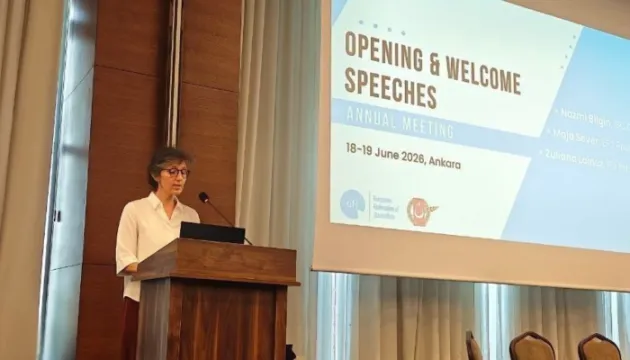
On June 19, the European Federation of Journalists adopted three resolutions aimed at supporting Ukraine and its media community. The documents call for strengthening solidarity with Ukrainian journalists and promoting the development of independent media amid the war.
The first resolution—“On the Strategic Role of Local and Frontline Journalism During War”—recognizes Ukrainian local and frontline media as a critical component of democratic and informational infrastructure.
“We call for the implementation of various initiatives to support frontline media in Ukraine and greatly appreciate the international solidarity we are receiving. We would like to develop more initiatives related to trauma recovery and the training of future journalists,” said Serhiy Tomilenko, chairman of the National Union of Journalists of Ukraine, in a speech before the vote.
He thanked the journalists’ unions of Denmark, Sweden, Norway, Finland, Iceland, and Estonia for their support of Ukrainian media and for co-authoring the resolution.
The document notes that journalists in frontline regions often remain the only reliable source of verified information for local communities. The EFJ calls for the creation of partnerships between European and Ukrainian media, the expansion of support programs from the European Union, and the development of mechanisms to assist newsrooms operating in wartime conditions.
The second resolution—“On Support for the Centers for Journalistic Solidarity in Ukraine”—concerns the network of Centers for Journalistic Solidarity established by the National Union with the support of the EFJ, IFJ, and UNESCO.
“The main role of our Centers for Journalistic Solidarity is to help journalists in emergency situations and provide rapid on-the-ground support. We are currently working on purchasing additional drone detectors. Every workspace for journalists must be equipped with protective gear and early warning systems,” said Tomilenko.
The document notes that since the start of the full-scale invasion, these centers have provided assistance to more than 9,000 Ukrainian and foreign journalists. The EFJ called on European institutions, governments, and international donors to ensure long-term funding for the centers, especially in frontline regions, as well as to support programs for the safety, psychological support, and professional development of journalists.
The third resolution is titled “On Continuing Solidarity with Ukrainian Journalists Illegally Detained by the Russian Federation.” It notes that as of May 2026, at least 28 Ukrainian journalists and media professionals remain unlawfully detained by Russia.
The EFJ called on European and international institutions to intensify diplomatic and political pressure for their release, to support international solidarity campaigns, and to push for the creation of a special international mechanism for the release of civilian hostages held by the Russian Federation.
All three resolutions were adopted unanimously, according to Ukrinform.
Earlier, the Ministry of Foreign Affairs criticized UNESCO for refusing to recognize the shelling of the Lavra as a Russian act.


