

To most people, mental arithmetic seems almost like magic. While some reach for a calculator or try to do the math on paper, others arrive at the correct answer in a matter of seconds using only the power of their imagination.
This is exactly how the brain of 15-year-old Oleksandr Bernatsky—the Ukrainian champion and a medalist in international mental arithmetic competitions—has been working for over seven years.
Oleksandr was first introduced to mental arithmetic back in 2018, when he was seven years old. Since then, he has become the Ukrainian champion and has won awards at international tournaments and national Olympiads.
At the same time, mental training is only part of his life. Today, he regularly boxes, goes to the gym, plays tennis, is interested in programming, and is already thinking about starting his own business.
UA.News spoke with the young champion about his path to his first victories, the secrets of quick calculation, discipline, family support, his passion for boxing, and his plans to pursue a career in IT and start his own business.
From a Chance Piece of Advice to a Championship
Oleksandr himself admits that he likely would never have discovered mental arithmetic if it weren’t for his grandfather. It was his grandfather who, seven years ago, suggested that his grandson attend his first class, since he was acquainted with the boy’s future coach.
Mere curiosity quickly turned into a genuine passion. After just the first class, Oleksandr realized he wanted to continue learning, and eventually, the training sessions became an integral part of his life.
“My grandfather suggested I try mental arithmetic. He was a friend of my coach. After just the first class, I became really interested, and we started practicing. Eight years have passed since then,” Oleksandr said.
The Most Memorable Victory
Over the years of training, Oleksandr has repeatedly become the champion of Ukraine and won awards at prestigious tournaments. However, the most valuable victory for him isn’t his most recent one, but his first major success.
In 2019, just one year after he started training, he became the Ukrainian champion for the first time. It was then that he realized that regular training really does pay off.
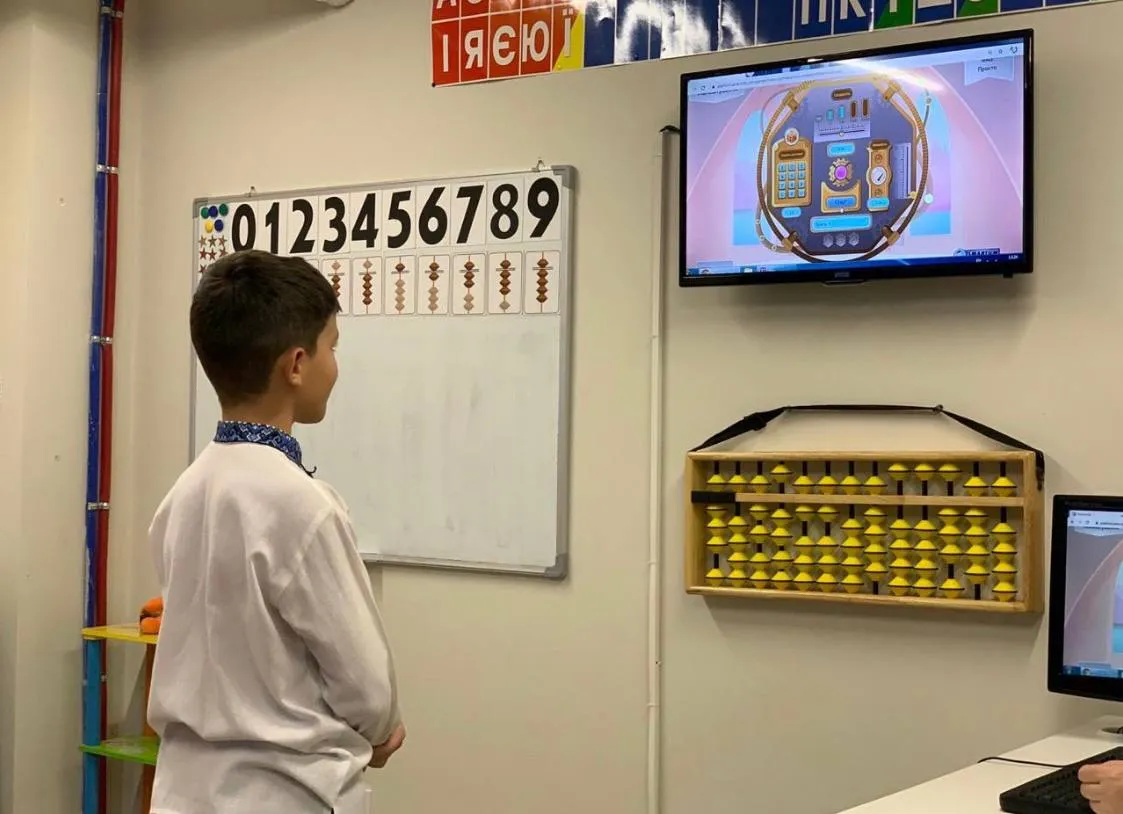
“Then came victories in 2023, 2024, and 2025. But it was that first-place finish in 2019 that meant the most to me. I’d only been training for a year at that point; it was very difficult, but I managed to win,” recalled the young champion.
It was this success, Oleksandr says, that became his greatest motivation to keep working on himself.
Not a Single Day Without Training
Despite school, sports, and the usual teenage life, there’s been one rule in his schedule for many years that he almost never breaks: daily training.
After school, the boy first sits down to work on the assignments he receives from his coach via a special online platform. Only then does he move on to other tasks.
He spends about an hour each day on mental arithmetic.
“After school, the first thing I do is mental arithmetic. My coach gives me assignments on a special platform, which I complete. It usually takes about an hour every day,” Alexander explained.
When the Abacus Appears in Your Mind
To someone who has never practiced mental arithmetic, this kind of calculation might seem almost supernatural. In reality, however, Oleksandr explains, it’s all based on visualizing an abacus.
When performing calculations, he doesn’t go through the numbers in the usual way; instead, he visualizes a mental abacus in his head and moves its beads mentally. Over the years of training, this process has become so automatic that ordinary calculation now seems unnatural to him.
“Basically, you’re counting on an abacus, but in your head. It’s much faster. I don’t even know how to count the usual way anymore, because I always use the mental abacus,” the young man said.
How Mental Arithmetic Helps in School
Oleksandr found these skills most useful in elementary and middle school. Fast calculation helped him in math, algebra, and geometry classes, especially when he needed to perform calculations quickly.
In high school, the curriculum becomes more complex and relies increasingly not only on arithmetic but also on formulas, proofs, and logic. Therefore, the direct benefit of quick calculation is no longer as noticeable. At the same time, Oleksandr is convinced that this skill remains important nonetheless.
“In elementary and middle school, mental arithmetic was a huge help—especially with math, geometry, and algebra. In high school, it’s not quite as necessary, but it’s still useful to know,” Alexander noted.
When It Seems You’ve Achieved It All
Despite his numerous victories, there was a period in Oleksandr’s life when he seriously considered giving up mental arithmetic.
This happened in 2023 after his victory at the national Olympiad. At the time, it seemed to him that his main goal had already been achieved, and that further training wouldn’t be as important.

However, his grandfather convinced him not to stop. He reminded him that even after the first major achievement, there’s always room for growth.
“At the time, I thought I’d already achieved everything I could in mental arithmetic. But that wasn’t true,” Alexander admitted.
After that, Alexander set new goals for himself: to continue winning at national tournaments and to develop his mental calculation speed to the highest possible level.
Nerves Never Go Away
Experience and a large number of competitions don’t mean the complete absence of fear. Before competitions, Oleksandr still gets very nervous.
His coach’s advice and mental preparation help him cope with the pressure. Instead of constantly thinking about the result, he tries to focus on the process itself and imagine how he’ll feel after a successful performance.
“I try to think about what will happen after the competition; I imagine myself winning. It helps me concentrate and just do what’s required of me,” Oleksandr explained.
Not all of his classmates know about his victories
Despite his championship titles, Oleksandr doesn’t try to constantly talk about his achievements. According to him, some of his classmates don’t even know that he practices mental arithmetic or that he has won Olympiads.
Those who do find out about his results are usually surprised. He even convinced two of his friends to give it a try. They eventually started training as well and have been doing it for several years now.
“Not all of my classmates know that I’ve won championships. But those who do know are very surprised. I suggested that two friends give it a try, and now they’re doing it too,” Alexander said.
Boxing, tennis, the gym, and books
Mental arithmetic plays an important role in his life, but it doesn’t define him entirely. After school, Alexander tries to devote one to two hours a day to physical activity.
He goes to the gym, plays tennis, and has been boxing for three years. Boxing has become his main passion. In the near future, he plans to move from training to competing.
“I love boxing the most. I’ve been doing it for three years now, and I plan to start competing soon,” he said.
In addition to sports, he tries to read for at least half an hour every day. For him, this is also part of his discipline.
The person who was there from the very beginning
Alexander’s story frequently mentions his grandfather. It was his grandfather who first took him to his first training session, supported him during daily workouts, and helped him stick with mental arithmetic after his first major victory.
The young man recalls that his grandfather would sit beside him as he prepared for competitions, monitoring his progress and offering support during difficult moments.
“I’m most grateful to my grandfather. He was always there when I was training, and he was the one who suggested I take up mental arithmetic,” Alexander emphasized.
At the same time, Oleksandr notes that his parents and coach also played an important role in his achievements.
An Example of Hard Work and Continuous Learning
For Oleksandr, his grandfather is not only the person who introduced him to mental arithmetic but also his greatest role model.
The young man admires his grandfather’s work ethic, love of learning, and passion for books. According to him, his grandfather came from an ordinary family but constantly sought to improve himself and worked hard to provide for his loved ones.
“He always worked, studied, and never gave up. He could read one, two, or even three books a day,” the young man recalled.
Oleksandr sees similar traits in his father, who also works hard and continues to learn. It is precisely this attitude toward life that the young man wants to carry into his own future.
Discipline Is More Important Than Talent
Over the course of seven years of classes, Oleksandr has had the chance to talk with many children who also came to mental arithmetic with great ambitions. Some had remarkable abilities and picked up the material quickly, but eventually stopped practicing. That’s why, when asked what the main secret to success is, he answers without hesitation: it’s not talent, but consistent effort.
In his view, the result depends entirely on whether a person is willing to work on themselves every day, even when they don’t feel like it.
“In my opinion, the most important thing is daily, persistent work. I had many friends who also practiced mental arithmetic, but at some point they stopped training. I, on the other hand, devoted one or two hours to it almost every day for seven years. That’s exactly why I was able to win the Olympiads,” Oleksandr is convinced.
This idea runs like a common thread throughout the entire conversation. Oleksandr hardly mentions talent or special abilities. Instead, he constantly returns to the topics of discipline, routine, and the habit of working regardless of his mood.
Next Goal: His Own IT Business
Although his life today is closely tied to mathematics, he doesn’t plan to pursue a career in the field.
He’s most interested in the field of information technology. He’s already spending a lot of time studying computer science.
“In the future, I want to go into business. I think it will be my own venture in the IT sector. That’s exactly why I’m spending so much time studying computer science right now,” Oleksandr shared his plans.
His Biggest Dream Isn’t About Medals
By the end of the conversation, Oleksandr is barely talking about championships or future achievements. When asked about his biggest dream, he responds in a way you wouldn’t expect from a 15-year-old athlete.
For him, the most important thing is for the war in Ukraine to end as soon as possible. Only then does he speak of his personal aspirations—the ability to support his loved ones and ensure they never want for anything.
“My biggest dream is for the war in Ukraine to end so that we can all live in peace. And I also want to always be able to help my family, so that none of my loved ones ever goes without anything,” Oleksandr said.


