
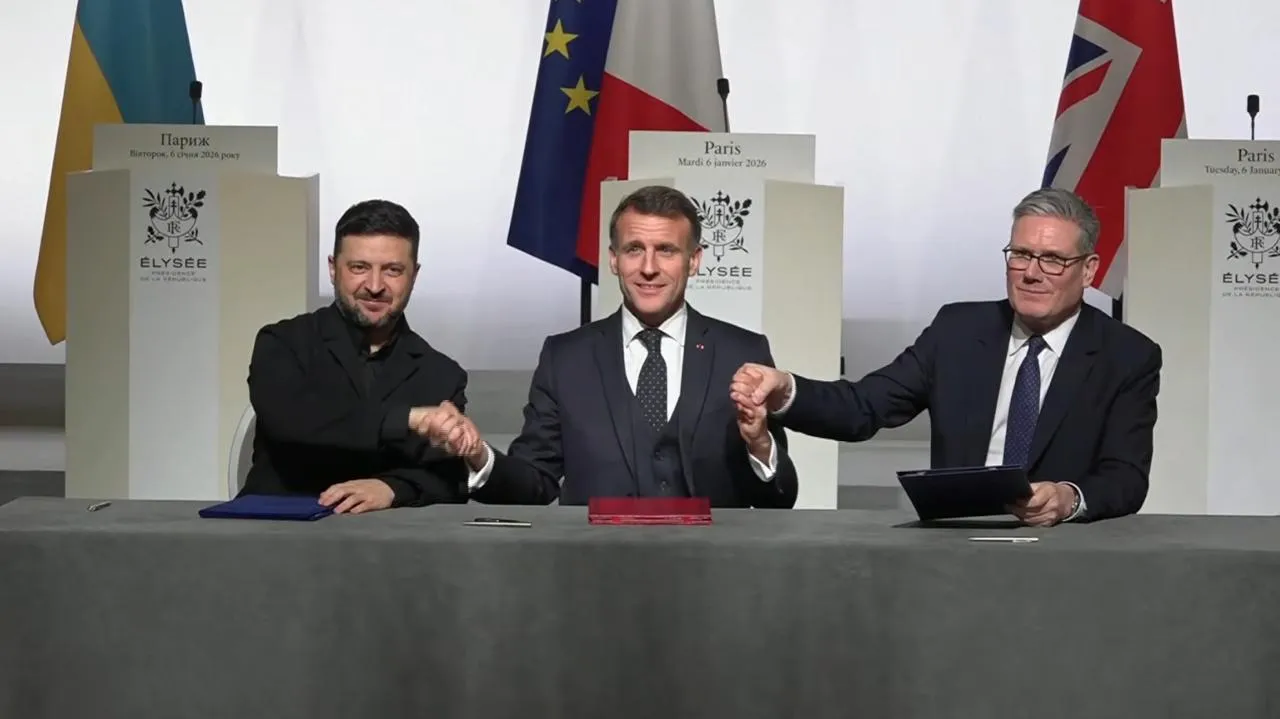
On 6 January 2026, President Volodymyr Zelensky paid an official visit to France. He attended the summit of the so-called “coalition of the willing” on support for Ukraine.
The coalition leaders met for the first time since March 2025. The meeting was attended by 35 representatives, including 27 heads of state and government. A key moment was the personal presence of the US delegation, consisting of special envoy Steve Witkoff and Donald Trump’s son-in-law Jared Kushner, as well as the Supreme Allied Commander Europe, NATO General Alexus Grynkewich.
One of the central outcomes of the event was the signing of a declaration on the deployment of European partner troops in Ukraine after the war. The document was signed by Volodymyr Zelensky, French President Emmanuel Macron and UK Prime Minister Keir Starmer. Its full title is “Declaration of Intent on the Deployment of Multinational Forces in Ukraine after the End of the War”.
All signatories praised the document, stating that it brings peace and security guarantees closer. However, some political leaders, such as Polish Prime Minister Donald Tusk, reacted more sceptically, pointing out that these are still merely “drafts” of potential agreements. It is also known that US representatives did not sign any documents.
So what exactly was signed in Paris, how likely is the deployment of NATO troops in Ukraine after the war, and does all this really bring the country closer to peace? Political analyst Mykyta Trachuk of UA.News, together with experts, examined the issue.
Not a treaty, but merely a declaration of intent
According to the letter and spirit of the document, after the end of hostilities and the achievement of peace in Ukraine, European partners are expected to deploy their contingents on Ukrainian territory. It is also planned to build appropriate military infrastructure, effectively turning the country into a network of military hubs.
It is expected that the ground forces of France and the United Kingdom will be involved. There is also information about Turkey’s participation: Ankara is allegedly to ensure the security of shipping and trade in the Black Sea.
On paper, everything sounds quite positive. However, as always, the devil is in the details.
Firstly, not all of Ukraine’s partners agree to take part. The newspaper Bild reports that German Chancellor Friedrich Merz has stated that Germany has no intention of sending its troops anywhere under any scenario. Meanwhile, Politiconotes that the US delegation also refused to sign the joint communiqué on the future deployment of contingents. Yet without the United States, it is unlikely that anything meaningful can be implemented.
Secondly, open sources do not specify the size of the international force that could be deployed in Ukraine. European officials, speaking to journalists, estimate its size at 10–15 thousand troops, while some commentators speak of 30 thousand. The bulk of the forces could consist of French and British troops. The most likely location for their deployment would be western Ukraine.
However, this would not constitute a real force in the event of a renewed Russian invasion. Russia’s current contingent in Ukraine exceeds 700,000 troops. Moreover, it is highly unlikely that, in the event of renewed aggression, Europeans would fight alongside the Ukrainian Armed Forces. They did not do so in 2022—so why would they do so in, say, 2032?
Thirdly, and most importantly, it is explicitly stated that the parties signed only a declaration of intent. This is literally a memorandum—a political, not a legal document—which confirms goodwill and symbolic support here and now, but carries no binding obligations for the future.
Ukraine once signed the Budapest Memorandum on security assurances, which failed twice. When the country’s leadership will finally understand the difference between a memorandum and a concrete treaty with real legal force remains an open question.

What the “coalition of the willing” statements mean
It appears that Ukraine’s and Europe’s strategy is to introduce changes to Trump’s peace plan. The essence of these adjustments is to force Moscow to publicly and officially refuse further discussions. After that, the Kremlin could logically be accused of derailing agreements, and hostilities could continue while attempting to persuade the US president to support Ukraine more actively.
However, so far it does not appear that America agrees to any significant changes. Europeans have merely “declared intentions” to send troops to Ukraine—after the war (the end of which is nowhere in sight), sometime, possibly, hypothetically, and even that is uncertain. Neither Witkoff nor Kushner signed the joint communiqué. Overall, the US position on future security guarantees remains vague.
There has also been no statement from Trump publicly supporting the deployment of partner troops on Ukrainian territory. Russia, for its part, has repeatedly and explicitly stated that it is categorically opposed to any armed presence of NATO countries in Ukraine.
Unfortunately, without Moscow and Washington, it is absolutely impossible to cut this “Gordian knot”. Without substantial security guarantees from the United States, no European leader will send their soldiers to Ukraine. Nor will they do so without Russia’s consent, for whom any Western contingent would immediately become a military target. This would mean casualties, and for the first time since 1945, coffins would return to Europe.
No EU politician—regardless of attempts to put on a brave face in a bad situation—is ready for this today. European societies are also not psychologically prepared. The first coffin of a regular French or British soldier officially killed in Ukraine would trigger such a political crisis that the governments concerned would likely fall the very next day.
That said, there is a certain probability that the Kremlin might nevertheless agree to a Western military presence in Ukraine. The key stumbling block in the peace process at present remains the Ukrainian Donbas. Moscow insists on the withdrawal of the Ukrainian Armed Forces from the region, and Trump appears to be pursuing the same goal. Zelensky is firmly opposed.
However, if we hypothetically imagine that Kyiv were to agree to such a scenario and withdraw its troops, there is a chance that Russia, as part of security guarantees, might agree to a limited Western contingent in Ukraine. In that case, Russia would obtain the remaining parts of Donetsk region without a fight, while 10–15 thousand (or even 30 thousand) NATO troops, as noted above, would hardly pose any serious military threat to Moscow.
For now, however, all of the above remains merely possible future scenarios and theoretical analysis. Because in the negotiating room there is still a huge “elephant” that everyone pretends not to see: the aggressor state itself.
The paradox of the peace process is that all sides talk as if Russia does not exist, as if everything has already been agreed. But these are conversations within a closed circle—Moscow is not participating. And without Moscow, it is impossible to end the war, achieve a ceasefire, deploy Western troops, or do anything at all. Ending a war with Russia without Russia’s participation is physically impossible, however much we might wish otherwise. This is like the well-known saying: “they married me off without me”.
As for security guarantees, which everyone is once again talking about, the situation becomes outright strange. Amid the information noise, it seems to have been forgotten that during 2023–2024 President Zelensky signed 28 (!) security agreements with various countries, which were presented domestically as powerful security guarantees.
For example, such an agreement was signed with France on 16 February 2024, personally by the leaders of Ukraine and France. On 13 June, an almost identical agreement was concluded with the United States, signed at the highest level by Volodymyr Zelensky and then-US President Joe Biden. One can also recall the “hundred-year agreement” with the UK, signed on 16 January 2025, whose very first point sets out broad military cooperation, defence procurement and the exchange of military technologies.
This creates a paradox: if Ukraine has already signed security agreements with dozens of partner countries, what security guarantees are being discussed now? Or were those documents not actually security agreements, but something else? If so, why were they signed and actively promoted in the media at all? Again, there are no clear answers.

Expert opinions
Political analyst and Director of the Institute of World Policy, Yevhen Mahda, believes that the signing of the Paris declaration is primarily a political gesture rather than a real step towards ending the war.
“On the one hand, European countries cannot ignore the fact of a war in Europe, which has become the largest war of the modern era. On the other hand, it is impossible to seriously talk about them sending contingents and providing real assistance right now, because Russia does not accept this logic and undoubtedly perceives NATO troops as NATO troops. I see no reason why Russia should change its approach or tolerate a situation in which NATO forces move hundreds of kilometres closer to its borders. Accordingly, all of this is a political gesture, but we need more practical actions, because measures with a delayed effect do not help us much right now,” the expert says.
According to Mahda, Ukraine needs to remain in a positive trend for Europeans: integration not only into EU roaming, but also cooperation with Ukrainian industry, investment in Ukraine’s defence sector, and further steps that would allow Ukraine to feel at least like a genuine EU candidate.
“At present, it is very difficult to talk about real European integration. This is a kind of ‘geopolitical placebo’. It is very telling that the Americans are represented by Trump’s special envoys. That is fine, but they are not government officials, and this indicates that the United States is continuing its policy of not strengthening its security presence in Europe while attempting to build hybrid contacts with the Russian Federation. This is the reality, and in this situation we must rely solely on ourselves,” Mahda believes.
Political analyst and Director of the “Third Sector” Centre, Andrii Zolotaryov, is convinced that what was signed in Paris will most likely have no practical continuation.
“We see that the Americans did not join this document, because it effectively torpedoes Trump’s plan, given the agreements reached in Anchorage. Russia will most likely once again remind everyone of its ‘red lines’ and the unacceptability of foreign troops in Ukraine. Another issue is the legal nature of this memorandum. The Verkhovna Rada has not given the president consent to invite foreign troops or deploy foreign military bases. And the third point is domestic politics. Macron has record-low ratings, Starmer also has political problems, and Germany has effectively refused to send troops. Merz likewise faces serious political difficulties.
This decision would have domestic political consequences in these countries, and risking the deployment of troops—given Europeans’ fear of direct confrontation with Russia—is something hardly anyone will do. Most likely, all of this is an attempt not to say ‘no’ to Trump directly, but to cast doubt on his peace plan. These look like the same kind of ephemeral guarantees with the same fate as the 28 security agreements previously signed by the Ukrainian president,” Zolotaryov concluded.


