
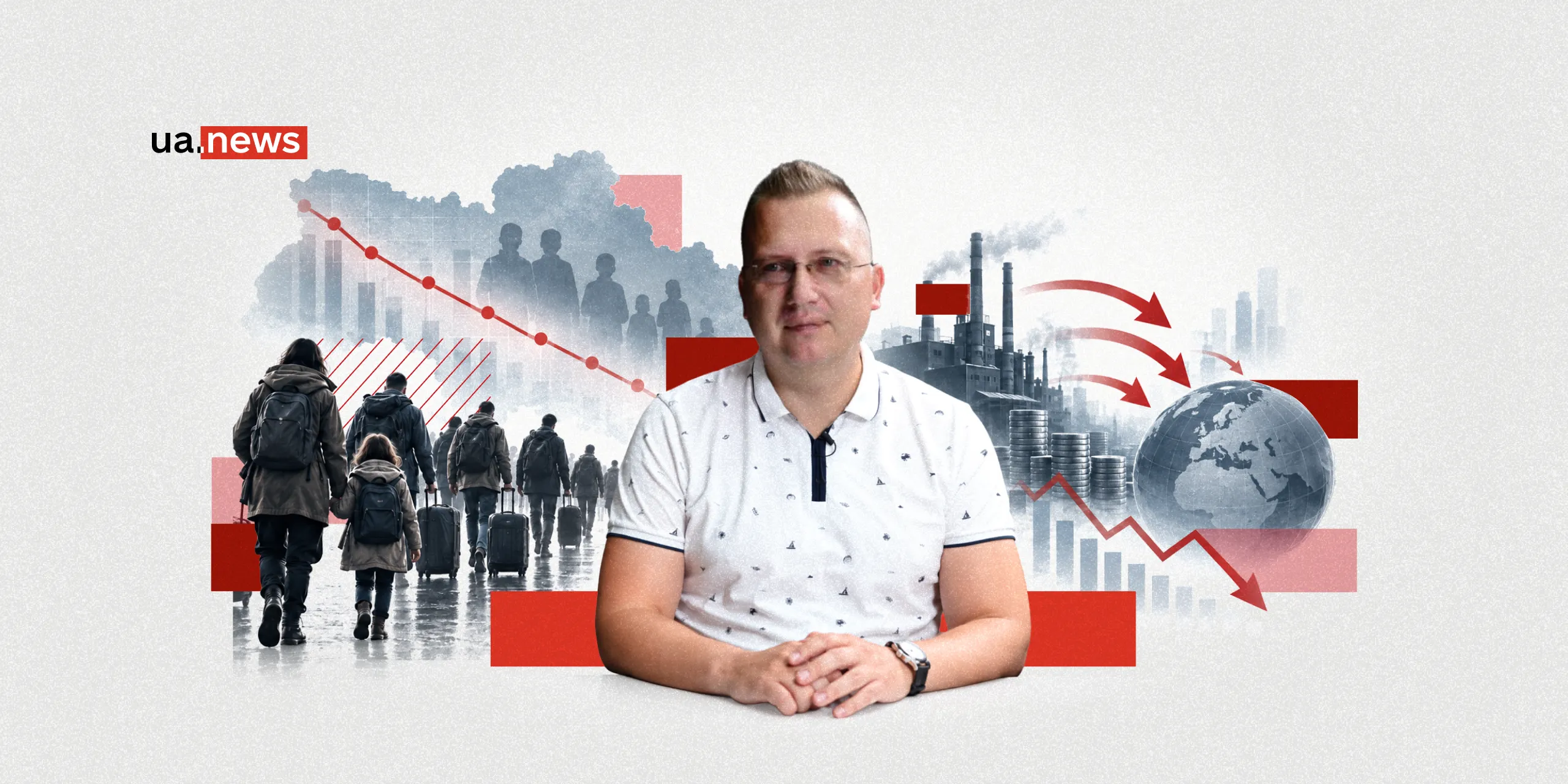
“About 7 million people could make up the new generation that will emerge in Ukraine over the next 30 years. As paradoxical as it may sound, this is an optimistic scenario because it assumes that current trends will continue,” says economist and financial analyst Oleksiy Kushch, adding that if the war continues, the situation will only get worse.
According to his estimates, the country risks reaching a point of no return if the war, mass emigration, a falling birth rate, and declining life expectancy continue simultaneously. The expert sees the solution not in attracting mass migration from other countries, but in creating an economic and social model that will encourage Ukrainians to return.
In an interview with UA.News, Oleksiy Kushch explains how the demographic crisis triggers economic contraction and infrastructure decline, how Israel managed to triple its population, and under what conditions Ukraine could benefit from this experience. Below are his direct quotes.
The Demographic Crisis and the Risk of a Point of No Return
Of course, a nation will not disappear, but it can enter a state of demographic crisis from which there will be no way out. In other words, a sort of point of no return will be crossed.
There are examples of nations that have fallen into such a historical state—so to speak, a state of historical homeostasis. But in such cases, the system is balanced with external factors of existence. This requires favorable external conditions.
Our geographical location, however, is such that there are no favorable conditions for a peaceful existence in historical homeostasis or suspended animation, nor will there be any in the foreseeable future.
Therefore, it is essential for our nation to remain dynamic, to preserve its demographic foundation, and to continue developing. That is why we cannot afford to reach a point of demographic homeostasis or suspended animation. This is precisely one of the main risks.
A “Perfect Storm” for the Deepening Demographic Crisis
In the context of demographics, we are currently facing, so to speak, a “perfect storm”—with negative connotations.
First, there is the mass exodus of the population abroad.
The second factor is a decline in fertility—that is, the number of births per woman of childbearing age. Here, we’re seeing a dramatic drop.
Thirteen to fourteen years ago, this figure was approximately 1.51. This was already below the level required for simple population replacement—about 2.01. The replacement rate is the minimum necessary birth rate for one generation to numerically replace the previous one. At that time, the fertility rate was also declining, but it followed a sort of arithmetic progression that would have postponed a large-scale demographic crisis until the 22nd century.
The third indicator is a decline in life expectancy. For men, it has fallen to approximately 63–65 years; according to some estimates, as low as 58 years. For women, average life expectancy has decreased from approximately 74 to 70 years.
Thus, these three indicators are, in fact, signs of our “perfect storm”—with negative connotations.
Similar demographic factors exist in other countries that are not at war. But there, the problem is partially solved by an increase in life expectancy, which automatically extends the period of economically active life.
For example, in Japan, the population is aging, but people aged 65–70 continue to work. And not because they are poor and forced to earn a living, but because they remain active in life.
Thus, additional labor resources are created through older adults. And this can even have a positive effect, as people remain socially active.
In addition, migration plays an important role in demographic projections. Japan’s population does not emigrate; on the contrary, people who want to live there come to Japan. In other words, they offset the decline in the birth rate by extending the duration of economically active life and attracting immigrants.
In Ukraine, however, the opposite is happening: the birth rate is falling amid mass emigration and a decline in life expectancy.
At most, about 7 million people could make up the new generation
I’ve done the math: if about 240,000 children are now entering first grade, that’s significantly fewer than before—when there were over 500,000. The decline is a 50 percent drop; the fertility rate has also fallen by half.
If we look at the decline in economic activity and demographic indicators as a whole, a simple calculation shows that the decline is no longer arithmetic but geometric.
A new generation takes shape over approximately 30 years. Therefore, knowing the number of children entering first grade today, we can extrapolate this trend over the next three decades. We’ll see that a maximum of about 7 million people could make up the new generation formed in Ukraine over these 30 years.
And, as paradoxical as it may sound, this is actually an optimistic scenario, since it assumes that the current trend will continue. If the war continues, the situation will only worsen.
And the loss of the ability to produce a numerically significant new generation of Ukrainians effectively means the dissolution of the nation into history. In other words, we have approximately 50 years left in historical terms.
The Human Capital Crisis and Economic
Decline
In everyday life, this will manifest as follows: like shagreen leather, the country’s economic potential will gradually diminish.
Right now, during the war, it’s hard to talk about normal economic development. But after the war, if this trend continues, we may face a situation where there won’t be enough investment in the economy and large enterprises won’t be created.
For example, there is this indicator: companies with more than 500 employees are typically established in countries with a population of over 20 million. In other words, large enterprises will not be established, investment will decline, and the economy will not develop.
The urban crisis in cities. Today, cities largely rely on resources from the provinces. Before the war, cities consumed resources from rural areas, but after the war, those resources will be gone. Villages are becoming depopulated, small towns are effectively dying out, and the number of settlements is declining.
Human capital in the 21st century is the foundation of economic development. As economists say, people are the “oil of the 21st century.”
That is precisely why economic focus is shifting toward Asia today: there is greater human capital there and significantly more prospects for its development.
Thus, a decline in human capital means a reduction in economic activity and economic prospects. We also find ourselves at a geopolitical crossroads where survival requires a populous nation, a strong economy, and a strong military. And all of this is possible only with well-developed human capital.
A crisis in human capital will lead to a crisis in all its other components—infrastructural, economic, geopolitical, and other forms of capital.
How to Mitigate Negative Demographic Scenarios
The turning point is finding a way to end the war. Ending the war is the key to saving the nation in this situation.
Therefore, when some politicians speak of an “eternal war,” they are, in fact, adding fuel to the fire of the demographic crisis every single time.
For example, in Israel, no one talks about an eternal war. There, conditions are created so that the country’s residents can live as comfortably as possible even during periods when military hostilities intensify. But politicians in Israel talk about life, not about an eternal war.
Therefore, the cornerstone is the search for mechanisms to end the war. Other mechanisms should then come into play.
The Return of Migrants: The Israeli Experience
In my view, the only option for us is the repatriation of the population. In other words, there are no other realistic options. I am referring to the launch of a Ukrainian “Aliyah.” In Israel, “Aliyah” refers to the return of Jews to their homeland. This program existed previously, but after the 1973 Yom Kippur War, Israel significantly expanded its scope.
The country realized that, with a population of about 3 million, it could not withstand its adversaries and launched a large-scale repatriation program.
In particular, it was aimed at resettling Jews from the Soviet Union.
But repatriation cannot be forced. In other words, it requires creating conditions for Ukrainians in Ukraine that are better than those they could obtain in other countries.
These must be conditions conducive to self-fulfillment. Accordingly, Ukraine must become a country with an effective economic development model. It must be an inclusive country—not tribalistic or insular. On the contrary, it must be multicultural and open.
For example, Jews from the Soviet Union would hardly have gone to Israel if it had been a country with closed borders and a rigid ideology. They went there, in part, because Israel was a significantly freer country than the Soviet Union was at that time.
We need to create growth engines
We need to find our own unique economic model. A resource-based economic model will not create the conditions for the kind of economic growth that will encourage people to return. A resource-based model provides for a minimal number of jobs and businesses. In fact, it consists of the extraction of natural resources and their subsequent export.
Therefore, we must transition to a cluster-based economic model and create several clusters based on our domestic resources. These could include a titanium cluster, a lithium cluster, an electronics cluster, and so on. We need to foster growth hubs and national economic champions that will continue to develop.
At the same time, we need programs to support social capital, boost the birth rate, assist young families, and create conditions for raising children.
This must be a comprehensive, interconnected program. It should be like a puzzle made up of many pieces. It must include educational, energy, infrastructure, social, and economic policies. All these elements must create a vision of a country to which Ukrainians will want to return.
In this regard, I’m surprised by some experts—particularly demographers—who see enormous demographic potential specifically among Ukrainians living abroad, yet at the same time speak of the need to attract some mythical migrants from Asia, Africa, or other regions.
In my opinion, these are absurd ideas.
The return of Ukrainians must become a priority
This should be part of the national vision—just as Israel welcomed Jews from all over the world. We need to develop programs for all regions of the world where Ukrainians live.
Of course, it will be difficult to create the conditions that would encourage Ukrainians to return. But it is possible, because the global situation will change.
The global socioeconomic situation is already changing and is likely to deteriorate. And we are at a turning point in global development trends. This is our only chance after the war—to take advantage of these trends and create our own economic model.
Ukraine has a temperate climate, fertile land, and water resources. It has the potential to create its own national identity that will be attractive to many people.
We, on the other hand, will need to build the country on the principles of multiculturalism, ideological diversity, and openness. It is precisely this model that will appeal to people.
A self-defense
mechanism must take hold in society
Of course, the initial period after the war will require a certain kind of psychological therapy—a unique form of treatment for these traumas. The political elites who come to power after the war must be aware of this.
A wide range of measures needs to be implemented here. This should be the work of politicians, opinion leaders, and cultural figures. It is necessary to develop joint cultural events, projects, and initiatives for Ukrainians from different countries. In other words, this must already become an element of state policy.
And here, even a certain sense of self-interest should come into play—but in a positive sense. Ukrainians currently living in Ukraine and experiencing the war naturally tend to be harsher in their judgments, particularly regarding Ukrainians who have left the country. But after the war, people must understand one simple thing: someone has to remain economically active and generate resources for the entire country.
In particular, for those Ukrainians who fought, were wounded, or became disabled. Someone has to earn the money to fund their pensions and social benefits. They cannot end up in a devastated country where there are few people and almost everyone needs help, yet there is no economically active segment of the population to drive economic processes.
A self-preservation mechanism must kick in here: who is supposed to earn the money for these pensions and social benefits?
We may find ourselves in a paradoxical situation: a closed country with a low birth
rate
An ideologically closed country with closed borders and a rigid ideology is usually based on high fertility rates—a high birth rate.
A similar situation exists, for example, in Iran: it is a fairly closed country, but the birth rate there is still significant.
This would be an absolutely unique situation in history. After all, there has never been an ideological system based on an extremely low birth rate. If our fertility rate is nearly zero, then this trend must be corrected.
Investors evaluate the economy based on the number of potential consumers
The very perception of human capital and human resources has changed compared to the last century. In the 20th century, natural resources and production capacity were determined primarily by the needs of production. Now, however, they are increasingly determined by the needs of consumption.
The 21st-century economy is a consumer economy.
Why are economic priorities shifting toward China, India, and other countries? Because there are more consumers there.
We must also take into account the fact that we occupy a very challenging geopolitical position on the world map. Australia or Mongolia are often cited as examples: supposedly, they have relatively small populations, yet these countries manage to survive. Ukraine cannot follow the same path. This is a completely irrelevant comparison.
Mongolia and Australia have vast territories that are unsuitable for comfortable living or have very harsh living conditions.
If you look at the areas where people can live relatively comfortably—for example, in Australia—they are mainly along the eastern and southern coasts. And those areas already have a fairly high population density.
Here’s another factor. Mongolia, for example, is sandwiched between two large empires. It maintains a balance because neither of these states has any interest in the other annexing it.
Australia is a continent-sized country, protected by the world’s oceans and lacking aggressive neighbors that would harbor territorial claims against it. Consequently, Australia faces no threat in the sense that we do in Ukraine. Furthermore, a vast amount of its land is unsuitable for active use.
Ukraine is in a completely different situation. We are located along major Eurasian trade routes. We have fertile land, and virtually the entire territory is of great value. Our land is suitable for active use. We do not have vast deserts or other significant areas unsuitable for settlement. Therefore, the Australian model simply will not work for us.


