
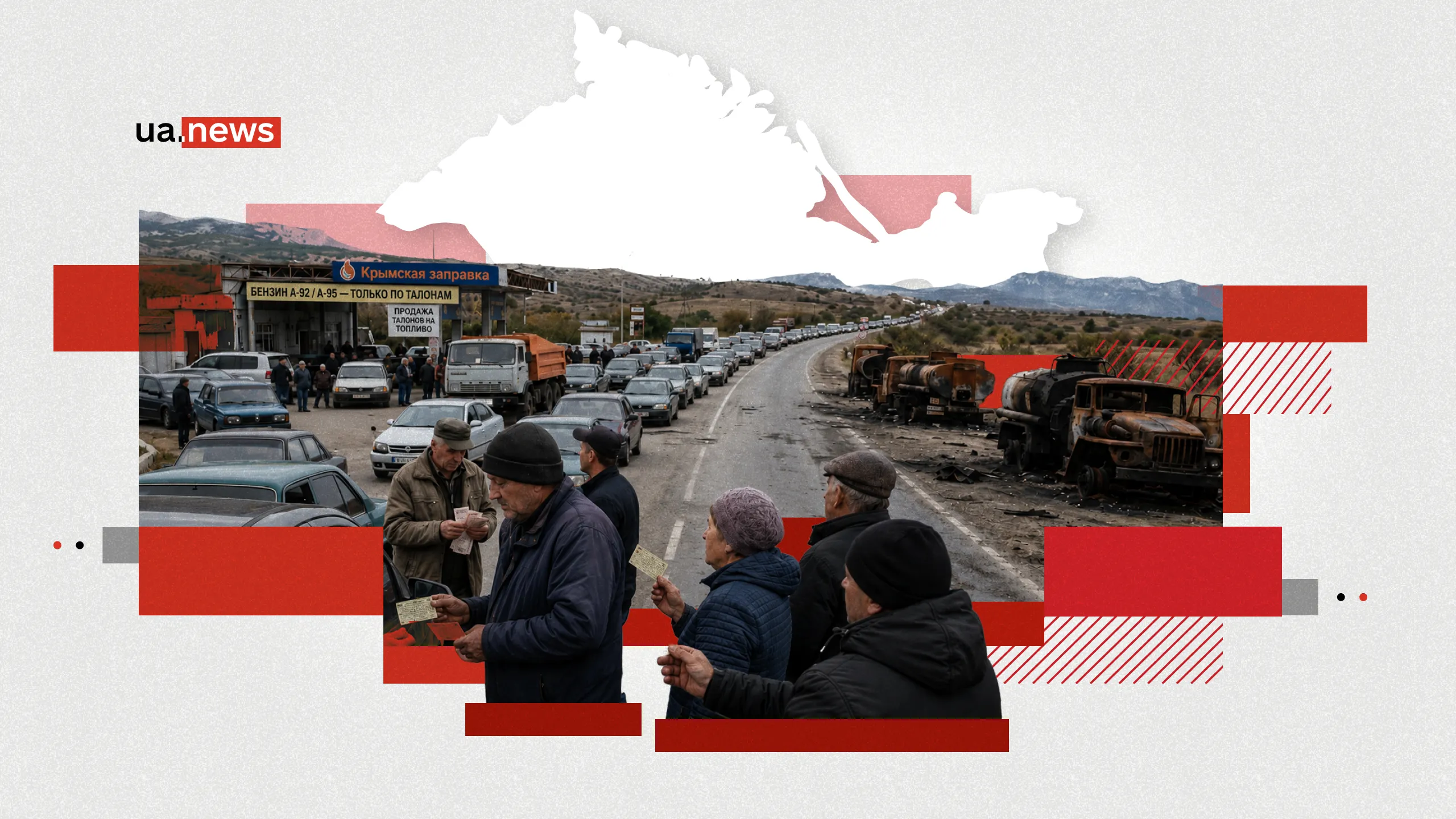
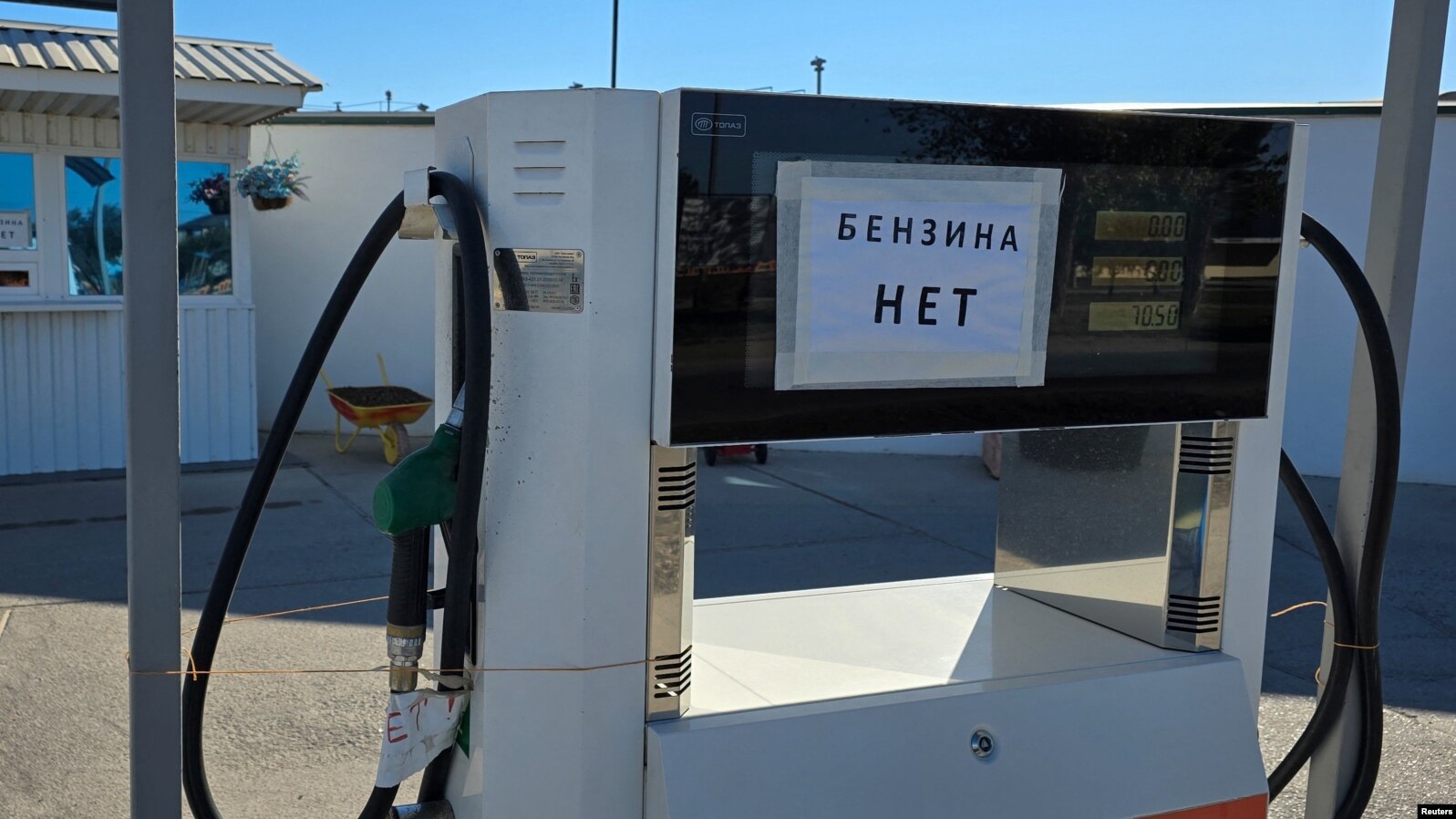
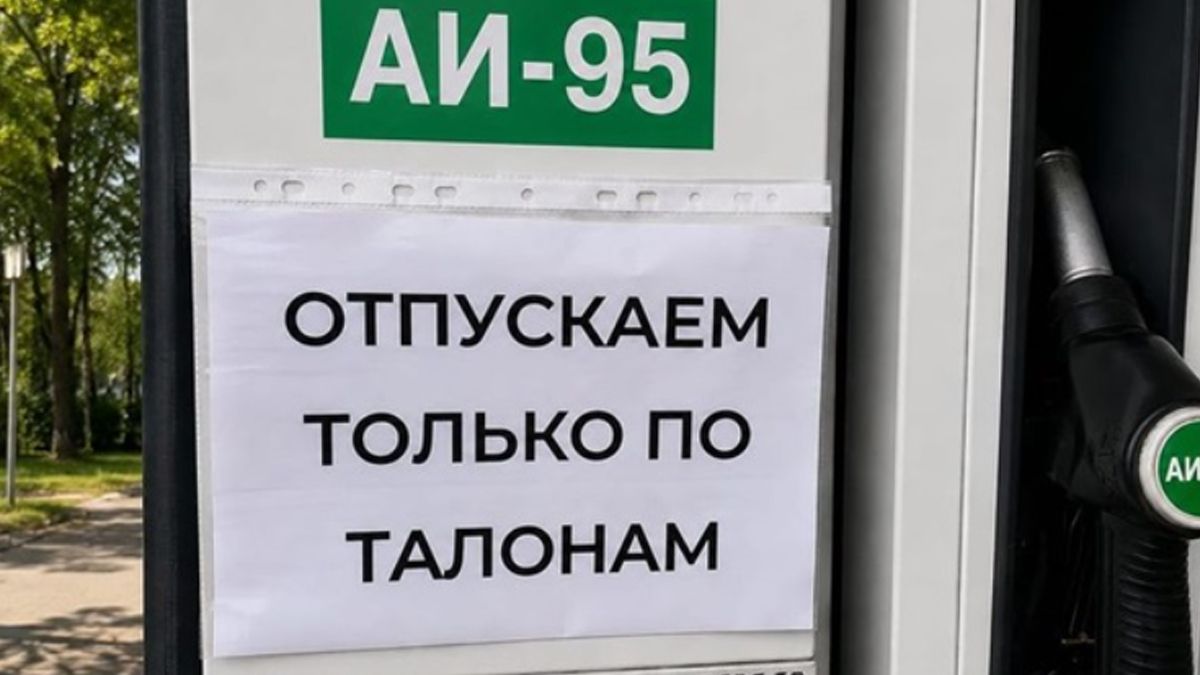
Simferopol, early June 2026. At the entrance to the Crimean capital, drivers are greeted not by resort billboards, as was once the case, but by signs at gas stations reading “No fuel” or “Sales by coupon only.” Queues, the likes of which the peninsula hasn’t seen since the late Soviet era, have also become a daily reality. Crimea, which for all these years has been positioned by Russian propaganda as a showcase of a “return to the native harbor,” now operates under a chronic shortage of the most basic resource—fuel. And this is not a temporary glitch, but a direct consequence of the new reality of war, in which the peninsula’s logistics have proven critically vulnerable to a targeted campaign of disruption.
Even local officials do not hide the reason for what is happening, although they try to phrase it in vague terms such as “temporary logistical difficulties.” In reality, however, this is a systemic shift in the nature of the war.
Ukraine is implementing a strategy of so-called “middle strikes”—strikes by UAVs and medium-range missiles up to 200 kilometers behind the front lines. The targets are not only military facilities in the traditional sense, but also oil depots, transshipment points, transportation hubs, and routes along which fuel, equipment, and ammunition move from Russian territory to the occupied south of Ukraine and on to Crimea.
What is happening now on the temporarily occupied peninsula, why is it happening, and what can we expect in the future? UA.News investigated the issue.
“Novorossiya” in the Crosshairs
Until recently, the “Novorossiya” highway remained the key supply artery to Crimea—apart from the Crimean Bridge. It was supposed to become a symbol of a “land corridor” connecting the Rostov region with Crimea through the occupied territories of the Donetsk, Zaporizhzhia, and Kherson regions.
On paper, it looked like a large-scale infrastructure project providing an alternative to the Crimean Bridge. In practice, however, this road has turned into a zone of constant danger in recent weeks. Traveling on it has become dangerous not only due to direct drone strikes on fuel convoys but also because of systematic remote mining, which turns the restoration of normal logistics into a deadly quest.
It has come to the point where fuel truck drivers flatly refuse to go on runs without additional safety guarantees, which, of course, no one can provide. Insurance companies are raising rates to astronomical levels or simply pulling out of the operation. As a result, fuel supplies to the peninsula have dwindled to a critical minimum, and local authorities are forced to introduce a ration card system that brings back memories of the long-forgotten Soviet era of shortages.
The gasoline ration cards being issued in Crimea today are not merely a technical solution to a logistical problem. They are a sign of a profound structural shift and crisis.
For over 12 years, the peninsula integrated into the Russian economy precisely through logistical links: first the ferry crossing, then the Crimean Bridge, then the “land corridor.” Each of these links was considered reliable enough to meet the needs of the military, the civilian population, and the tourism sector. The Ukrainian “middle-strike” campaign, however, is simultaneously putting pressure on all these links, preventing any of them from operating at full capacity. The bridge remains under threat of attack, the “Novorossiya” highway is under constant fire from the Ukrainian Armed Forces, and the ferry crossing is too slow and also vulnerable. Taken together, this leads to an “island scenario”: when the peninsula is transformed into an island in a logistical and economic sense.
The island’s economy: three shaky pillars
Crimea has never been a self-sufficient region, neither as part of Ukraine nor as an occupied region of Russia. Its economic model after the annexation was based on three pillars: federal subsidies, tourist revenue, and military spending. All three are now under attack.
The federal budget is forced to simultaneously finance rising military spending, compensate for the consequences of attacks on oil refining infrastructure within Russia itself, and plug the holes in the regional budgets of the occupied territories. Tourist traffic, which was already declining due to the overall situation, now faces the simple impossibility of reaching vacation destinations. When a typical Russian family plans a road trip from Moscow to Yalta but realizes there is no guaranteed access to fuel along the entire route from Rostov to Simferopol, the trip is most likely canceled. Military spending, in turn, while remaining significant, does not create the multiplier effect for the local economy that could offset the collapse in civilian sectors.
The situation with tourism is particularly telling—the only sector that kept Crimea from being entirely self-sufficient, but at least somewhat less reliant on subsidies. Now that the tourist flow is under double pressure, this sector is shrinking. Job cuts, falling business revenues, and declining tax revenues—all of this is transforming Crimea from a mere subsidized region into a territory that no longer needs subsidies but requires direct financial support from Moscow. The federal budget will be forced to plug an ever-widening financial hole simply to maintain basic social stability and prevent a sharp decline in living standards amid general stagnation.
It is also worth taking a closer look at how the economic logic of this campaign works. The production of a medium-range strike UAV costs tens of thousands of dollars per unit. In contrast, defense against such drones requires the deployment of a layered air defense system, which includes expensive radars, anti-aircraft missile systems, ammunition for them, as well as the constant presence of on-duty forces. That amounts to many billions of dollars. In other words, the cost ratio is so heavily stacked against the Russian side. However, it is worth acknowledging that the same dynamic applies in reverse: in the event of similar Russian strikes against Ukraine.
Crimea as Putin’s sole “trophy”
Crimea holds a special place—and not just because of its geography. For 12 years after the annexation, it remained Putin’s only territorial “trophy” that did not turn into a complete “death zone.” Unlike Mariupol, Bakhmut, Avdiivka, and other Ukrainian cities captured at the cost of total destruction, Crimea was taken without a fight, without civilian casualties, with its infrastructure intact and a decent standard of living. This allowed the Russian authorities to use it for years as a showcase, as proof that the “return” supposedly brings peace and prosperity, rather than war and poverty.
The political capital gained from this contrast was enormous. Opposition Russian political scientists and sociologists call this effect the “Crimean consensus”: when Russians as a whole agreed to tolerate negative changes in their lives against the backdrop that, in exchange, Russia had received Crimea. Now, however, as kilometer-long lines for gasoline appear on the peninsula and tourists cancel their trips, this facade is beginning to crack and crumble like a house of cards. And all of this, incidentally, is happening just as Russia enters a new election cycle: this fall, the aggressor state faces elections to the State Duma.
The connection between the logistical collapse in Crimea and the domestic political situation in Russia is not straightforward, but it is still evident. Crimea has always been not just a region, but a symbol of “restoring historical justice,” Putin’s personal triumph, a focal point for consolidating power, and so on. Losing control over the situation in this territory—not even militarily, but purely economically—deals a blow to the legitimacy of the entire structure. If the government cannot even supply a small peninsula with basic gasoline, what can it actually do? This is a question that inevitably arises among parts of society, even despite total control over the information space.
This is where the “island” paradox arises. An island, in a political-economic sense, is a territory that requires constant external supplies, as it does not produce enough to be self-sufficient. Its viability depends entirely on the reliability of communications with the mainland. This is exactly what is happening with Crimea right now. Its strategic value as a military base is not going anywhere, but its economic and symbolic value are rapidly crumbling. It no longer projects an image of success, nor does it yield political dividends, and so on. Instead, it demands ever-increasing infusions of resources: financial, logistical, and military.
This process is protracted and has a cumulative effect. Every fuel depot destroyed, every fuel tanker intercepted on the “Novorossiya” highway, every day that gas stations are closed “for technical reasons”—all of this adds a brick to the wall that is gradually separating Crimea from mainland Russia. That is precisely why the Ukrainian campaign does not look like a series of isolated strikes, but rather like a strategic operation aimed at the gradual destruction of the enemy’s logistical infrastructure. Its goal is not so much to destroy everything at once as to create conditions under which the normal functioning of the economy and the military machine in the occupied territories becomes impossible or prohibitively expensive.
If we look at the situation more broadly, it becomes clear that the war is increasingly shifting to the rear areas. The front line, which has long been the main focus of attention, is losing its monopoly on determining the outcome of the war. Medium-range drones are blurring the line between the front and the rear, turning territories that were considered relatively safe just yesterday into potential battlefields. In this new reality, logistics, energy supply, and economic stability are becoming just as legitimate and important targets as military facilities themselves. And Crimea—due to its geographical location, symbolic significance, and structural vulnerability—has proven to be an ideal target for demonstrating this new logic of war.
For Ukraine, the stakes in this campaign go beyond purely military outcomes. Turning Crimea into an “island” is not just about making life difficult for the Russian forces. It is about demonstrating that control over territory without reliable logistics is conditional, that symbolic victories can turn into economic defeats, and that the security architecture built by Russia in the occupied territories has fundamental vulnerabilities.
In this sense, Crimea is truly becoming an “island”—not merely a piece of land cut off from the mainland, but an example of how a new type of war is changing the rules of the game for all parties to the conflict. And this island, by all indications, will only continue to expand its symbolic borders, at least as long as the war continues.


