
The weather in Ukraine on July 22 will be warm and dry, while the Odesa region will experience a storm

On Wednesday, July 22, most regions of Ukraine will experience warm and dry weather. At the same time, forecasters are warning of thunderstorms, hail, and strong gusts of wind in the Odesa region. In Kyiv, comfortable daytime temperatures of +22…+24° are expected.
On July 22, forecasters predict calm weather in most regions—no precipitation and pleasant warmth. But there is an exception: brief showers and thunderstorms are expected at night in the east of the country and during the day in parts of the southwestern region. The most severe conditions are expected in the Odesa region: moderate rain, heavy in places, thunderstorms, and in some areas, hail and squalls with wind speeds of 15–20 m/s are forecast.
At higher altitudes over most of the territory, cool air from the northwest will move in, shaping the weather accordingly. It will be warmest in the south and east of the country, where a warmer air mass prevails. Winds will be from the west and northwest at 5–10 m/s. Temperatures will range from 10–15° at night to 21–26° during the day; in the southern and eastern regions, temperatures will range from 14–19° at night to 24–29° during the day.
On Wednesday, July 22, Kyiv will see variable cloud cover, with no precipitation expected—the capital will enjoy a pleasant day without any unexpected surprises. The wind will be westerly, 5–10 m/s. Temperatures in the Kyiv region will range from 10–15° at night to 21–26° during the day; in Kyiv, temperatures will range from 13–15° at night to 22–24° during the day.
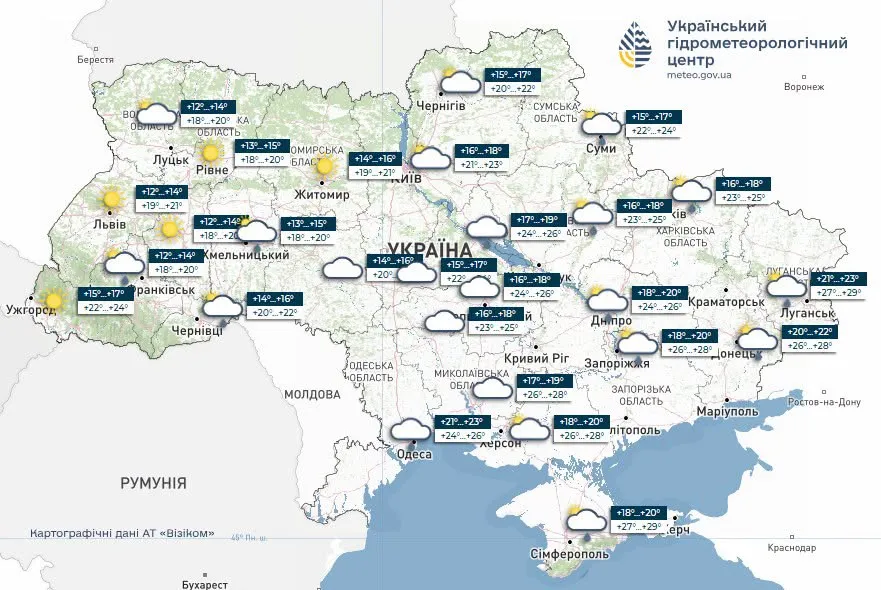
This information is provided by the “Ukrhydrometcenter.”
Heat up to +37° will return to Ukraine: weekly weather forecast.
As a reminder, Belgium has recorded a sharp rise in mortality amid a severe heat wave. According to the Sciensano Institute of Public Health, the excess mortality rate reached 47%—the highest figure since records began in 2000.
Earlier, average nuclear power generation in France fell below 33 GW, the lowest level in the past nine months, due to the need to limit output at nuclear power plants. The reduction was caused by a critical rise in the temperature of the water in the rivers used to cool the reactors.


