
Russian billionaires are facing unprecedented pressure from the Kremlin – Bloomberg
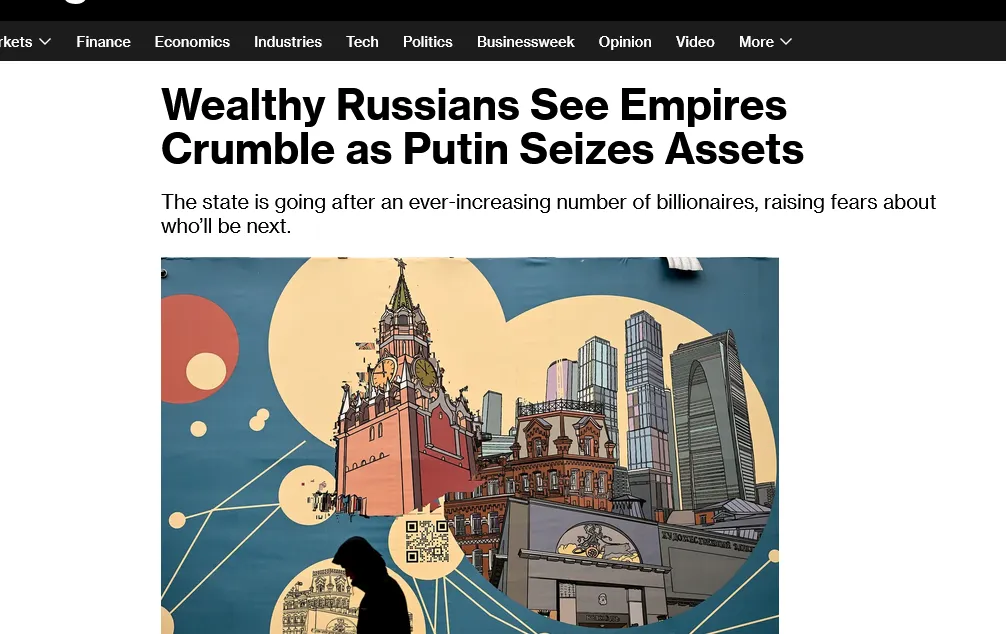
The confiscation of private property, disguised as “anti-corruption lawsuits,” has become a key tool for the Kremlin to dismantle old business empires and redistribute national wealth in favor of the state and new, business groups more loyal to Vladimir Putin.
A striking example of this new wave of expropriation is the fate of Vadim Moshkovich, founder of Rusagro, one of Russia’s largest agricultural holdings. In May 2026, a Moscow court ruled to confiscate 49% of his family’s stake in the company.
Prosecutors accused the businessman of illegally combining public service with commercial interests while serving in the Federation Council (2006–2014) and of using his political status to enrich himself. Just a few days after the court’s verdict, Moshkovich’s agricultural assets were promptly transferred to the management of the state-owned Rosselkhozbank. Earlier, in March 2025, the tycoon was also arrested in a separate fraud case.
This precedent caused panic among the Russian elite, as at least five of the twenty richest Russians on the Bloomberg Billionaires Index had previously held or still hold government positions. For example, Roman Abramovich served as governor of Chukotka for seven years, and Andrei Guryev (who controls PhosAgro) was a member of the Federation Council. And although their cases are not yet under investigation, the scale of nationalization in Russia is frightening big business. Last year alone, the Kremlin confiscated assets worth an astronomical 1.1 trillion rubles ($15.1 billion) in corruption cases—eight times more than in 2024, and accounts for one-third of all state confiscations in 2025.
The catalyst for this process was a 2024 ruling by the Russian Constitutional Court, which determined that the standard 10-year statute of limitations does not apply to the property of corrupt officials. And although in May 2026 the State Duma passed a law limiting the review of 1990s privatization to 10 years, this relaxation does not apply at all to anti-corruption lawsuits against former and current politicians. Even those considered models of loyalty are being targeted, such as 67-year-old Konstantin Strukov, a member of the United Russia party’s board and a Chelyabinsk deputy, from whom the gold mining company Yuzhuralzoloto and an agricultural business were seized last year.
Against the backdrop of colossal military spending and sanctions, the Kremlin is skillfully employing a “carrot-and-stick” approach, compelling oligarchs to voluntarily share their wealth. According to sources, billionaire Senator Suleiman Kerimov agreed during a closed-door business meeting with Putin in March to “donate” 100 billion rubles ($1.4 billion) to the state budget. At the same time, the state itself is facing serious difficulties in managing the seized assets. Due to the toxicity of the assets and the lack of real investors, privatization auctions are failing en masse: the authorities have already failed twice to sell Strukov’s expropriated stake in Yuzhuralzoloto, and Moscow’s Domodedovo Airport was previously sold for only half its initial value.
Bloomberg reports on this.
In recent years, a wave of asset confiscations in corruption cases in Russia has swept up officials, security forces, and judges, bringing the state assets worth about 100 billion rubles.
The Nikulinsky District Court of Moscow ruled to confiscate the property of former First Deputy Minister of Defense of the Russian Federation Ruslan Tsalikov and his family, totaling approximately $61 million.


