
A 20-kilometer exclusion zone forced the Russians to hide their heavy equipment
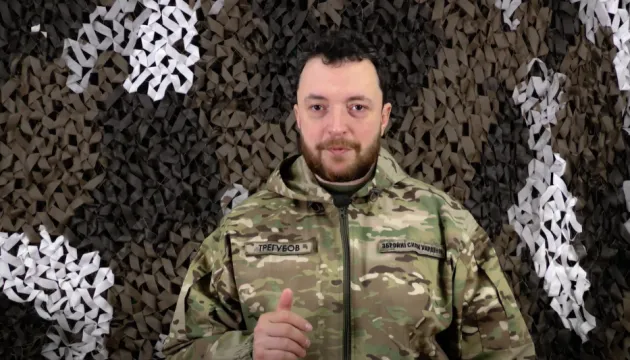
Russian troops rarely use tanks and other heavy equipment directly during assaults. Viktor Tregubov, a spokesperson for the Joint Forces Operation, explained that this is due to a 20-kilometer “kill zone” where Ukrainian drones can destroy equipment even as it approaches positions.
Russian troops continue to use heavy equipment, but it is appearing less and less frequently during assaults themselves. According to Viktor Tregubov, spokesperson for the Joint Forces Operation, the main reason is the large strike zone that has formed due to the active use of drones.
He said that Russian tanks are now difficult to use in direct assaults. Even if the equipment remains on the battlefield, they try not to bring it close to Ukrainian positions. “Heavy equipment is effectively not being used. That is, it exists, but if we record that a single tank was damaged in a day, that’s a lucky strike, and most likely, it was damaged somewhere deep in the rear,” Tregubov explained.
He added that vehicles can be struck at a considerable distance from the front line. Various weapons, including drones, can be used for this purpose.
Tanks cannot withstand drone attacks
Tregubov noted that fiber-optic-controlled drones have become the main problem for Russian heavy equipment. Such drones are more difficult to jam with electronic warfare systems because they receive their signal via a physical cable. That is why standard tank defenses do not guarantee protection against this threat. “As for them actually driving tanks or heavy equipment directly into an area—no, because the 20-km exclusion zone isn’t protected from fiber-optic-controlled UAVs by any ‘mangal,’” the spokesperson said.
The military refers to the metal structures installed above armored vehicles to protect against drones as “mangals.” However, according to Tregubov, such protection does not solve the problem against fiber-optic UAVs. Because of this, Russian troops are having to change their tactics. Tanks and other heavy equipment remain in service, but they are used much less frequently for direct assaults. “Under our current conditions, tanks have quietly moved not even to the second, but already to the third tier,” Tregubov noted.
A tank attack requires specific conditions
According to the spokesperson, the Russians may still attempt to use heavy equipment for an offensive. But this requires a well-planned operation and conditions under which Ukrainian drones cannot operate effectively. Tregubov explained that even a single tank in the strike zone can become a target for several drones at once. Therefore, to use armored vehicles effectively, the Russians would have to organize massive cover. “In a situation where several drones are simultaneously hunting tanks in the area of operations, they can only be used to advance if they are accompanied by a massive escort,” he said.
This isn’t just about the tanks themselves. Such an offensive would require planning the entire operation in advance, ensuring cover for the vehicles, and choosing a moment when Ukrainian drones are unable to operate at full capacity. Weather remains a separate factor. Strong winds, heavy rain, or other adverse weather conditions can affect the operation of drones. “And in addition to preparing the entire operation, you also have to time it right with the weather so that the drones are practically grounded,” Tregubov noted.
He even cited an extreme example in which the weather could significantly limit the use of UAVs. “If a storm with a tornado were to hit here, then the Russians would likely be able to deploy heavy equipment a bit more,” the spokesperson said.
Thus, the active use of drones significantly complicates the deployment of Russian armored vehicles directly on the battlefield. Russian troops are forced to take the wide area of effect into account and try to conduct assaults in a way that does not expose tanks and other heavy equipment to drone strikes. Tregubov discussed this on television.
Russian troops attacked the Zaporizhzhia region 928 times over the past 24 hours. As a result of strikes on the Zaporizhzhia district, one person was killed and three others were wounded. Fifty-five settlements in the region came under fire.
Russian forces attacked a monastery in the village of Chervonyi Mayak, in the Novorayska community of the Kherson region, using a drone. A 71-year-old clergyman was killed in the strike, and four other priests were wounded.
A 71-year-old clergyman was killed in the attack on the monastery in Chervonyi Mayak. Four other priests were wounded. Information about their condition may be updated.


