
95% of drone attacks occur on the front lines — Magyar
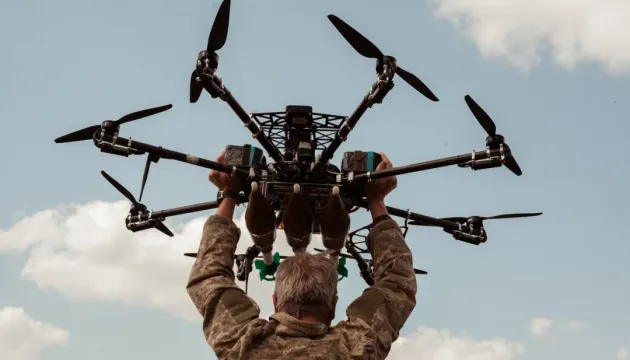
About 95% of Ukrainian drone attacks take place directly on the battlefield, while the rest are used for long-range strikes. This was stated by Robert Brovdi, commander of the Unmanned Systems Forces, known by the call sign “Magyar,” in an interview with the Belgian television channel VRT News. According to him, Ukraine also continues to ramp up drone production and combat use.
Most Ukrainian drones are used directly on the battlefield. According to Robert Brovdi, commander of the Unmanned Systems Forces, only about 5% of attacks target distant targets on Russian territory. “Only 5% are launched directly at the ‘swamps.’ That’s what the international community is watching. It’s always interested in something extraordinary, something far away. But the real war is happening right under our feet,” Brovdi said.
Thus, according to his estimate, about 95% of drone attacks take place on the battlefield. This primarily involves combat against Russian troops and equipment directly on the front lines. More recent data, which Brovdi released earlier, also show a significant predominance of frontline operations. As of the end of July, over 95% of strikes by the Unmanned Systems Forces occurred within tactical depth near the line of engagement, while the share of strikes in Russia’s strategic depth accounted for about 0.5%.
The range of strikes is constantly increasing
Brovdi also stated that Russia no longer has any completely secure rear areas. “The psychological barrier of 2,500–3,000 kilometers has already been overcome. Moreover, everything depends on the pace of technological development,” said the SBS commander. According to him, technology is advancing so rapidly that new capabilities for drones may emerge even before the procurement cycle for previous-generation equipment is complete.
“Sometimes the procurement cycle for drones isn’t even complete yet, and there’s already new technology that surpasses the previous one,” Brovdi explained. In recent months, the Ukrainian Unmanned Systems Forces have indeed conducted operations far beyond the front lines. In particular, there have been reports of strikes on Russian energy facilities, military infrastructure, and vessels of the Russian “shadow fleet.”
People Remain the Most Important Resource
Despite the rapid development of drones, Brovdi emphasized that technology cannot fully replace military personnel. “Our people are our most important asset, our number one priority. First, we have far fewer people than the Russian Federation. Second, our tactics are different: the enemy attacks, and we defend ourselves. We defend ourselves with drones; they attack with manpower,” the commander said.
According to him, it is people who control the drones, make decisions, and determine how to use new technologies on the battlefield.
Ukraine produces millions of drones
Brovdi also spoke about the scale of Ukrainian production. According to him, Ukraine currently manufactures about 10 million drones per year. At the same time, production and the number of combat deployments continue to grow. “We are constantly increasing the scale of their deployment,” noted the SBS commander.
He also cited figures specific to his unit. “My group alone—which makes up 2.5% of the Ukrainian army—carries out over 250,000 combat sorties per month. A quarter of a million per month, and that number is rising,” Brovdi said. According to figures he had previously cited, in July alone, units of the Unmanned Systems Forces carried out more than 230,000 combat missions—128,000 strike missions and 102,000 reconnaissance missions. During this time, more than 53,000 enemy targets were struck.
Thus, according to Brovdi, long-range strikes on Russian territory are only a small part of the work carried out by Ukrainian drones. Their primary role remains on the front lines, where drones are used daily for reconnaissance, destroying military equipment, and engaging Russian troops. He discussed this in an interview with the Belgian broadcaster VRT News.
Over the past 24 hours, on September 26, there were 221 combat engagements on the front lines. Russian troops carried out 90 airstrikes, dropped 289 guided bombs, deployed over 10,000 kamikaze drones, and carried out 2,729 artillery strikes. The highest number of attacks was recorded in the Kostiantynivka and Pokrovsk directions—26 in each.
Over the past day, the Russian army lost approximately 1,690 soldiers. Total Russian personnel losses since the start of the full-scale war have reached approximately 1,528,970. During the same period, Russian forces lost dozens of pieces of military equipment, including 57 artillery systems, seven armored vehicles, and eight tanks.
On the night of September 27, Russia attacked Ukraine with 170 strike drones, including 76 jet-powered ones. As of 7:30 a.m., air defense forces had shot down or neutralized 147 enemy drones. At the same time, strikes were recorded at 18 locations, and debris from downed targets fell at eight additional sites.




