
The attack on Moscow demonstrated the effectiveness of Ukraine's air defense overload tactics – CNN
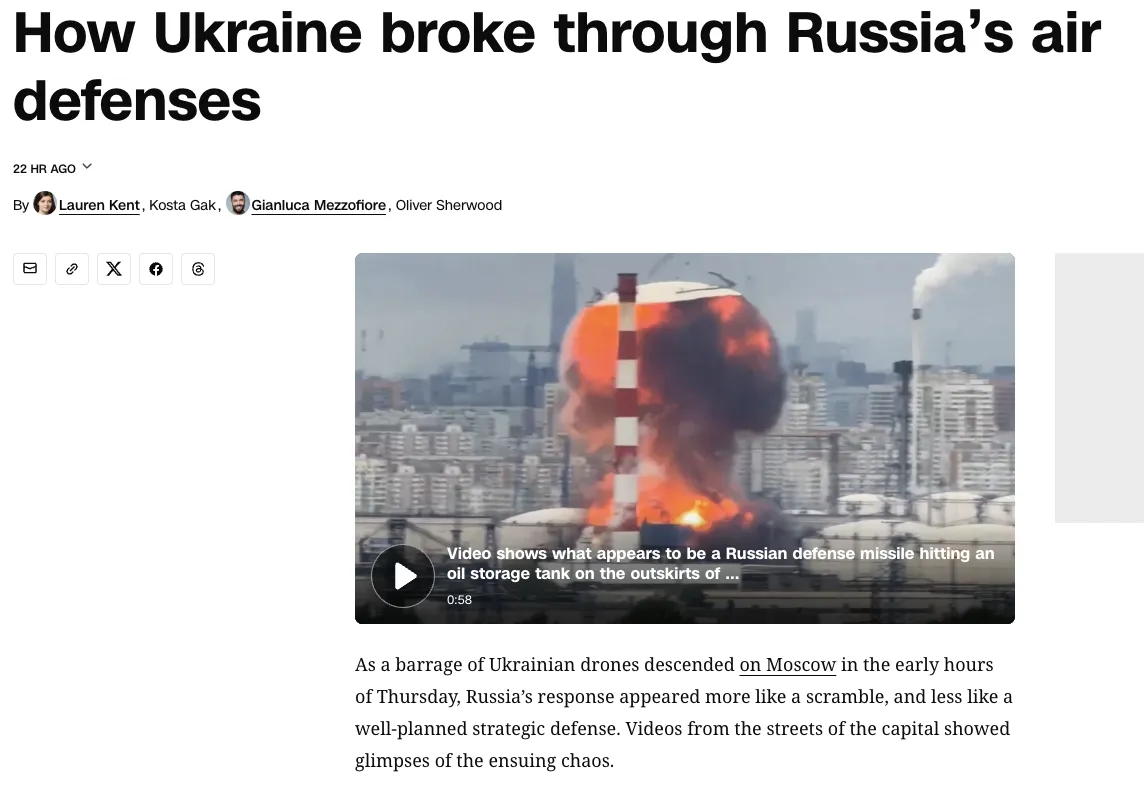
The Ukrainian drone attack on targets in the Moscow region, which took place on Thursday, was yet another example that, according to CNN, confirms the effectiveness of Ukraine’s strategy of overwhelming Russian air defense systems through the massive use of drones.
Markus Schiller, an arms expert at the Stockholm International Peace Research Institute, commenting on the chaotic response by the Russian military as well as the instances of Russian anti-missile systems striking their own targets, emphasized that “there have been repeated instances in Russia where older systems were not 100% reliable.” He added that Ukraine, meanwhile, has been continuously improving its offensive capabilities “for many years,” CNN reports.
Stu Ray, a senior analyst at McKenzie Intelligence Services, drew attention to the Russian military’s use of man-portable air defense systems on a busy highway, which, in his view, indicates a hasty, improvised, and unprofessional response to the attack.
“The complete lack of traffic control and the use of military equipment at an incredibly close distance from civilian vehicles and people confirm this assessment,” Ray said.
Thomas Whittington, a research fellow in military studies at the Royal United Services Institute for Defense Studies in London, emphasized that “Russian air defense systems simply do not fulfill their intended purpose; this is quite obvious. They are not designed to detect, track, and repel this type of attack (drone attacks—ed.), and unless there are fundamental changes to the Russian air defense system, the situation will remain the same.”
He added that international sanctions have limited Moscow’s access to the technologies needed to develop new systems capable of countering these drone attacks.
“Even if you were able to ramp up production, you would simply be ramping up production of missile systems that don’t even fulfill their intended purpose,” said Whittington, emphasizing that drones “may appear on radar, but there’s a huge difference between detecting something on radar and achieving what we call ‘quality tracking.’
At the same time, he noted that hundreds of UAVs approaching from different directions require massive coordination on the part of Russia’s integrated air defense systems, which, according to Whittington, “is not happening properly.”
Ukraine’s repeated massive long-range attacks have led to speculation that Russia may also be running low on defensive ammunition. Experts note that it is difficult to determine the exact stockpile of such ammunition because such information is kept secret. However, stocks will inevitably run out if Ukrainian shelling remains intense and frequent, the publication adds.
On the night of June 20, the Ukrainian Defense Forces struck a number of Russian military targets. Among the targets was a bridge near Henichesk, which the occupiers use to transport equipment and resupply their troops between occupied Crimea and the southern front.
In Taganrog, Russia, a power substation that supplied electricity to the “Atlant-Aero” defense enterprise was damaged. As a result, production lines involved in the manufacture of drones were disrupted.


