
Donbas Remains the Main Obstacle for Russia — OSINT Data
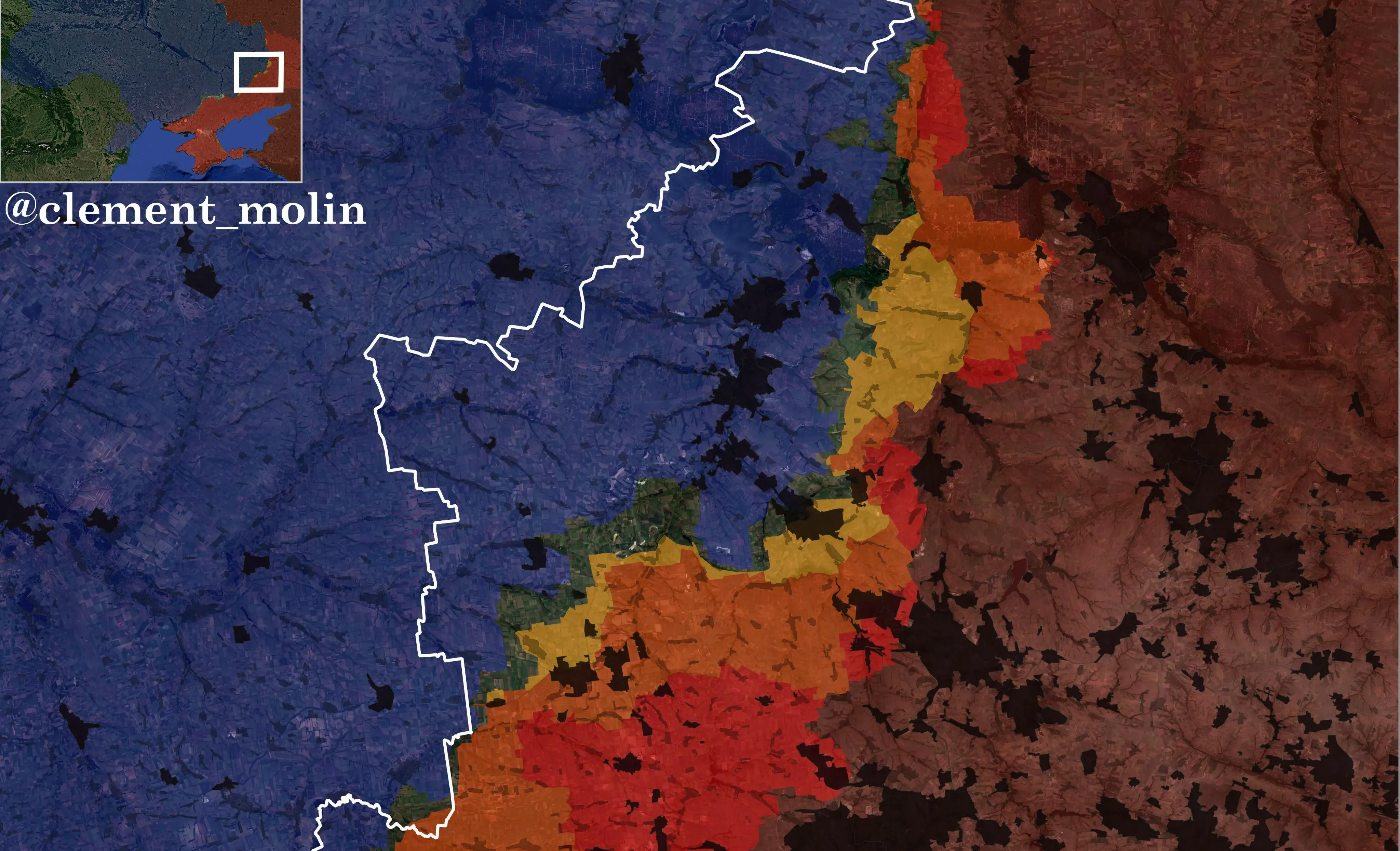
OSINT researcher Clément Molen believes that the fight for Donbas remains Russia’s primary military objective, but Moscow has not succeeded in quickly seizing the entire region. In his assessment, Ukrainian fortifications continue to hold back the Russian advance, and fighting for individual cities, villages, and industrial areas could go on for years.
Donbas remains one of the main theaters of the Russian-Ukrainian war. Russia has concentrated a significant portion of its forces and firepower there since the start of the full-scale invasion. OSINT researcher Clément Molen analyzed the situation in the region from a strategic perspective. He notes that since May 2022, the capture of the Donbas has effectively become Russia’s primary military objective.
In his assessment, Moscow has been attempting to break through Ukrainian defenses and establish control over the entire industrial region. However, in several years, the Russian army has not managed to implement this plan quickly.
Russia has spent years on the offensive
The fighting in the Donbas has been ongoing for many years. The current phase of this war is a continuation of hostilities that began back in 2014. According to Molen, Russian troops have been trying for the past three years to advance through territory that is well-prepared for defense. Ukrainian fortifications, industrial facilities, mines, urban areas, and complex terrain significantly complicate the offensive. Russian units are forced to expend a great deal of time and resources even to advance short distances.
“For three years, Russia has been trying to advance through heavily fortified terrain,” the researcher notes. In his view, this is one of the main reasons why the Russian offensive has not resulted in a rapid capture of the entire Donbas.
The breakthrough near Pokrovsk did not solve the problem
According to Molen, a turning point occurred in May 2024. Russian forces managed to achieve a breakthrough in the southwestern part of the Donbas and unblock the axis near Pokrovsk. This created new opportunities for the Russian army to advance. However, even this success did not mean that the path to a complete capture of the region was open.
Russian forces still have to overcome Ukrainian defenses, literally one settlement at a time. The advance has not turned into a single major breakthrough that would allow them to quickly sweep through the entire region. That is precisely why, according to Molen’s assessment, the Russian army has to fight hard battles for every city, village, and industrial facility. Among the examples he cites are Toretsk, Pokrovsk, and Kostiantynivka. The battles in these areas have dragged on for a long time and have demonstrated just how difficult it is for Russian troops to overcome Ukrainian defenses.
Which cities remain under Ukrainian control
Molen notes that Russia is seeking to capture the last major cities in the Donetsk region that remain under Ukrainian control. Among them, he mentions Kramatorsk, Sloviansk, Druzhkivka, Dobropillia, and Lyman. These cities are of not only military but also strategic importance. They are connected by transportation routes and form part of Ukraine’s defense system in the Donbas.
Kramatorsk and Sloviansk are particularly important. They form one of the key urban areas in the Donetsk region and remain vital centers of Ukrainian defense. Russian troops are attempting to advance in their direction, but to do so, they must first overcome the defenses on the outskirts of the cities. Therefore, capturing each subsequent settlement may require significant forces and time.
Why Ukraine Is Holding Onto Donbas So Tightly
For Ukraine, the Donbas is significant not only because of its cities and territories. One of the main factors is geography. The Donbas effectively creates a powerful defensive barrier against a further Russian advance into central Ukraine. If Russian troops gain control of the entire region, new directions for potential advancement will open up before them. This includes, in particular, the agriculturally developed areas of central Ukraine and the Dnipropetrovsk region.
That is precisely why Ukraine’s defense in the Donetsk region is significant far beyond the Donbas itself. “For Ukraine, the rest of the Donbas remains important for one main reason—it is heavily fortified and prevents the continuation of an offensive into Ukraine’s central agricultural regions and the densely populated and wealthy Dnipropetrovsk region,” Molen explains. In other words, even individual cities and defensive positions in the Donetsk region can serve as a kind of shield for other regions.
The Donbas has already been severely devastated
Over the years of war, the region has suffered immense destruction. Cities, villages, industrial enterprises, mines, and transportation infrastructure have all been affected. Part of the Donbas population has been killed or forced to leave their homes. Many settlements are now without functioning businesses or basic infrastructure.
The areas where the heaviest fighting took place have been particularly affected. There, Russian strikes have reduced entire neighborhoods to rubble. At the same time, the Donbas remains of significant industrial importance. The region has historically been one of Ukraine’s main industrial centers, home to mines, steel mills, and machine-building enterprises. Therefore, the war has dealt a blow not only to the population but also to the region’s economic foundation.
Russia will have to fight for every settlement
Molen predicts that the battle for the Donbas may remain very slow. The reason is simple: it is not enough for the Russian army to simply approach the next city. It must advance through fortified positions, populated areas, and other defensive lines. In urban areas, the advance becomes particularly difficult. Buildings, industrial facilities, underground structures, and other objects can be used as defensive positions.
Mines and industrial areas also create additional problems for advancing troops. Because of this, even a small section of territory can turn into a protracted battle. According to Molen, this is exactly what has already happened in the Toretsk and Pokrovsk areas. Now a similar scenario could play out in other areas. “Russian forces have to fight for every city, every village, and every mine,” the researcher notes.
Why the Water Issue Could Become Critical
Molen also highlights the long-term significance of water resources. In his view, even if Russia captures most of the Donbas, it will face the challenge of rebuilding the region. Large volumes of water are required to operate industry and mines.
That is precisely why control over areas near the Dnieper River and access to its water resources could be of strategic importance to Russia. This means that potential Russian plans may not be limited to the current front line. If Moscow truly intends to rebuild Donbas’s industry on the scale typical for the region, it will need resources and infrastructure beyond Donbas itself. At the same time, this is the researcher’s strategic assessment, not a confirmed plan by the Russian military leadership.
The battle could last for years
Molen believes that the battle for Donbas could remain one of the longest and bloodiest campaigns of this war. Russia continues to try to capture Ukrainian cities in the Donetsk region, but has yet to achieve a quick result. The Ukrainian army is using defensive lines and challenging terrain to slow the advance.
At the same time, even the loss of a single city will not automatically mean the fall of the entire region. New defensive lines, settlements, and fortifications will remain in place. “The battle for Donbas will remain one of the longest and bloodiest battles in history,” Molen predicts. In his assessment, the fighting could continue city by city. And even if Russia manages to advance further, this does not guarantee it rapid control over the entire region.
For Ukraine, holding onto the Donbas remains crucial not only because of the territory itself. The Ukrainian defense here is holding back the further advance of Russian troops toward the central regions and Dnipropetrovsk Oblast. Therefore, the future of the Donbas will depend not only on the situation around individual cities, but also on how long Ukraine can hold its defensive lines and what resources Russia is willing to expend to continue its offensive. This is reported by OSINT researcher Clément Molen.
Earlier, Zelenskyy called for strengthening Ukraine’s air defense and protection against ballistic missiles via PURL.
The occupiers have intensified their attacks in the Kupiansk direction.
As a reminder, Russia attacked warehouses and energy infrastructure in the Odesa region.
Earlier, drones struck Ozon logistics centers in two regions of the Russian Federation simultaneously.
Drones also attacked Krasnodar and caused a fire at a warehouse.
Earlier, warehouses caught fire in Akulovo, near Moscow.


