
A photo circulating in Russia purporting to show the aftermath of Oreshnik's strike on Bila Tserkva turned out to be fake

A number of Russian propaganda outlets have circulated an AI-generated satellite image of the airfield in Bila Tserkva, which allegedly shows damage caused by the use of the "Oreshnik" missile system.
Astra reports on this.
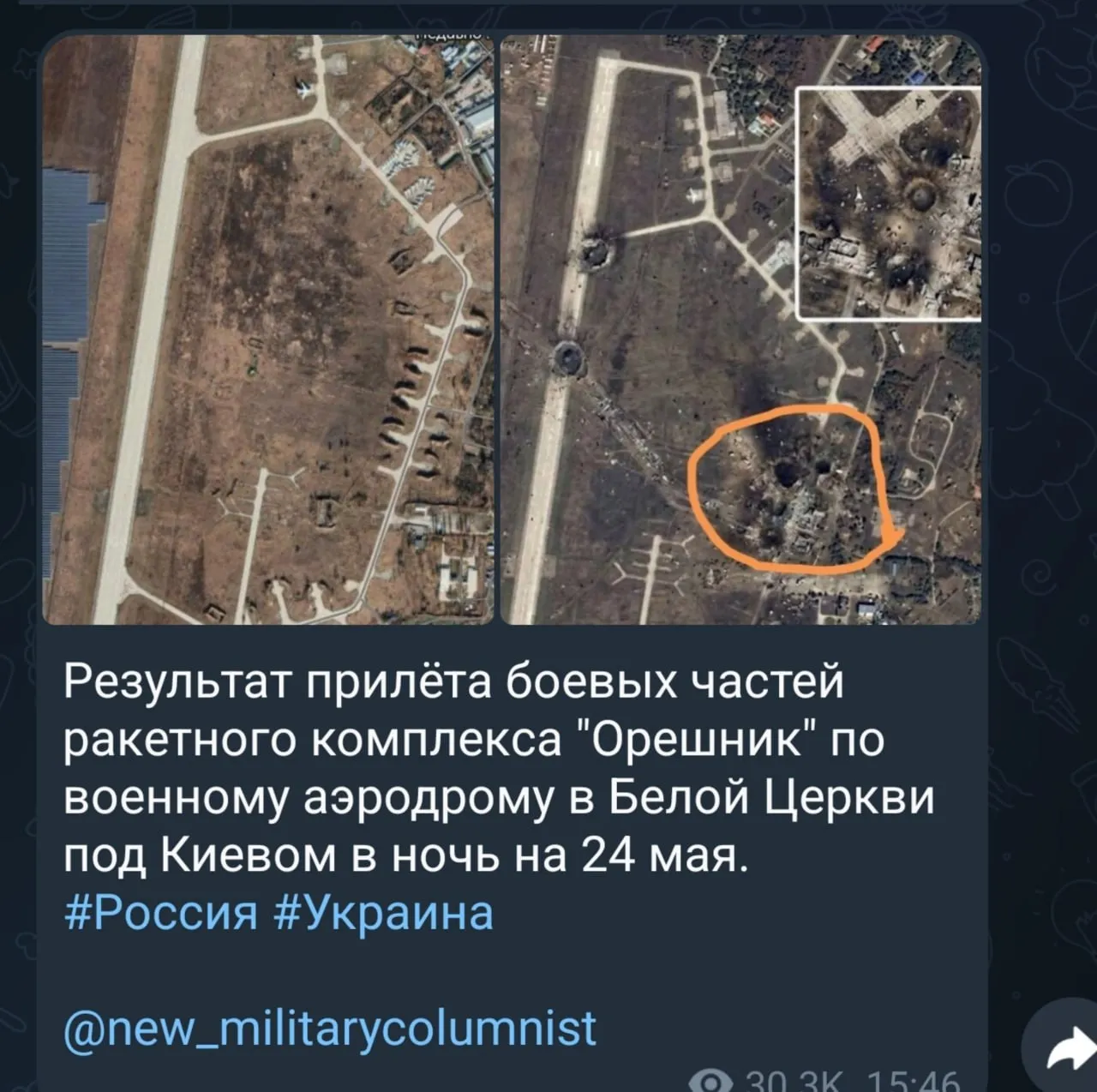
The fake images were published by pro-Russian channels such as “Voenny Obozrevatel,” “Major Grom,” Divgen, and “Ramzay.” The authors of these resources claimed that two strikes hit the runway to prevent the airfield from being used as a staging airfield, and they marked a hit on an underground military facility in orange.
Subsequently, the forgery of the satellite image was publicly acknowledged even within the Russian military segment of Telegram. In particular, the channel Fighterbomber, which is close to the Russian Air Force, called this image a “crudely drawn fake” and urged the creators to think bigger, while the resource “Informal Informant” described the post as “neuro-nonsense.” Despite the debunking of the image, the author of the Fighterbomber channel confirmed that on May 24, Russia launched two “Oreshniks” at Ukraine and expressed confidence that the second system allegedly hit its target precisely in territory controlled by the Ukrainian Armed Forces.
At the same time, independent experts and researchers cast doubt on the propagandists’ version of the geography and results of the strikes. OSINT analysts thoroughly examined video footage from cameras in the temporarily occupied city of Donetsk during the attack on Kyiv, which clearly shows the fall of six characteristic “Oreshnik” submunitions. Based on this and other data, analysts at the Institute for the Study of War suggest that the second Russian missile may have actually fallen on Russian-controlled territory 40 kilometers from the front line, where the positions of the occupying forces were directly located.
According to the Ukrainian Prosecutor General’s Office, in Bila Tserkva, a garage cooperative and a business were damaged by the Oreshnik strike, and the target was most likely a local airfield.
A satellite image of the aftermath of the “Oreshnik” strike near Kyiv, widely circulated in Russia, turned out to be fake
A number of Russian propaganda outlets circulated a fake satellite image of an airfield near Kyiv, which allegedly shows damage caused by the use of the “Oreshnik” missile system. The original source is not cited in the text provided, but the fake images were published by pro-Russian media outlets such as “Voenny Obozrevatel,” “Major Grom,” Divgen, and “Ramzay.” The authors of these outlets claimed that two strikes hit the runway to prevent the airfield from being used as a staging airfield, and they marked the strike on an underground military facility separately in orange.
Subsequently, the forgery of the satellite image was publicly acknowledged even within the Russian military segment of Telegram. In particular, the channel Fighterbomber, which is close to the Russian Air Force, called this image a “crudely drawn fake” and urged the creators to think bigger, while the resource “Informal Informant” described the post as “neuro-nonsense.” Despite the debunking of the image, the author of the Fighterbomber channel confirmed that on May 24, Russia launched two “Oreshniks” at Ukraine and expressed confidence that the second system allegedly hit its target precisely in territory controlled by the Ukrainian Armed Forces.
At the same time, independent experts and researchers cast doubt on the propagandists’ version of the geography and results of the strikes. OSINT analysts conducted a detailed analysis of video footage from cameras in the temporarily occupied city of Donetsk during the attack on Kyiv, which clearly shows the fall of six characteristic “Oreshnik” submunitions. Based on this and other data, analysts at the Institute for the Study of War suggest that the second Russian missile may have actually fallen on Russian-controlled territory 40 kilometers from the front line, where the positions of the occupying forces were directly located.


