
Russia's sham elections were marred by fraud — CPD
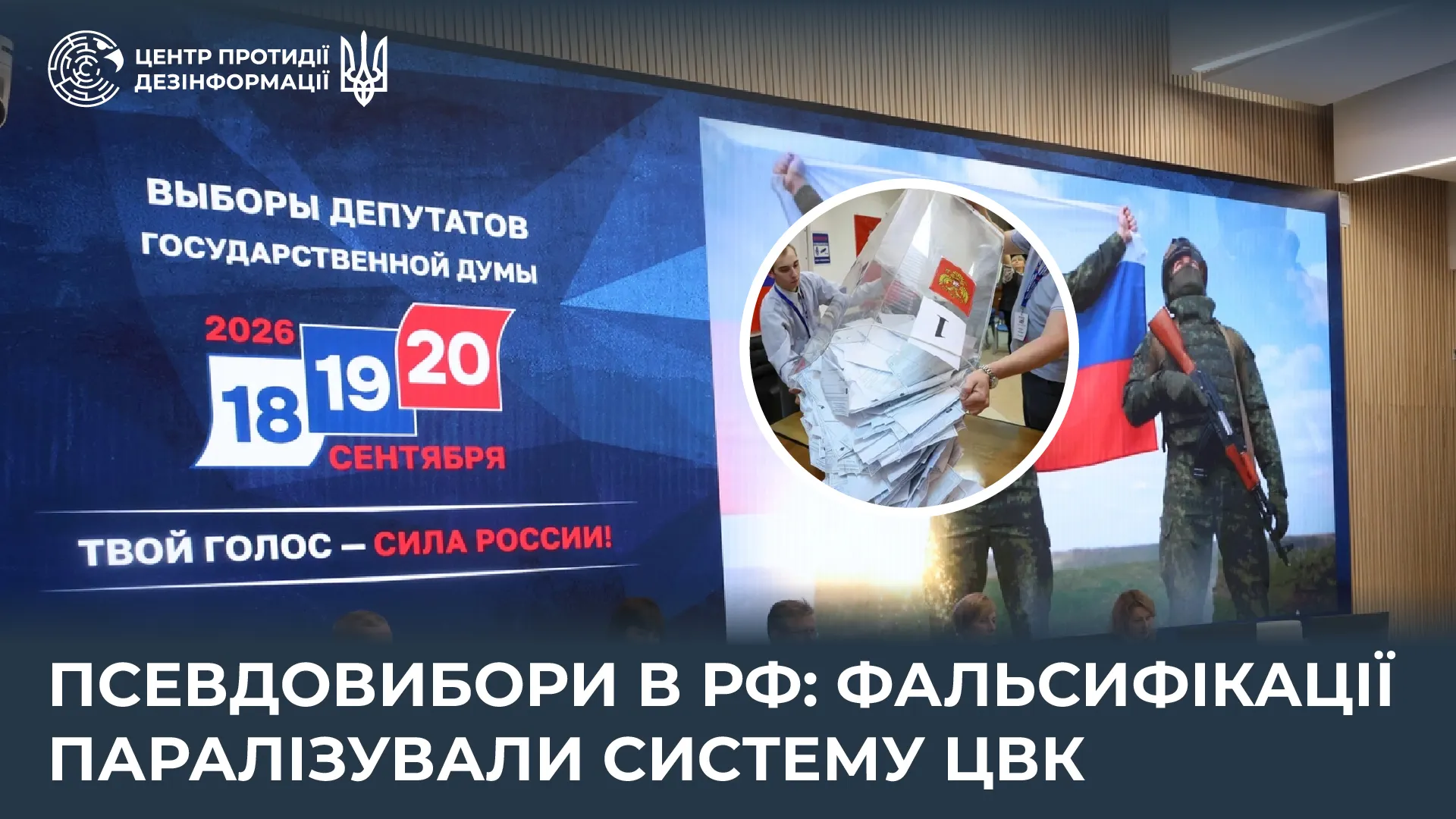
The Center for Countering Disinformation has reported widespread manipulation during the Russian State Duma elections, particularly in the temporarily occupied territories of Ukraine. The Center claims that the Russian system attempted to create a picture of voter turnout and support for pro-government candidates that suited the Kremlin’s interests. At the same time, the Central Election Commission of the Russian Federation approved the final results of the State Duma elections on September 25, so claims that the results were not available a week after the vote are now outdated.
The Center for Countering Disinformation under Ukraine’s National Security and Defense Council stated that the elections to the Russian State Duma were accompanied by manipulations and an information campaign aimed at creating the appearance of legitimacy for the process. Voting in Russia took place on September 18–20, 2026. The Russian authorities also organized illegal voting in the temporarily occupied territories of Ukraine. Ukraine and international law do not recognize such actions as legitimate.
The Center for Political and Democratic Studies (CPDS) stated that the Russian side attempted to create a desired picture of voter turnout and support for the ruling party. According to the Center, this narrative was promoted particularly aggressively through propaganda media and other Russian-controlled information outlets. The CPD links these “fabrications,” in particular, to voter turnout figures and voting results. The Center asserts that at the local level, there may have been attempts to manipulate the figures to meet predetermined targets.
At the same time, it is important to clarify the timeline. On September 25, 2026, Russia’s Central Election Commission officially certified the results of the elections to the State Duma of the 9th convocation. According to official Russian data, voter turnout was 59.8%, and “United Russia” won 349 out of 450 seats. Therefore, the delay in tabulating the final results cannot in and of itself be used today as evidence that the Russian electoral system failed to complete the count. The final results were announced five days after the conclusion of the main voting.
What the Center for Countering Disinformation Says About Manipulation
In its analysis, the Center for Countering Disinformation draws attention not only to the vote count results but also to the entire information campaign surrounding the election. According to the Center, between March and September 21, 2026, 29,370 posts related to the preparation and conduct of the Russian sham elections in the temporarily occupied territories of Ukraine were identified. The total number of views of these materials, according to the Center’s estimates, exceeded 44 million.
The highest level of activity occurred on September 18–20—the main voting days. Russian media outlets simultaneously disseminated reports on the opening of polling stations, voter turnout, the work of election commissions, preliminary results, and statements about alleged high support for the process. Separately, the CPD reported attempts to create the impression of massive public participation in the occupied territories. According to the Center, Russian propaganda depicted supposedly long lines and high activity at polling stations, even though voting took place under Russian occupation and without independent international observation.
The Center also noted that in the occupied territories, some people were forced to participate in the voting. In particular, there were reports of election commission representatives going door-to-door, accompanied by armed Russian military personnel.
Voting in the Occupied Territories
For the first time, Russia held elections to its State Duma in the temporarily occupied territories of Ukraine, attempting to portray them as part of its own political system. The Center for Political Analysis (CPA) notes that as early as March 2026, Vladimir Putin announced the alleged “participation” of residents of the occupied territories in the elections. Following this, Russian authorities gradually established the electoral infrastructure and launched a media campaign to support the voting process.
Russian sources also enlisted foreigners to create the impression of international recognition of the process. In the occupied parts of Luhansk and Donetsk regions, the CPD documented the presence of several foreign participants, whose positive comments were later used by Russian propaganda. At the same time, in the Zaporizhzhia and Kherson regions, as well as in Crimea, the Center for Political and Public Opinion Research found no evidence of the physical presence of specific “international observers” at polling stations during the voting.
What Results Did Russia Announce?
According to official data from the Russian Central Election Commission, “United Russia” won 349 seats in the new State Duma. The Communist Party of the Russian Federation (CPRF) received 37 seats, the Liberal Democratic Party of Russia (LDPR) — 23, “New People” — 19, and “Fair Russia” — 17. “Rodina” received one additional seat, and four seats went to independent candidates. These figures are the official results released by the Russian Central Election Commission. They do not in and of themselves confirm the Center for Political Analysis’s (CPA) assessments regarding possible manipulation, but it is precisely these assessments that pertain to the conditions under which the voting took place, the information campaign, and the methods the Center has identified for manipulating the results.
Separately, the CPD emphasizes that holding Russian elections in the temporarily occupied territories of Ukraine is illegal and has no legal consequences. In the Center’s view, Moscow uses such elections to further impose its own political and legal mechanisms on the occupied territories.
Thus, the CPD’s main conclusion does not concern the Russian Central Election Commission’s alleged inability to announce the results, but rather how exactly Russia organized and publicized the elections. The final results of the State Duma elections were approved on September 25, while the issue of possible fraud and illegal voting in the occupied Ukrainian territories remains a separate matter.




