
Defense forces are moving into a new phase in Crimea
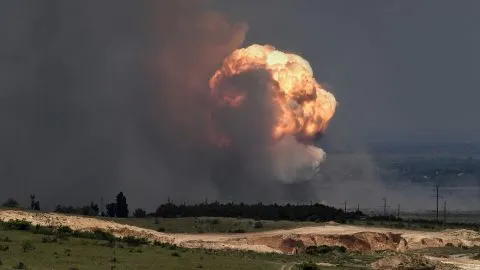
Roman Svitan, a reserve colonel in the Ukrainian Armed Forces and a military expert, believes that the Ukrainian Defense Forces’ operation in occupied Crimea has entered a new phase. According to him, following strikes against Russian air defense systems and logistics, the main targets are now military facilities, energy infrastructure, and infrastructure supporting the occupying forces.
The expert also noted that Russian military personnel are increasingly camouflaging their equipment and cargo as civilian transport. At the same time, he emphasized that this does not change the situation and does not guarantee the security of the occupiers’ military logistics.
Roman Svitan, a reserve colonel in the Ukrainian Armed Forces, flight instructor, and military expert, stated that the Ukrainian Defense Forces’ operation in occupied Crimea has entered a new phase. According to Svitan, the Ukrainian military is now gradually shifting the priorities of its strikes.
Whereas the main goal previously was to weaken Russian air defenses and disrupt logistics, military facilities belonging to the occupiers will now increasingly come under direct attack.
The Russians are changing their tactics
The expert explained that the first phase of the operation is nearly complete. Its main objective was to destroy Russian air defense systems, radars, and other assets that control the airspace. The second phase is underway in parallel.
Its goal is to make it as difficult as possible for Russian forces to resupply their troops in Crimea. According to Svitan, Ukrainian long-range drones are already keeping the main routes used by the Russians to transport equipment, ammunition, and personnel under fire control.
As a result, the occupiers have begun to change their tactics. “They’re already afraid to drive out. Recently, they’ve switched to civilian vehicles, but we’ve also started destroying the trucks the Russians use to transport military equipment,” Svitan said. According to him, Russian troops are increasingly camouflaging their vehicles.
In particular, they use ordinary civilian trucks or even repaint them red to make them look like fire trucks or vehicles belonging to Russia’s Ministry of Emergency Situations. The occupiers also use medical service vehicles to transport military equipment, the expert said. “They even use special services and medical vehicles to transport various types of military equipment, including drones. We need to pay attention to this,” the military expert emphasized.
The third phase has begun
According to Svitan, following the weakening of Russian air defense and strikes on logistics, the Ukrainian military is moving on to a new phase of the operation. “The third phase has begun—the direct destruction of military facilities. There are about 150 of them, not counting dual-use facilities,” he noted. These include military bases, ammunition depots, equipment locations, command posts, and other facilities used by the Russian army.
According to the expert, special attention should be paid to the energy infrastructure. He explained that Russian military logistics in Crimea depend heavily on the railway system, which, in turn, requires a stable power supply. That is why striking power plants and power grids could significantly complicate the transport of military equipment and ammunition.
Not Just Crimea
Svitan believes that such tactics should be applied not only in the temporarily occupied Crimea. According to him, the occupied areas of the Kherson, Zaporizhzhia, Donetsk, Luhansk, and Kharkiv regions should also remain under fire control. In addition, he considers it important to strike at Russian rear areas that support the occupying forces. “We now have the opportunity to scale up these strikes. We need to focus particularly on the Bryansk direction, because the Russians may try to stretch the front line and create new strongholds,” the expert said.
He also highlighted the Kursk and Belgorod sectors as important, and among Russia’s deeper rear regions—the Rostov, Voronezh, and Bryansk regions. In his view, constant pressure on military logistics should prevent Russia from building up reserves, rapidly redeploying equipment, and opening new directions of attack. At the same time, it is worth noting that these assessments represent the opinion of military expert Roman Svitan. Officially, the Ukrainian Defense Forces have not commented on information regarding possible phases of operations in occupied Crimea. He discussed this on Channel 24.
Since the start of the day, Russian troops have attacked the positions of Ukrainian defenders 55 times. The situation remains most tense in the Sloviansk and Kostiantynivka sectors, where the heaviest fighting is taking place.


