

A Blow to Russian E-Commerce: How Attacks on Wildberries Warehouses Are Affecting the Russian Economy
22 July 2026 15:35Over the course of several days, Ukrainian long-range drones carried out a series of strikes against the logistics network of Wildberries, Russia’s largest online marketplace. On the night of July 18, 2026, large warehouse complexes in Elektrostal, Moscow Oblast, and Kotovsk, Tambov Oblast, were attacked.
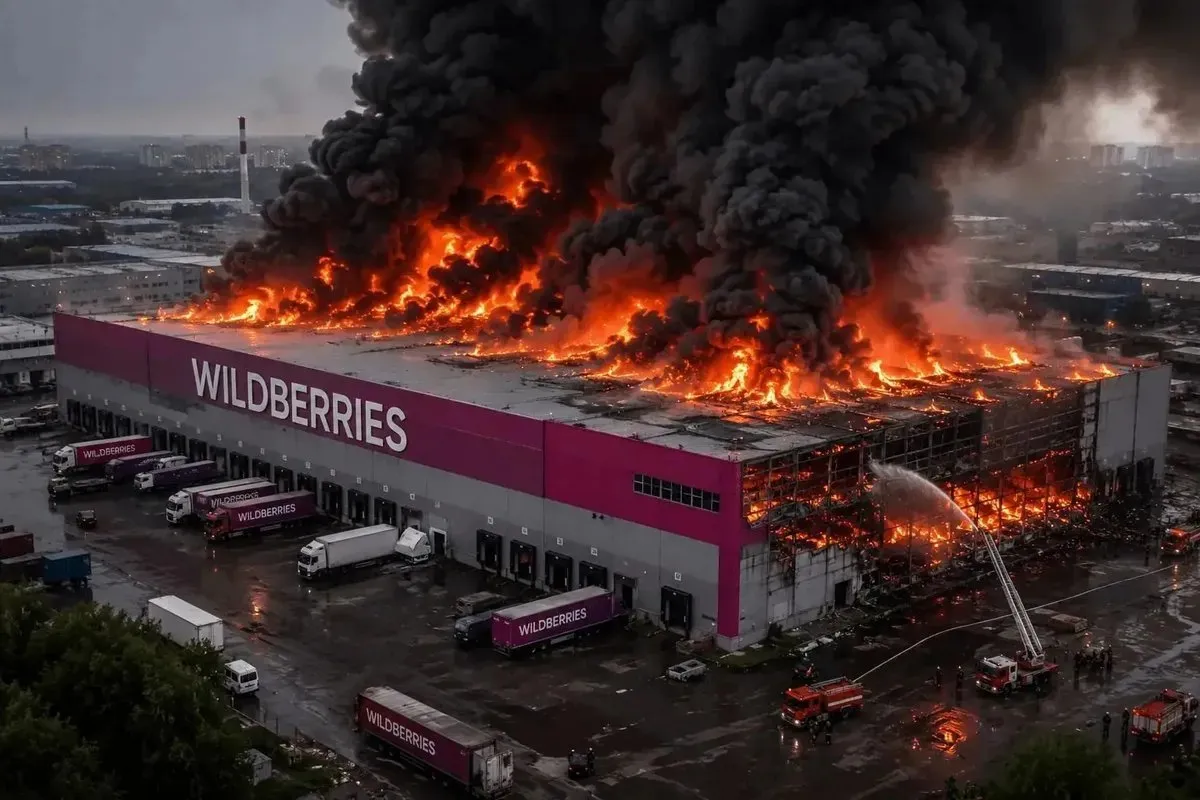
Large-scale fires broke out at both facilities, destroying part of the premises, equipment, and goods.
As early as July 22, Wildberries reported new strikes—this time targeting logistics facilities in Krasnodar and Nevinnomyssk. A major fire broke out at the warehouse in Krasnodar, and more than 100 firefighters and aircraft were deployed to extinguish it.
Thus, within a few days, at least four facilities belonging to a single company in different regions of Russia came under attack. This suggests not isolated strikes, but a possible campaign against major logistics centers in the Russian Federation.
UA.News explains why Wildberries’ warehouses may have become targets of Ukrainian strikes, what damage the company and its sellers have suffered, and whether such attacks are capable of impacting the Russian economy.
What Is Wildberries and Why Is It Important to Russia
Wildberries was founded in 2004 by Tatiana Kim, formerly known as Tatiana Bakalchuk. Initially, the company sold clothing online, but later evolved into a general-purpose marketplace. Today, it sells electronics, home appliances, building materials, groceries, auto parts, cosmetics, and industrial goods.

Wildberries is the largest e-commerce operator in Russia. Over one million sellers operate through the platform, and the company processes more than 20 million orders per day. In 2025, the volume of Russian online commerce grew by 28% and reached 11.5 trillion rubles.
Together with its competitor Ozon, Wildberries controls the vast majority of the Russian marketplace market. According to analysts’ estimates, Wildberries’ market share in 2026 could be around 45%, while Ozon’s could be approximately 32%.
The company has effectively become a ready-made infrastructure for small businesses. Entrepreneurs do not need to create their own online store, rent a warehouse, hire couriers, or process payments themselves. They simply transfer their goods to the marketplace, and Wildberries handles storage, advertising, order fulfillment, and delivery.
The company’s co-founder, Vladislav Bakalchuk, previously described the business’s dependence on warehouse capacity. He claimed that a shortage of approximately four million square meters of warehouse space takes trillions of rubles out of circulation, since without storage space, goods cannot be sold.
His remarks were part of a corporate conflict with Wildberries’ management, so the figures he cited cannot be considered an independent assessment. However, he explained the underlying principle of the system clearly: sales volume and sellers’ revenue depend directly on the availability of warehouse space.
Therefore, damage to a single large complex affects more than just the building’s owner. Entrepreneurs, transportation companies, couriers, pickup point operators, and customers all feel the consequences.
Why Ukraine Might Have Targeted Wildberries’ Warehouses
Following the strikes on July 18, Ukrainian President Volodymyr Zelenskyy stated that the targeted logistics complexes were linked to the supply of sanctioned components needed by Russia to manufacture drones and navigation equipment.
According to him, these facilities were used to transport electronics and dual-use goods, which were then utilized by the Russian military-industrial complex.
There is currently no independent confirmation of exactly what cargo was stored in the destroyed facilities. At the same time, Wildberries openly sells goods that can be used both in the civilian sector and on the front lines: radios, antennas, batteries, fiber-optic cables, electronic circuit boards, cameras, thermal imaging equipment, and navigation modules.
Military journalist Sergey Ausländer drew attention to the reaction of pro-war Russian authors following the fires. According to him, they themselves began asking where they would now be able to buy drones and fiber-optic cable. Ausländer cited the supply of the active military through a regular marketplace as an indicator of problems with Russian military planning.
This reaction does not prove that all the goods in the warehouses were intended for military use. However, it shows that Russian units, intermediaries, and volunteers do indeed use civilian e-commerce platforms to purchase equipment needed at the front.
The military significance of such complexes may lie not only in a specific shipment of equipment. A large warehouse brings together goods, automated sorting lines, transportation, digital tracking systems, and delivery routes. Damaging it simultaneously disrupts several supply chains.
Sellers may suffer the greatest losses
Wildberries’ direct losses consist of the value of buildings, equipment, and goods. However, a significant portion of the products inside legally belongs to independent sellers.
A seller transfers goods to the marketplace but receives payment only after a sale. If a shipment is destroyed in a fire, the seller simultaneously loses inventory, future revenue, and invested working capital.
Afterward, the seller must wait for an inventory assessment and a decision on compensation. To resume sales, they must purchase or manufacture a new batch of products at their own expense.
After the first series of attacks, Tetyana Kim acknowledged that the company was receiving many requests for compensation for damaged goods. She stated that it would take time to determine the exact extent of the losses. Wildberries did not disclose an official figure for the damages at that time.
However, Sergey Ausländer emphasized that Wildberries’ contract includes a clause under which damage to goods resulting from shelling, explosions, or falling drones may be recognized as a force majeure event, thereby exempting the marketplace from liability. If this provision is applied to specific cases, a significant portion of the losses may fall on the sellers themselves.
That said, the final decision on compensation will depend on the contracts, the results of the inventory check, and the company’s own position. Therefore, it is too early to claim that all business owners are guaranteed to receive no compensation.
Even the Turkish clothing manufacturer Koton has reported damage to its products. This shows that the consequences of the attacks have affected not only Russian small businesses but also foreign companies that continue to operate in the Russian market.
Do the losses really exceed one billion dollars?
Following the fires, estimates emerged that the combined losses of Wildberries and its sellers could exceed 100 billion rubles, or about $1.3 billion.
These estimates include the cost of buildings, automated equipment, and inventory.
However, this figure cannot yet be considered final. There is no complete inventory, no data on insurance coverage, and no conclusions as to which parts of the complexes can be restored.
British-Bulgarian analyst Stanimir Dobrev pointed out that Ukraine has posed a threat not only to a few individual buildings but to Wildberries’ entire business model.
In his view, following a series of attacks, the company must consider the possibility of repeat strikes on any major logistics center. As a result, the risk extends to the entire network, even if only a portion of the warehouses has been physically damaged.
That is precisely why it is not just the losses already calculated that are important. The company will have to spend money on backup capacity, security, insurance, and rerouting. These costs are not included in the initial estimate of the value of the burned goods but will affect the business for a long time to come.
How the Strikes Are Changing Russian Logistics
The first consequence is a disruption in deliveries. Orders from the affected warehouse must be rerouted through other centers, which increases the load on sorting lines, transportation, and employees.
The second consequence is rising costs. Wildberries must repair or build new facilities, purchase equipment, and strengthen security.
The third is higher insurance costs. Following repeated attacks, insurance companies may raise rates, impose additional requirements, or exclude war risks from policies.
The fourth is the need to decentralize inventory. Storing millions of units of goods in one place is cost-effective because it speeds up sorting and reduces transportation costs. But during regular attacks, such concentration creates the risk of losing a huge volume of products all at once.
Distributing goods across several smaller warehouses reduces the likelihood of total loss but makes logistics more complex and expensive. It requires renting more space and duplicating staff, equipment, and accounting systems.
Ultimately, these costs may be passed on to businesses through commissions, storage fees, and logistics charges, and to consumers through higher prices for goods.
Why Multiple Warehouses Won’t Cripple Russia’s Economy
Wildberries has an extensive network of logistics centers, tens of thousands of pickup points, and significant financial resources. The company is able to reroute some orders through other regions. Some sellers may be absorbed by Ozon, Yandex Market, and smaller platforms.
Therefore, the destruction of one or even several facilities will not immediately bring down Russia’s online retail sector.
The key factor is the frequency of the strikes. If warehouses, railway hubs, oil depots, industrial facilities, and energy infrastructure are constantly under attack, Russia will be forced to spread its air defense systems thin and spend increasingly more resources on repairs.
The Russian government may also need to support large companies through preferential loans, tax deferrals, or state guarantees. At the same time, a halt in sales means a reduction in tax revenues from businesses, employees, and consumer spending.
A single incident will not pose a critical problem for the federal budget. However, the cumulative damage across various sectors is gradually increasing the economic cost of the war.
The Most Tangible Impact on Russians
An ordinary Russian citizen may not notice the consequences of a strike on a remote military factory. An attack on an online marketplace, however, is felt directly: shoppers face order delays, canceled deliveries, out-of-stock items, or higher prices.
Sellers risk losing their products, their invested capital, and the ability to continue doing business. Warehouse and delivery workers may be left without jobs while the facility is being restored.
Sergey Ausländer believes that the economic consequences of such attacks will extend far beyond the warehouses themselves. He points to the risk of losses for business owners, job cuts in logistics, and the high costs of restoring high-tech sorting facilities.
A Strike Not Against a Store, but Against a Larger System
Attacks on Wildberries’ warehouses will not destroy Russia’s largest marketplace or cause the immediate collapse of the Russian economy.
However, they highlight a weakness in a business model where massive volumes of goods, equipment, and orders are concentrated in just a few large facilities.
If the attacks continue, companies will have to spend more on insurance, security, backup facilities, and alternative routes. Some of the costs will be borne by large businesses, some by sellers, and some may be passed on to buyers and the Russian government.
Therefore, the significance of the attacks on Wildberries lies not only in the cost of the goods already destroyed. They increase the overall risks of doing business in Russia and force the economy to divert more and more resources not toward development, but toward defense and recovery from the consequences of the war.




