
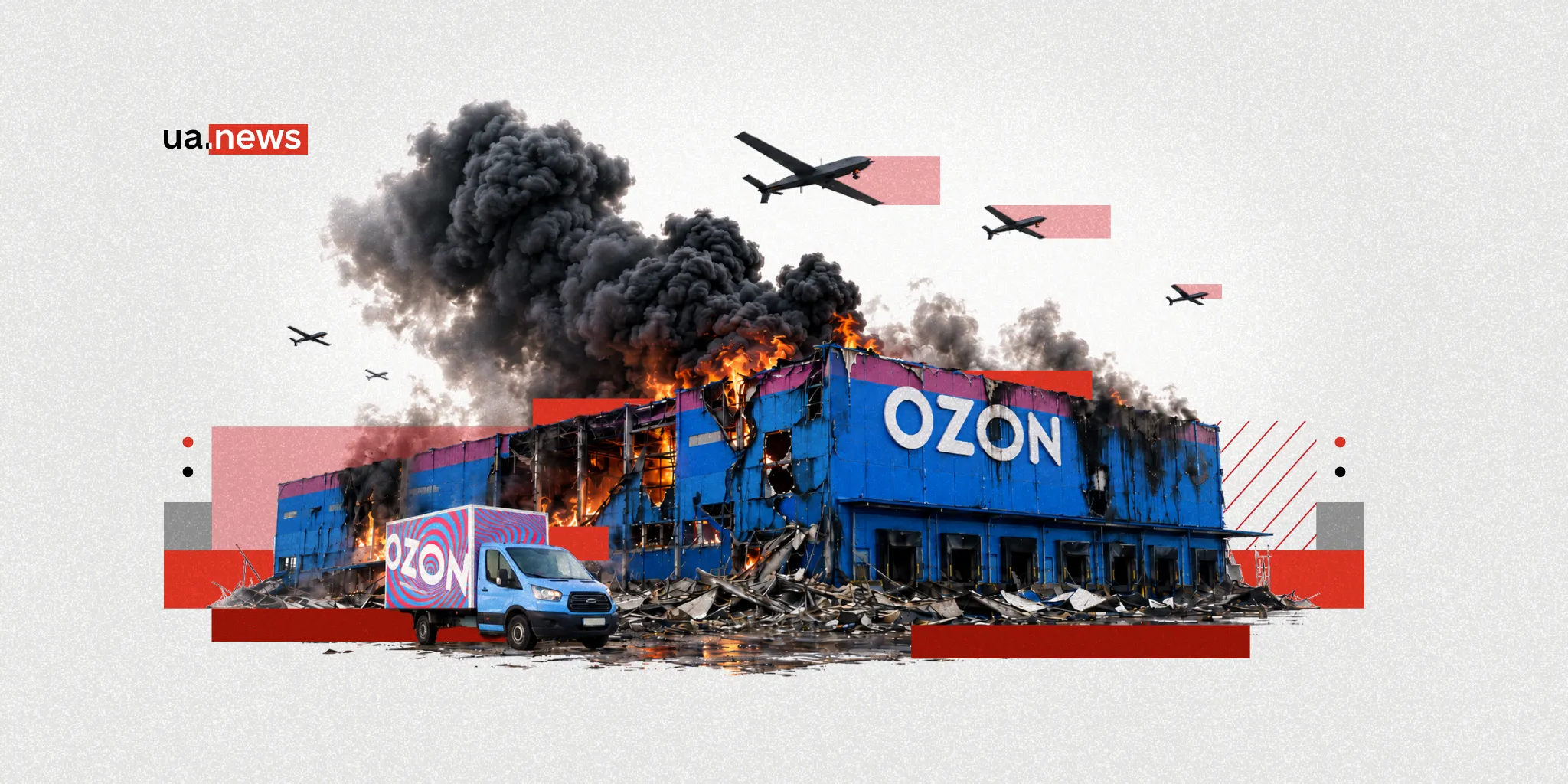
Ukraine is disrupting Russia's logistics: What the series of strikes on Ozon warehouses means
25 August 2026 14:26Just a few weeks ago, Wildberries was the main target among Russian marketplaces. Ukrainian long-range drones struck its large logistics complexes one after another, and by mid-August, according to the Ukrainian Ministry of Defense, seven of the company’s ten largest centers had been put out of commission.
Now Ozon—Russia’s second-largest online retailer—has joined that list. In just three days, six of its logistics facilities in various regions of the Russian Federation came under attack or faced an immediate threat of strikes.
While the focus had previously been on oil refineries, military facilities, airfields, and ammunition depots, now civilian and commercial logistics have also come under systematic pressure—a sector the Ukrainian side links to the supply of dual-use goods and the overall resilience of the Russian economy.
UNNews explains what Ozon is, how extensive its logistics empire is, where exactly the latest attacks were recorded, how they are affecting sellers and the marketplace itself, and whether such a campaign—combined with strikes on other sectors—could make continuing the war so costly for Russia that Moscow would be forced to engage in more serious peace talks.
What Is Ozon and How Big Has It Become
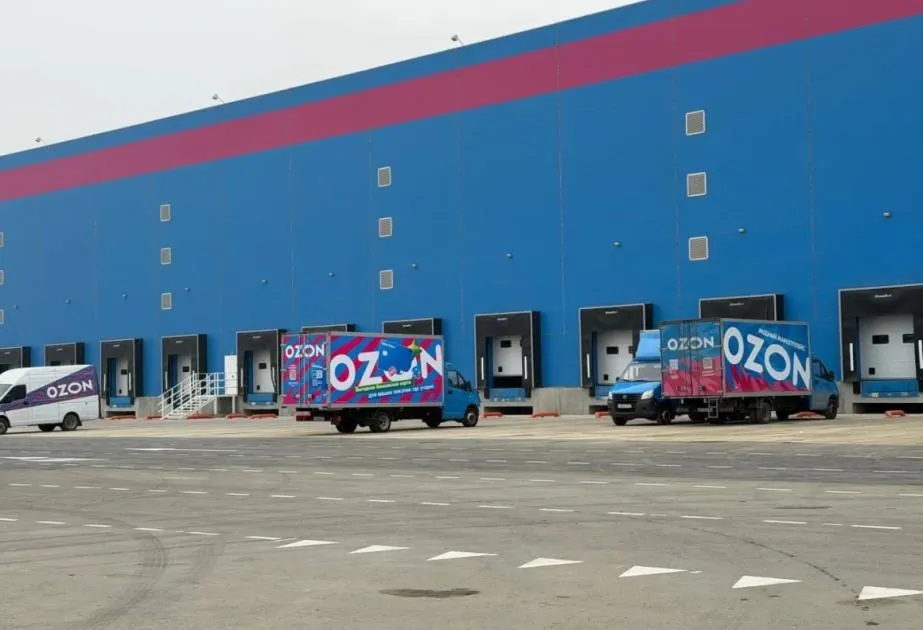
Ozon is one of Russia’s oldest online stores. It began operating in the late 1990s as an online bookstore, but over the following decades it evolved into a general-merchandise marketplace with millions of products and its own vast logistics system.
Today, Reuters ranks Ozon as Russia’s second-largest online retailer after Wildberries.
By the end of 2025, Ozon’s revenue had grown by 45% to 4.16 trillion rubles. At the current official exchange rate, that’s approximately $50 billion.
Over the course of the year, shoppers placed 2.48 billion orders through Ozon—a 69% increase from the previous year. The number of active shoppers exceeded 65 million, and by the end of the year, each active customer was making an average of more than three purchases per month.
In other words, this is no longer just a popular shopping site. Ozon has become part of Russia’s everyday infrastructure, used regularly by tens of millions of people.
Nearly $12 billion in revenue: how much does Ozon earn?
In 2025, the Ozon Group’s revenue grew by 63% to 998 billion rubles—approximately $12 billion.
The company’s adjusted EBITDA nearly quadrupled, reaching 156.4 billion rubles, or about $1.88 billion. At the same time, Ozon still ended 2025 with a net loss, but the size of that loss effectively plummeted: from 59.4 billion rubles a year earlier—approximately $713 million—to just 0.9 billion rubles, or about $10.8 million.
And in the fourth quarter, the company posted a net profit of 3.7 billion rubles—approximately $44 million. This stood in sharp contrast to the 17.6 billion rubles in losses for the same period the previous year.
In other words, the attacks began just as Ozon was turning its rapid growth into real profitability.
Five Million Square Meters: How Ozon’s Logistics Empire Works
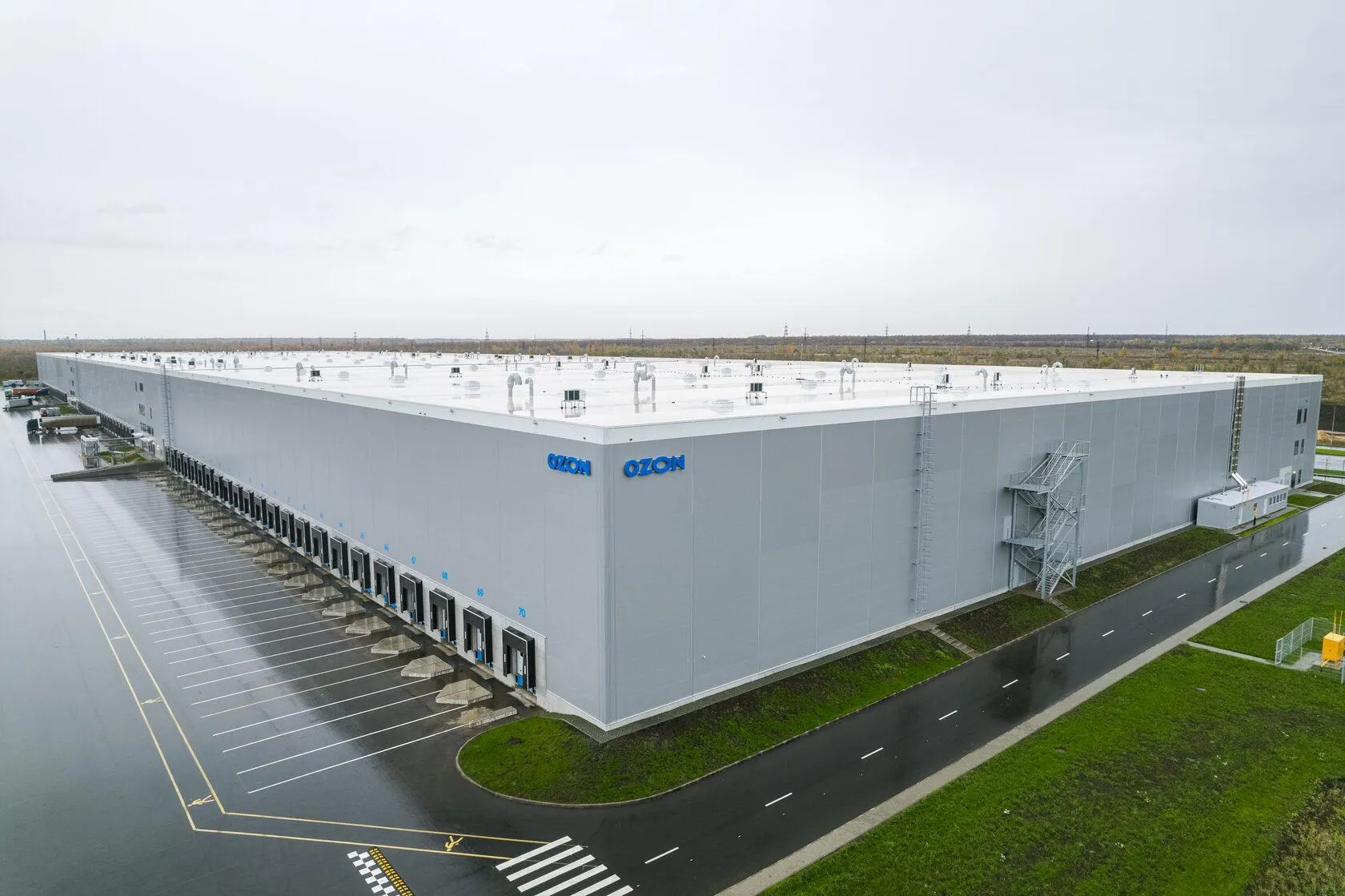
Ozon’s main strength is not its app—or even its brand—but its vast physical network, which enables goods to travel thousands of kilometers from seller to buyer in just a few days.
By the end of 2025, the total area of Ozon’s logistics infrastructure had reached nearly 5 million square meters. More than 83,000 partner pickup points were also connected to the platform.
According to industry analysts, by the summer of 2026, Ozon already had about 47 large fulfillment centers and over 170 sorting centers. The largest single warehouse accounted for about 2% of the company’s total warehouse space.
A fulfillment center is much more than just a regular warehouse full of boxes. Here, goods are received from sellers, inventoried, stored, order-picked, packed, and shipped onward to sorting centers, pickup points, or directly to customers.
Consequently, when a major hub ceases to operate, the problem isn’t limited to the cost of the damaged building. Goods must be rerouted, the workload shifts to neighboring centers, transportation distances increase, some items disappear from sale, and sellers have to reorganize their deliveries.
It all started in Chapaevsk: the first direct strike against Ozon
The first confirmed strike on Ozon’s logistics infrastructure occurred on the night of August 22.
Ukrainian drones attacked the Samara region. One of the strikes hit Ozon’s logistics center in Chapaevsk. After the attack, the center’s operations were suspended, and the company reported casualties. This was the first direct strike against Ozon following several weeks of systematic attacks on Wildberries.
Subsequently, the General Staff of the Armed Forces of Ukraine confirmed the destruction of the logistics hub. Ukrainian officials explained that systematic strikes on dual-use goods storage centers are intended to disrupt Russian logistics and put additional pressure on the Russian economy.
And the very next day, it became clear that the matter would not be limited to Chapaevsk.
Orenburg, Dagestan, the Caucasus: six centers in three days
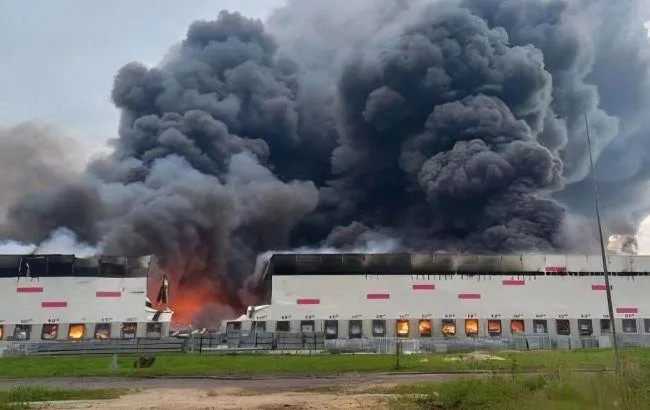
On August 23, drones struck the Ozon logistics center in the Orenburg region. The company evacuated more than 300 employees and temporarily suspended operations at the facility. According to reports from the Russian side, no one was injured during this attack.
On August 24, the scope of the attacks expanded dramatically. Ozon reported attacks or threats of attacks on four of its logistics facilities in southern Russia simultaneously. In particular, a fire broke out at the hub in Makhachkala, where people were injured and operations at the center had to be suspended.
A major fire was also reported at a logistics facility near Enema, and centers in Adygeysk and Nevinnomyssk were evacuated due to the threat of drones. In just three days, six Ozon facilities came under attack.
The stock market felt the impact of these events almost immediately: during trading on August 24, Ozon’s shares fell by more than 20%.
Before Ozon, there was Wildberries
To understand why the current strikes on Ozon are significant, one must look at what had been happening to its main competitor.
Starting in mid-July, Ukrainian forces began regularly attacking Wildberries’ large warehouses. As early as July 22, strikes on warehouses in Krasnodar and Nevinnomyssk were reported. In the days that followed, the list of damaged facilities continued to grow.
By mid-August, the Ukrainian Ministry of Defense stated that seven of Wildberries’ ten largest logistics centers had been put out of commission. Among them was a complex in the Koleshino Industrial Park in the Moscow Region, covering an area of approximately 250,000 square meters—the company’s largest warehouse.
The Ukrainian side claims that dual-use goods pass through these marketplace networks. There is no evidence that Wildberries is systematically integrated directly into the logistics of the Russian Ministry of Defense, however, pro-Russian volunteers regularly purchase goods there for the army, and similar purchases are also made through Ozon. Analysis of purchases for the Russian army via marketplaces
How Russian sellers are restructuring their operations following the attacks
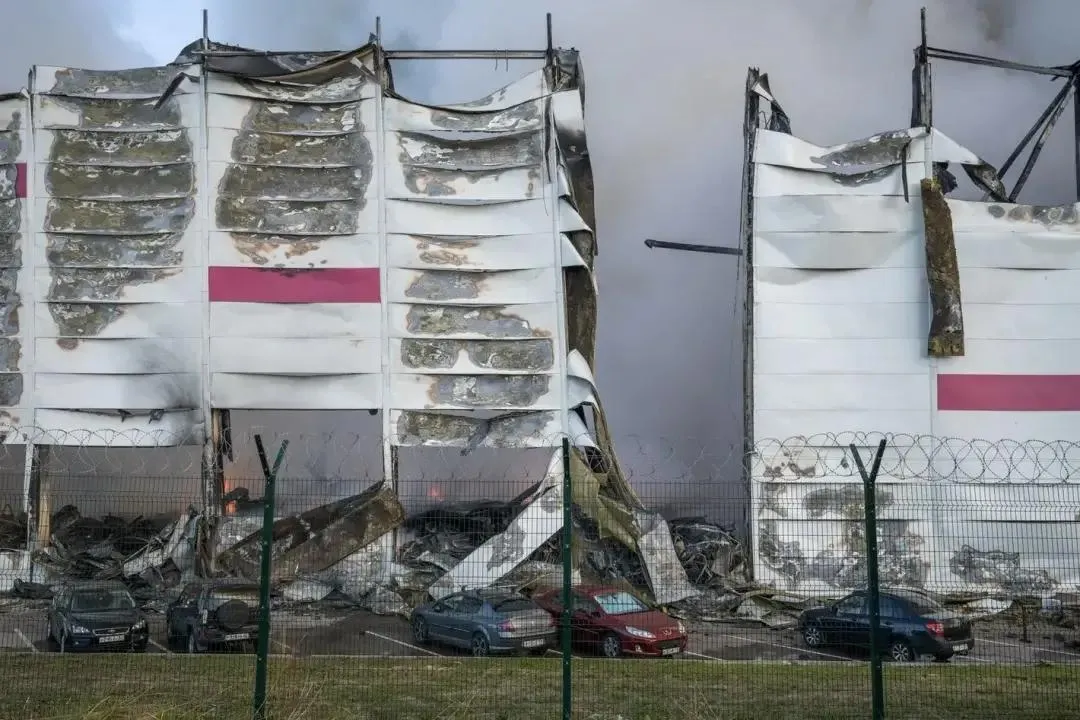
Following a series of strikes on Wildberries’ and Ozon’s logistics centers, Russian sellers are increasingly discussing the need to move away from excessive reliance on a single large warehouse. The main risk for sellers right now is that a significant portion of their inventory may be concentrated in a single fulfillment center, and if that center shuts down or is damaged, it immediately impacts sales, deliveries, and product availability.
As a result, sellers are increasingly distributing their inventory across multiple warehouses and regions to ensure that the loss of a single logistics hub does not bring their entire business to a standstill. Industry-specific channels and communities are also discussing the transition to the FBS model, where goods are stored in the seller’s own or a third-party warehouse and shipped to the marketplace only after an order is placed.
This model is seen as one way to reduce dependence on major platforms like Ozon and Wildberries.
Another approach is to avoid simply transferring all inventory from one marketplace to another. After the setbacks Wildberries faced, some sellers may have viewed Ozon as a safer platform; however, the current attacks have shown that simply switching platforms does not solve the problem if the goods are again concentrated in a single large warehouse.
In fact, Russian e-commerce is gradually shifting toward a more decentralized model: smaller batches of goods, more warehouses, backup routes, in-house or third-party warehouse facilities, and a greater focus on risk mitigation. For sellers, this means additional costs and more complex logistics, but it also reduces the likelihood that a single attack will bring their operations to a complete halt.
Ozon changed its rules for sellers in advance
Interestingly, the company began factoring in the risk of attacks even before the first direct hit.
In June, Ozon amended the terms of its agreement with sellers. Military actions, shelling, and the crash or use of drones were explicitly added to the list of force majeure circumstances under which the marketplace does not assume full responsibility for the loss of goods. The changes took effect on June 12.
Wildberries took a similar step in early July.
For sellers, this means that a warehouse fire could result not only in delivery delays but also in a direct loss of working capital. If a large seller has goods distributed across a dozen locations, they may still be able to weather the loss of a single facility. For small businesses with their main inventory stored in a single warehouse, the consequences can be much more severe.
Why have large warehouses become such a prominent target?
Modern warfare is not just about the front lines. Any major power wages war thanks to a vast logistical system: factories, transportation hubs, fuel, railways, banks, warehouses, repair facilities, and millions of people who continue to sustain the economy.
That is precisely why Ukraine has increasingly been striking deep into Russian territory in recent years.
In May 2026, the Ukrainian Ministry of Defense even launched a separate program called “Logistics Lockdown,” allocating 5 billion hryvnia to develop medium-range weapons. Its goal is to systematically strike Russian warehouses, military equipment, command centers, and supply routes in the operational rear.
In the case of large logistics hubs, the effect has another dimension: Moscow must now consider protecting not only oil refineries or defense plants, but also a vast network of commercial logistics facilities.
And there simply aren’t enough air defense systems to cover everything at once.
The Kremlin is already responding to the strikes

Perhaps most telling is that the issue of strikes on warehouses is no longer exclusively a problem for private companies.
On August 24, Vladimir Putin signed a decree authorizing temporary state control over critical infrastructure if the owners are unable to adequately protect it or restore it in a timely manner following attacks.
The decree applies, in particular, to energy, industrial, transportation, and logistics infrastructure.
First Deputy Prime Minister Denis Manturov stated that this does not mean full-scale nationalization, but the state wants to be able to intervene in cases where a private owner is unable to adequately protect a strategically important facility.
In other words, Russia is effectively forced to restructure the rules governing large businesses to adapt to the new reality of regular long-range attacks.
Could the strikes on Ozon and Wildberries force Russia to seek peace?
The destruction of a single Ozon warehouse—or even a dozen Wildberries warehouses—will not force the Kremlin to end the war the very next day.
Russia remains a vast country with a massive economy, a large territory, and the ability to reroute logistics. Even Ozon has nearly 5 million square meters of logistics space, so the loss of a single facility does not mean the collapse of the entire system.
But the point of such strikes, it seems, isn’t to find a single “magic” target.
A single strike on an oil refinery is a problem for that specific facility. Dozens of attacks on oil refineries, however, become a problem for the fuel market. A single destroyed warehouse is a local disruption. A series of strikes against the largest logistics centers forces an entire industry to change its storage policies, transportation routes, insurance practices, and infrastructure security protocols.
Added to this are attacks on military factories, airfields, railways, oil depots, and other facilities.
Commander of Ukraine’s 413th Unmanned Systems Regiment “Raid,” Yevhen Karas, explained in an interview with the Associated Press that the rationale behind the long-range strikes is precisely to exert economic and psychological pressure on Russia, which in the long run could push Moscow back toward genuine peace negotiations.
And already, at least one result is evident.
For the Russian economy, the war is increasingly less of an event happening somewhere far away on the front lines. Businesses are amending contracts due to the risk of drones. Retailers are considering how many warehouses to distribute goods to. Marketplaces are evacuating hundreds of employees and rerouting deliveries. Investors are selling stocks after yet another attack.
And the Kremlin is creating a mechanism for state management of infrastructure that private companies can no longer guarantee protection for.




