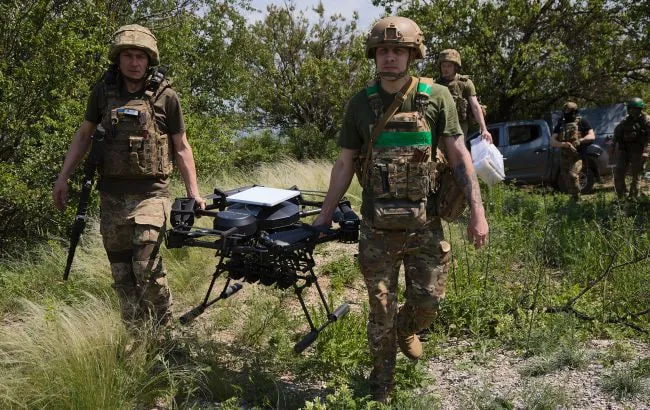
Ukrainian medium-range strike drones have begun actively attacking Russian supply routes far from the front lines. According to Business Insider, this is creating serious logistical problems for the Russian army and compromising its rear areas, which were previously considered relatively safe.
A New Phase in the Drone War
Ukrainian medium-range strike drones have ushered in a new phase of the war. They are exposing Russian supply lines that the occupiers had long considered secure.
Thanks to new technologies, operators can strike military targets hundreds of kilometers from the front lines. This significantly complicates logistics for the occupying forces.
Dmytro Zhluktenko (call sign “Liber”), a former drone operator now an analyst studying combat experience with the 413th RAID Unmanned Systems Regiment, Dmytro Zhluktenko (call sign “Liber”), told the publication that Ukrainian operators can install a Starlink terminal on a drone.
This provides the drone with internet access and allows it to be deployed “on critical highways,” where the “free hunt” begins. According to him, operators are sowing “chaos” up to 100 kilometers deep behind enemy lines.
“These highways are so overloaded with military logistics that it would be very difficult not to find targets,” Zhluktenko noted, adding that this is “not a 100 percent strike zone,” but simply being there already carries a high risk.
What drones strike at various distances from the front
The publication’s journalists emphasized that Ukrainian drones have become one of the key factors in the country’s survival in the war against Russia.
Short-range FPV drones strike Russian troops, supplies, and equipment near the front lines;
long-range drones attack oil facilities, air bases, and military targets deep within Russian territory.
“New medium-range strike drones bridge the gap between these two highly effective uses of drones, striking targets at distances of approximately 20 to 300 kilometers from the front,” the publication writes.
In this zone, Ukraine can attack Russian warehouses, vehicles, transportation hubs, and command posts. This disrupts supplies to the occupiers’ frontline units. The Ukrainian side states that the use of such drones is rapidly expanding and remains one of its top priorities.
Russia lacks a robust defense in the “middle zone”
According to Zhluktenko, Russia lacks a robust defense system in this “middle zone.” This is partly because the occupiers cannot redeploy a significant number of defensive assets there from other fronts, where Ukraine is already keeping them under constant pressure.
Western military analysts assert that Ukraine’s drone attack campaigns have already significantly depleted Russia’s air defense system. The occupying forces’ command has to decide which areas to defend first, and opening up new fronts for attacks only exacerbates this problem.
Zhluktenko noted that even if Russia deploys a large number of interceptor drones to destroy other drones, defending such a vast territory will require “a great deal of resources.”
“So in any case, this is a win-win situation for us. We’re simply expanding the danger zone for them,” the analyst said.
Ukrainian officials claim that the new medium-range strike drones open up areas of the Russian rear—previously considered safe—to attack. This creates new opportunities for Ukraine and increases pressure on the Russian army.
Capabilities of Ukrainian Drones
In recent weeks, Ukrainian units have continued to expand the capabilities of their unmanned systems across various fronts.
For example, on July 20, Ukrainian marines used FPV drones for the first time—launched from unmanned Barracuda boats—to strike occupier positions near Zalizny Port in the Kherson region.
During the mission, the occupiers destroyed one of the boats with four “Lancet” munitions; however, the rest successfully reached the drone launch point and struck enemy logistics, equipment, and personnel.
On the night of July 19, Russian forces launched a ballistic missile strike on Kyiv. One person was killed and eight others were wounded as a result of the attack. Damage and fires were reported in five districts of the capital.
Throughout the day on July 17, Russian forces launched strikes on Kharkiv and 29 other settlements in the Kharkiv region. Two people were killed and 18 others were injured in the shelling; among the casualties were five children.
Throughout the day on July 17, the Chernihiv region came under attack from enemy drones. Fires broke out in several districts at once but have already been extinguished by Ukrainian rescue workers.