
High speed has proven to be a drawback for anti-aircraft drones - Business Insider
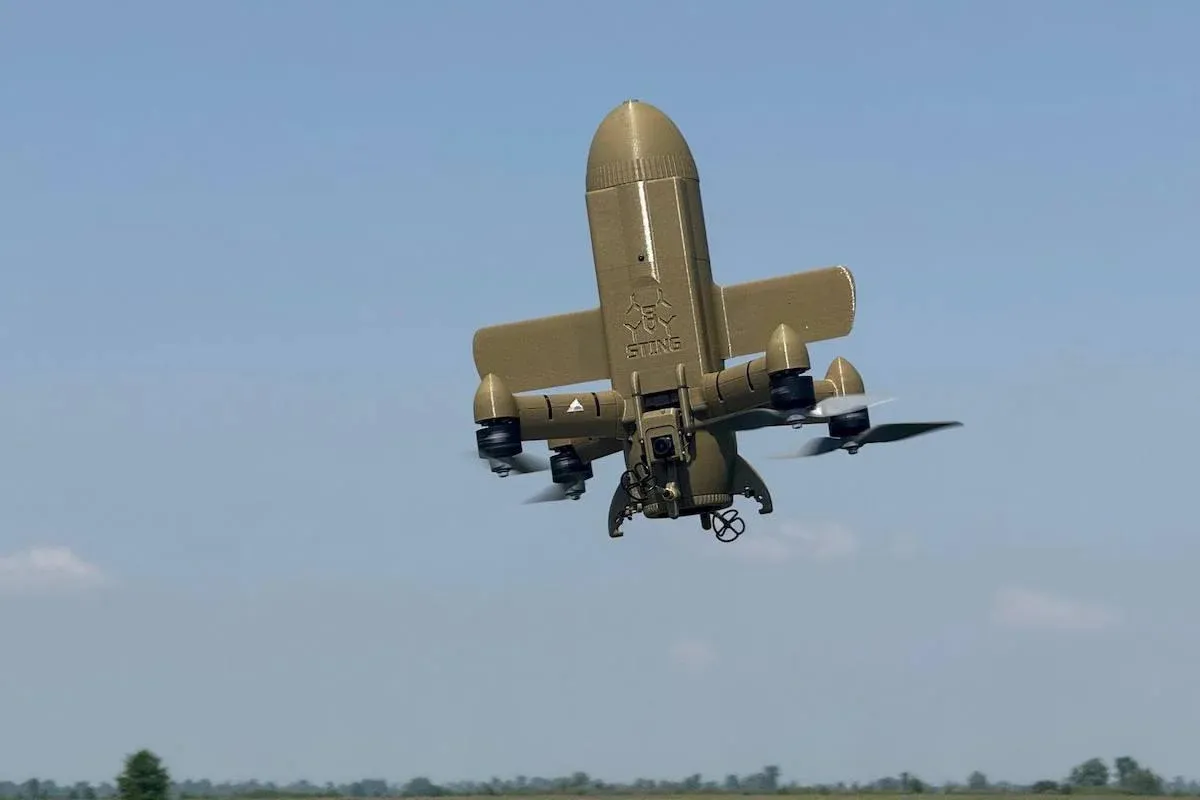
Ukrainian drone developers from the company "Wild Hornets" discovered through practical experience that an interceptor’s excessive speed does not always make it more effective at shooting down Russian Shahed drones, and that in real combat conditions, the balance between speed and flight time proved to be more important. This conclusion was confirmed by Business Insider journalists after a visit to a training site near Kyiv, where the Sting drone was being tested.
The Ukrainian company “Wild Hornets,” which created one of the country’s most famous interceptor drones, the Sting, reached a conclusion during development that was not immediately obvious to engineers: maximum speed is not always the main advantage in the fight against Russian Shahed-type kamikaze drones. As Business Insider notes, the publication’s journalists observed the system in action at a testing ground near Kyiv and confirmed that the Sting has already become one of the key tools of Ukraine’s air defense.
According to the manufacturer, these interceptor drones destroyed about 1,500 Russian drones in April alone. Work on the project intensified in late 2024, when Ukraine began urgently seeking cheaper and mass-producible solutions to defend against massive attacks.The first versions of the Sting were designed with a focus on speed—they could accelerate to over 320 km/h, which significantly exceeded the Shahed’s speed. However, practical tests quickly showed that this was insufficient for stable interception.
Engineers, together with the military, revised the concept. A company representative explained to journalists that the army had turned its attention to another critical parameter. “Speed isn’t always the most important factor. Endurance is also important,” the company’s spokesperson quoted military officials as saying.
After modifications, the maximum speed was reduced to approximately 280 km/h, but in return, the drone gained significantly better endurance. According to the developers, the Sting can remain airborne for over 20 minutes, climb to an altitude of up to 7,000 meters, and remain sufficiently maneuverable to intercept targets. Another important factor is the price. A single drone costs less than $2,000, making it significantly cheaper than both interceptor missiles and the Shahed drones themselves, which are valued at tens of thousands of dollars.
The company emphasizes that the system continues to be improved, particularly through new camera modifications for day and night operations. At the same time, the Russian side is also modernizing its drones, adding cameras and improving maneuverability. The developers claim that the Sting’s effectiveness increases over time, and some units are already demonstrating an effectiveness rate of over 90% under favorable conditions.
Separately, the company has launched the Hornet Vision remote control technology, which allows operators to control interceptors over long distances while remaining in relatively safe areas. “This allows experienced pilots to control more weapon systems and deploy more drones over greater distances,” explained Wild Hornets, emphasizing that the focus is now not on speed, but on systematic coordination and scale. Business Insider reports on this.
On the night of June 10, drones attacked the Novokuybyshevsk oil refinery in Russia’s Samara region. Following the strikes, a massive fire broke out at the facility, which, according to local residents, was visible from various parts of the city.


