
A suspension of contracts for armored vehicles could complicate the evacuation of wounded soldiers
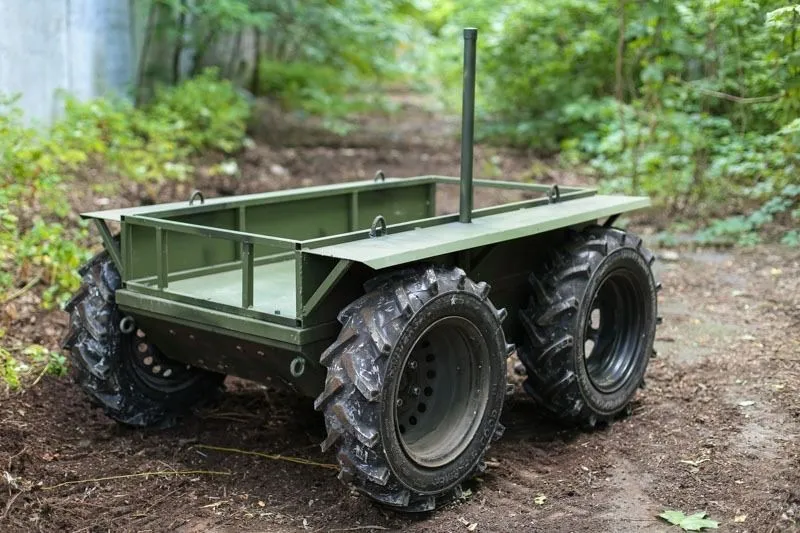
The journalist highlighted a critical problem with the evacuation of wounded soldiers, emphasizing that ground-based robotic systems are not capable of fully replacing armored vehicles. According to her, suspending contracts for armored vehicles could put soldiers’ lives at risk.
This was reported by military correspondent Yulia Kirienko-Merinova.
According to the author, statistics on the evacuation of the wounded from the battlefield over the past six months point to a difficult situation. She criticizes the approach that considers unmanned ground vehicles (UGVs) a sufficient means for evacuating survivors, as well as the refusal to procure full-fledged armored vehicles due to their cost.
The journalist cited as an example a video in which the commander of CODE.92 company rescues the wounded in a pickup truck. In her opinion, the soldier deserves an award for this act, but the situation itself highlights the problem of an insufficient number of armored vehicles.
She noted that following the scandal over the shortage of small-caliber anti-tank systems (SAT) that occurred last winter, there was initially political will to procure 25,000 such systems for the front lines. According to her, the then-Defense Minister made this announcement at the time.
“Then the number was doubled, at the president’s initiative,” she added.
According to Kirienko-Merinova, contracts with manufacturers are in place, and the NRKs are gradually arriving at the front. At the same time, she estimates that deliveries are proceeding more slowly than needed, as manufacturers are overwhelmed with government, volunteer, and direct orders.
“Even 20,000 units won’t be enough to fully cover the front lines by fall,” she stated.
At the same time, as Kirienko-Merinova claims, citing some manufacturers, contracts for armored vehicles capable of handling evacuations have been suspended.
“Because they spent all the money on various types of drones? Is that how it is?” she wrote.
Kirienko-Merinova noted that the large number of videos showing Russian equipment being destroyed by drones may give a sense of hope for victory; however, in her opinion, strengthening one sector should not come at the expense of another.
“But if we’re strengthening one sector, why should it be at the expense of another? And why are our wounded on the battlefield left without a chance of being rescued?” the post reads.
For comparison, the journalist cited the cost of armored vehicles: a “Novator” costs 12 million hryvnia, while a “Varta” costs 20 million hryvnia. She noted that the state’s compensation for a fallen soldier amounts to 15 million hryvnias, so just one successful evacuation using such a vehicle fully justifies its purchase.
According to the reporter, armored personnel carriers are needed to deliver supplies to the trenches or to evacuate the bodies of the fallen. However, to evacuate the wounded, the armored personnel carrier must be protected.
The journalist added that testing of the protection system for vehicles and NRKs has already taken place, but scaling it up is still a long way off and expensive. Andriy Lebedenko worked on this active protection project, but “they now want to remove him because the team didn’t pan out.”
“The question isn’t as black-and-white as ‘either drones or armor.’ The issue is one of priorities: if we declare the value of a soldier’s life, then this shouldn’t just be a slogan to appease social media,” Kirienko-Merinova emphasized.
She believes that orders for ground and aerial drones should be placed simultaneously with the procurement of armored vehicles for the front lines, not in place of them.
“What we need are concrete actions in which orders for drones—both ground-based and aerial—are included in the same package as armor for the front lines, rather than replacing it,” she concluded.
As a reminder, the “ATESH” partisan movement reported the destruction of three Russian communications towers in the border areas of the Kursk region. According to the movement, the facilities near the settlements of Darino, Mala Loknya, and Sverdlikovo provided communication links between the command posts of Russian units.
As a result of a Russian attack on August 18, the premises of the “Kyivguma” factory in Brovary, Kyiv Oblast, sustained damage. No employees were injured, and the damage, according to preliminary estimates, is not critical.
On the evening of August 18 and overnight on August 19, Russian troops attacked the Nikopol and Kryvyi Rih districts of the Dnipropetrovsk region more than 10 times with drones and artillery. As a result of the shelling, an administrative building, a private home, and other civilian facilities were damaged, and a fire broke out. According to preliminary data, there were no fatalities or injuries.
Earlier, a Russian drone attacked a car carrying bread near Zaporizhzhia.


