
Astronomers have discovered a new celestial object the size of the Solar System
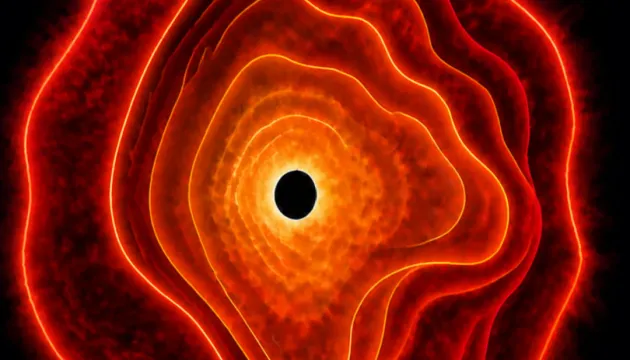
An international team of astronomers has discovered a previously unknown type of celestial object, dubbed a “star-black hole.” It is comparable in size to the Solar System and emits an unusually bright red light.
Astronomers focused their attention on a mysterious red spot in images of the early Solar System captured by the James Webb Space Telescope. The object was “hidden” in the constellation Cetus, billions of light-years from Earth. It is believed to have formed 660 million years after the Big Bang.
Measurements of the celestial body showed that although it resembles a massive star, it emits 100 billion times more energy than any known star, and by this measure is much closer to a black hole than to stars.
“We have discovered a new type of astrophysical object—a star-like black hole,” said Dr. Rohan Naidu of the Kavli Institute for Astrophysics and Space Research at the Massachusetts Institute of Technology (U.S.).
According to him, this object “emits energy typically associated with black holes, but at the same time exhibits characteristics traditionally associated with stars.”
This was reported by The Guardian.
Archaeologists have deciphered the name of a Mayan astronomer for the first time.
In Crete, at the Sanctuary of Apollo, archaeologists have found more than 450 mouse skeletons.
In the Odesa region, archaeologists have uncovered Roman burials containing unique artifacts.
Previously, archaeologists discovered that the kings of Urartu used bronze bowls for propaganda purposes.
As a reminder, gold jewelry made before the Bronze Age Catastrophe was found in Cyprus.
Near Halych, archaeologists have discovered unique medieval artifacts.


