
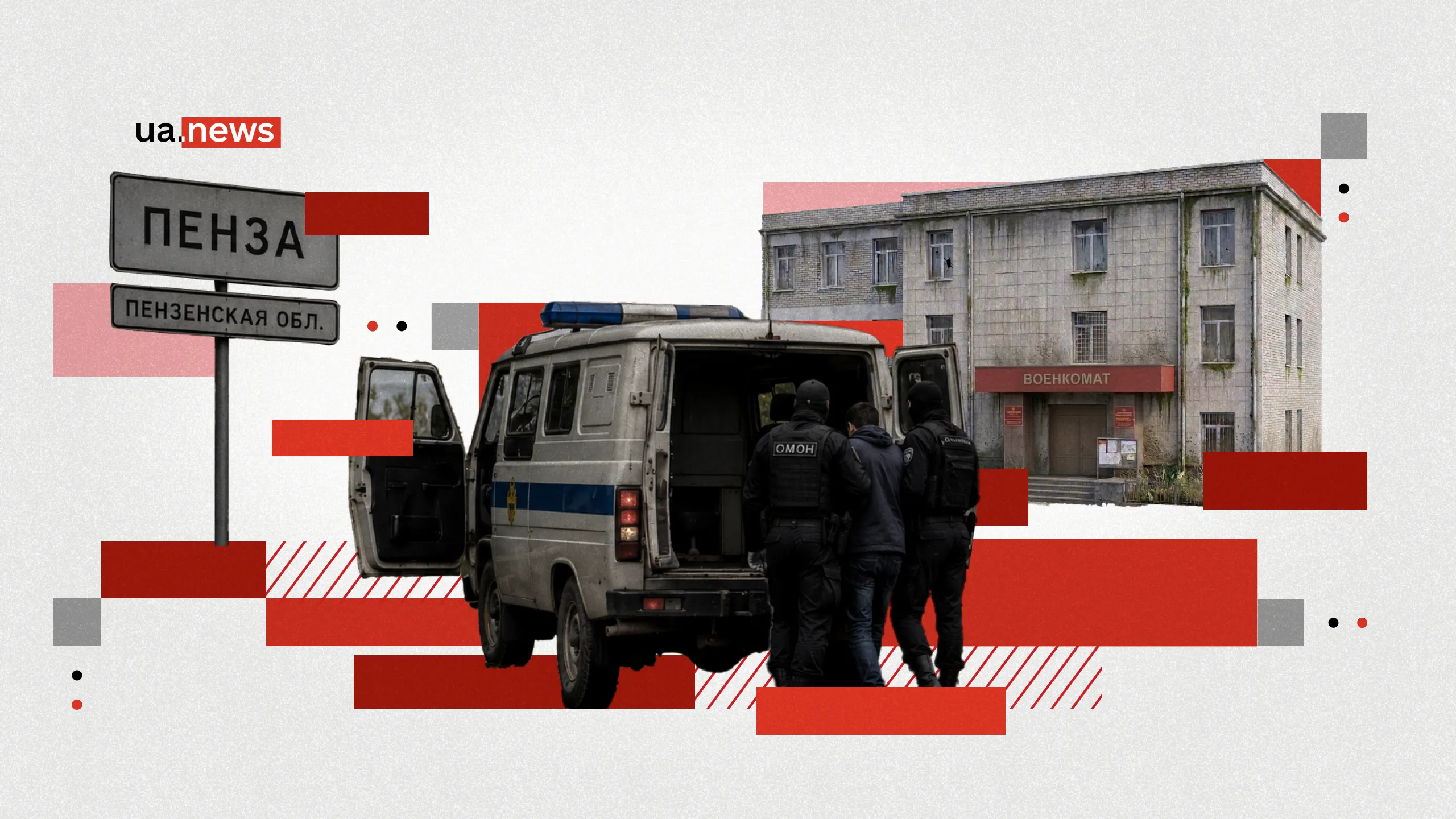
Last week, events took place in the Russian city of Penza and several towns in the Penza Region that shook not only the local community but also the entire Russian information space (primarily in opposition circles—it was precisely through “foreign agents” that this issue came to public attention). From June 17 to 19, joint patrols consisting of military registration and enlistment offices, OMON, and the police took to the streets. They stopped male passersby, checked their military registration documents, and then loaded the men into minibuses and took them to the military registration and enlistment office, where they were forced to sign contracts with the Russian Ministry of Defense. Eyewitnesses filmed everything on their cell phones: women—the mothers and wives of those detained—tried to rescue their loved ones, blocked the buses’ path, and shouted at the security forces, among other things. Videos from the Penza military registration and enlistment office, showing detained men sitting in a minibus while women pleaded not to send them to the front, went viral on social media.
Local military commissars later confirmed that the raids had taken place, noting that they are “conducted regularly, once a month, in conjunction with the police” with the aim of “locating citizens who are evading conscription.” However, the sheer scale of the raids, their brutality, and the fact that they detained not only “draft dodgers” but practically every man who came into view caused shock even in Russia.
Are these events a coincidence? Or are we, rather, witnessing a sort of “rehearsal” for what may soon become a reality for millions of Russian men? UA.News investigated the issue.
Penza Raids: What’s Happening
On the evenings of June 17–19, mass roundups began simultaneously in Penza, Kamensk, and Kuznetsk—three cities in the Penza region. Minibuses are driving around the cities, picking up men right off the streets, and checkpoints are being set up with the participation of the military, police, and traffic police. Cars and public transportation are being stopped, and the documents of all men are being checked. The main goal is to force those detained to sign a contract with the Russian Ministry of Defense to be sent to fight in the war against Ukraine. According to some reports, there was a “plan” to recruit at least 700 men from this region alone.
The most high-profile incident occurred near the military registration and enlistment office on Skladskaya Street in Penza on the night of June 17. Numerous videos show a minibus carrying the detained men. Women—their mothers, wives, and sisters—surround the van and try to prevent the military from taking their loved ones away. In response, the men locked inside the van ask them to “pray” for them. Relatives of the detainees report that the military did not allow them to communicate with their loved ones, confiscated their phones, and roughly pushed the women aside. Lawyers were not allowed to see the detainees. Many of the men did not have any identification on them at the time of their detention—new military ID cards were issued to them in just a few hours. One of the women recounts that she tried to ask her husband why he had signed the contract—to which he replied gloomily, “I had to,” hinting at physical violence.
They detained not only those actually subject to military conscription, but essentially anyone who happened to be within the police’s line of sight. These could have been people with child support debts, those with outstanding criminal convictions, or simply men walking down the street while intoxicated. After the scandal gained publicity, the local police issued a “warning” to anyone filming the security forces’ actions, also stating that such videos were allegedly “in no way related to deployment to the ‘special military operation’ zone.” The military commissar even acknowledged that the raids “are conducted regularly,” but emphasized that there was “nothing to worry about” in this.
And this was indeed not the first time. As it turned out, similar raids had been carried out in the Penza region before—but this time, they took on a larger scale, were captured on numerous cameras, and sparked a public outcry. It is particularly telling that similar raids had previously been carried out against so-called “new citizens of the Russian Federation”—immigrants from predominantly Asian countries who had recently received Russian passports. Tens of thousands of such people have already ended up in the Russian army.
But now it appears that the target has shifted, and “real” Russians are in the crosshairs. It is worth noting that this blatantly contradicts Russian law itself, which clearly states that “Russian citizenship is the sole and full citizenship for all,” regardless of whether one obtained it just yesterday or at birth.
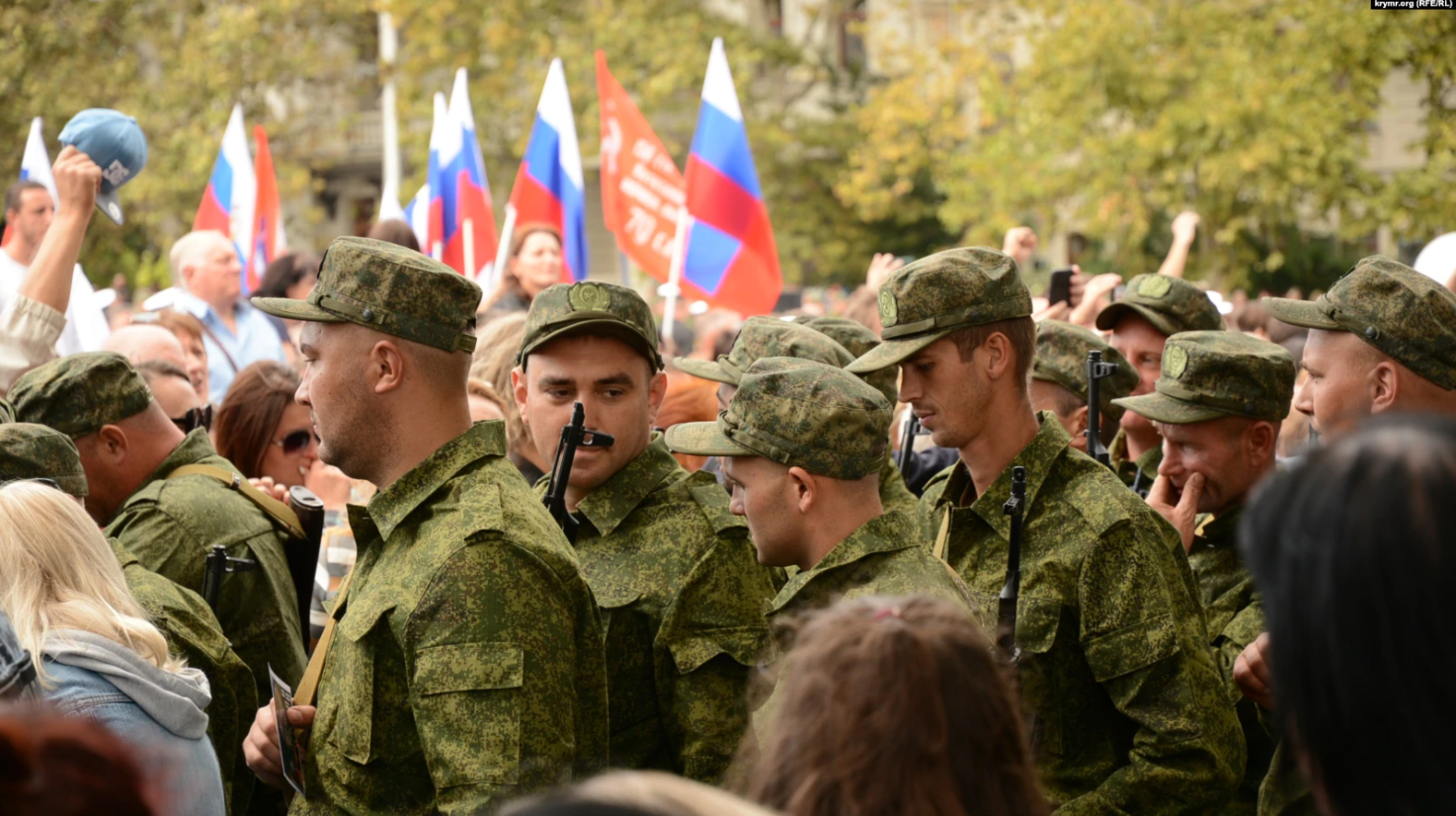
Penza as a Rehearsal for Total Mobilization
What happened in Penza is not a local incident nor the initiative of a local military commissar who decided to exceed his quota. It appears to be a systematic test run of a procedure that the Kremlin likely plans to implement nationwide.
First, the military commissars themselves admitted that such raids are conducted monthly: in other words, this is not a one-off operation but a well-rehearsed scheme. Second, in Penza they were testing a method for rounding up not only “draft dodgers,” but practically any man who could be “targeted” due to debts, criminal records, or administrative offenses—this is a universal tactic that can be scaled up to any city. Third, Penza became a sort of testing ground for gauging public reaction, which turned out to be quite revealing: there was no mass resistance, although people were clearly shocked and very dissatisfied.
The authorities responded in their usual manner: they acknowledged the fact but called it “standard practice.” For the Kremlin, this is a signal that, if necessary, they can act more boldly.
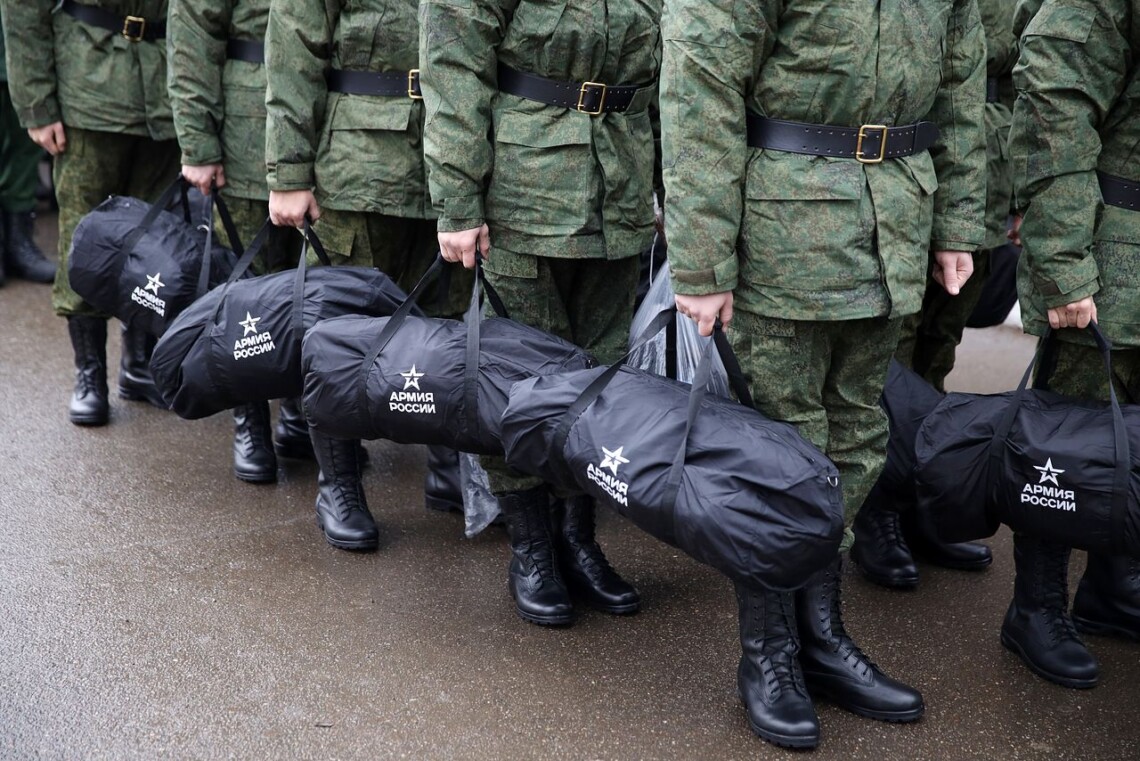
There is a perfectly understandable logic behind what is happening. Russia’s need for manpower on the front lines is enormous. Over the years of the war, the flow of volunteers signing up for paid contracts has gradually dried up. Yes, certain segments of the population—residents of economically depressed regions, ex-convicts, or immigrants from poor countries—are still bolstering the Russian military, but these resources are insufficient for large-scale offensive operations.
Western analysts and Ukrainian intelligence have repeatedly warned that Russia is preparing a new wave of mobilization. The Russian political leadership has set the goal of increasing the occupation force by at least tens of thousands, ideally by hundreds of thousands or even 1–2 million. But there is one “but”—the elections to the Russian State Duma, scheduled for September 20, 2026. Announcing an extremely unpopular mobilization immediately before the elections would amount to political suicide for Putin and for “United Russia,” whose support is already low. Therefore, if a decision is made, the Kremlin will most likely wait until after the elections and only then, in the fall or winter of 2026, launch a new wave of forced conscription.
Penza has provided a glimpse of what this might look like: people won’t be waiting inside military registration offices—authorities will come for them on the streets, stop them on public transportation, check their documents, and look for any formal pretext to detain them, and after detention—rapid paperwork processing, signing a contract under pressure, and being sent to the front. We are seeing how the Ukrainian phenomenon of “busification”—forced mobilization, where people are simply “packed” onto buses and taken to military registration offices—is now becoming a reality in Russia as well. The only difference is that in Ukraine this process is taking place amid a full-scale defensive war, while in Russia it is for the sake of an aggressive, expansionist war that is unpopular with the public—a war that most Russians would prefer to ignore.
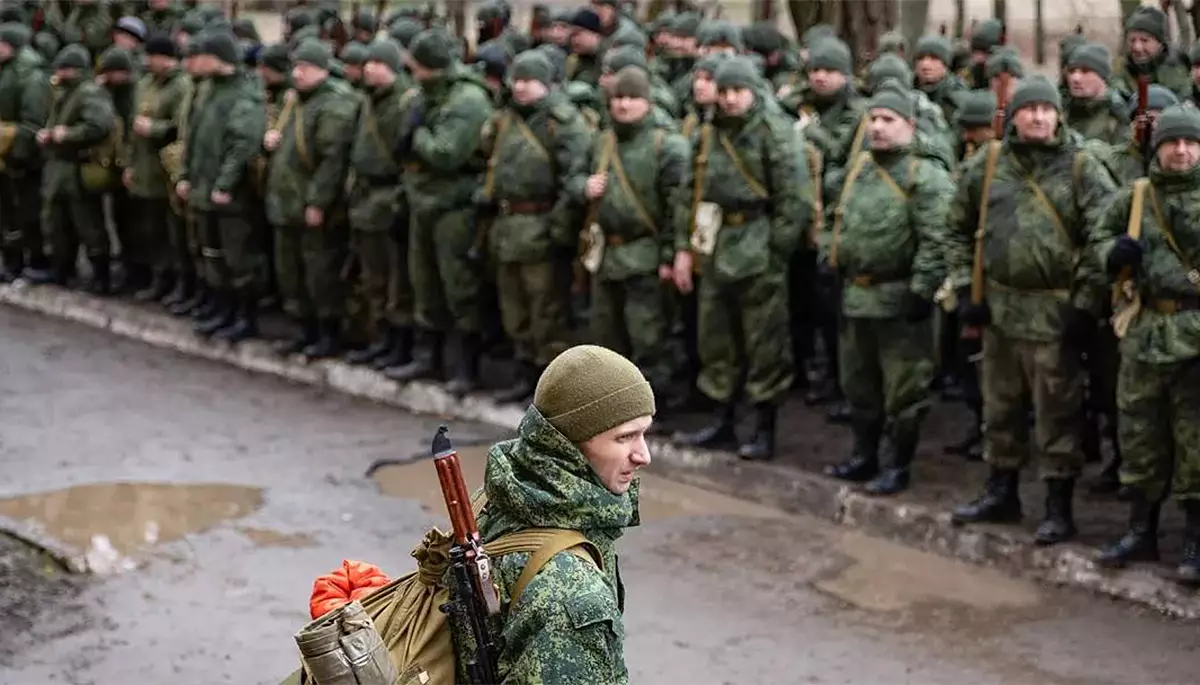
Why can we be sure that the mobilization will be coercive? Because there are very few volunteers left who are willing to fight for money: tens of thousands may sign up under contracts, but the front lines need hundreds of thousands, and the only way to get them is through coercion. The Penza scenario is a “test run” for this coercion.
A large-scale offensive—that is the Kremlin’s main goal. The Russian command is likely planning to launch large-scale offensive operations on one or more fronts in the spring and summer of 2027, and to do so, it needs fresh, trained reserves—which are currently in critically short supply. A new wave of mobilization is intended to provide the Kremlin with these reserves. A million—or even 300,000 to 500,000—new soldiers thrown into the meat grinder could very, very significantly alter the balance of power on the front lines. That is precisely why Putin will likely take this unpopular step sooner or later—despite all the risks to domestic stability.
At the same time, there is absolutely no reason to rejoice here. Yes, these are Russians—and, to put it mildly, it’s hard for Ukrainians to feel sympathy for those who, for 4.5 years, simply stood by and watched the war unfold without making any attempt to stop it, without taking to the streets in protest, or at least without emigrating from Russia. But we must not forget that over the years, none of these people have volunteered for the occupying army. They did not go to war of their own accord, nor are they eager to fight—even for large sums of contract money. They are potential victims of coercion, being driven to their deaths by force. As we can see, there are nuances—and quite significant ones at that.
For Ukraine, the arrival of hundreds of thousands of new Russian soldiers on the front lines is a direct existential challenge: more Russians on the front lines mean more attacks, more shelling, and more casualties among Ukrainian military personnel and civilians. This will allow Russia to intensify its offensive operations, apply pressure on all fronts, and break through Ukrainian defenses. So there’s no reason to rejoice here: even if Russian society gets its share of pain, fear, and suffering, the price of this is Ukrainian lives, casualties on the front lines, the destruction of Ukrainian towns and villages, the continuation of an endless bloody war, and so on.
For Russia itself, however, mass forced mobilization is a huge risk. Putin’s “special military operation” in Russia, whatever anyone may say, has never become a war popular with the people. A significant portion of Russians do not accept it; most often, they prefer simply to ignore it, or view it with deep skepticism or even hostility. If people start being dragged from their homes, loaded onto vans, and sent to war at gunpoint, social tensions could reach a breaking point. Riots, chaos in public spaces, outbreaks of violence, and a new wave of mass migration—as happened in the fall of 2022—could become possible, and in certain regions (especially the national republics), this could escalate into serious unrest. Russia risks facing a new period of turmoil—a time of internal instability that could threaten the very existence of the current power structure.
Will the Kremlin take this risk? History shows that Putin has repeatedly chosen escalation, even while seemingly aware of its consequences. He has absolutely no regard for the lives of foreign citizens—or even his own people. But whether Russian society and the Russian state can withstand yet another round of violence remains an open question.

In summary, the June raids in Penza are not just a local scandal, but a mirror in which Russians can see their very real and possible near future. The method of rounding up men has already been tested, and the public reaction—protest, but not rebellion—has already been documented. All that remains is to wait for the State Duma elections, after which the Kremlin is fully capable of putting the mechanism into full operation.
It’s worth noting that this isn’t some 100% reliable information from “insiders in Moscow.” But given the current situation, everything described above seems at least logical and does not elicit a reaction along the lines of “this can’t be true because it can’t be true.” And that in itself speaks volumes.
For Ukraine, this means one thing: the war, unfortunately, shows no signs of ending. On the contrary—it seems a new, even larger-scale and bloodier phase is being prepared. And for Russia, the Penza scenario is a warning: what is happening in Penza today could begin across the entire Russian Federation tomorrow. The only question is whether Russian society realizes this sufficiently to bring about change—before it’s too late.


