
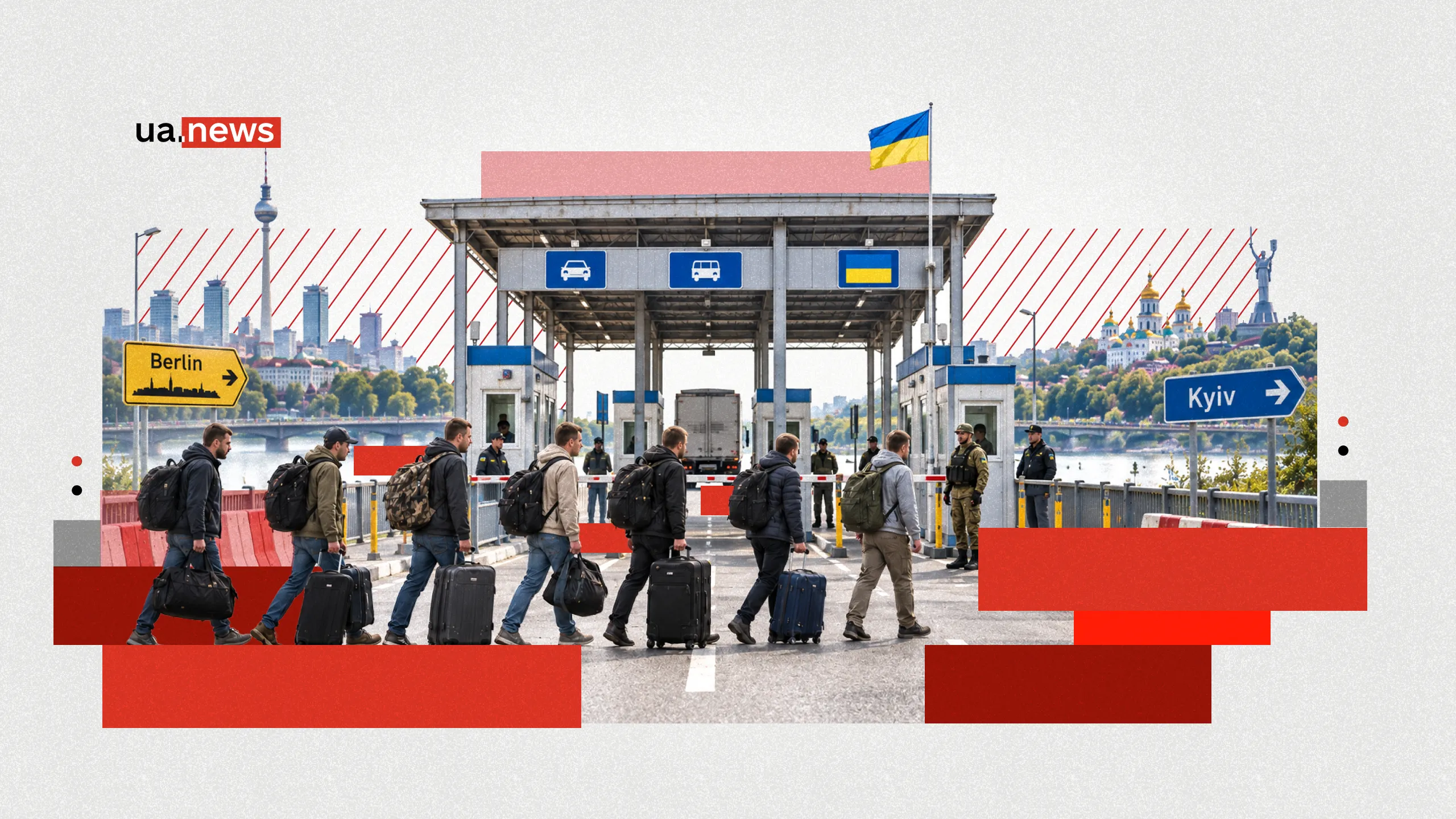
It’s time for Ukrainian men subject to military conscription to return home—this rhetoric is being heard more and more often in European capitals.
Recently, German Foreign Minister Johann Wadephul stated that the German government is ready to facilitate the return of male refugees of draft age to Ukraine, but will do so “without coercion.” Berlin can help identify men subject to military conscription who have temporary protection in Germany through relevant registries. For its part, the Ukrainian government could send letters to these men urging them to return.
Back in June, Ukraine and Germany established a joint working group to develop mechanisms for the return of men of conscription age who left the country illegally.
Statements by high-ranking officials from European Union countries regarding the search for mechanisms to repatriate Ukrainian men are nothing new. But can the EU bring itself to follow through on such statements, and why is Ukraine actively promoting the idea of replenishing its mobilization reserves with citizens who have left the country? UA.News asked Ukrainian experts about this.

The
situation will depend on the interests of each specific EU member state: Yevhen Magda, director of the Institute of World Policy
The issue of our citizens subject to military conscription residing in the European Union is complex in nature. This is because some of them entered the EU illegally, while others did so legally. I am convinced that the situation will depend on the interests of each individual European Union member state.
The statement by German Foreign Minister Mr. Wadeful that they may share data on Ukrainian citizens does not mean much in this case. This is because, due to bureaucratic hurdles, sharing data on registered Ukrainian men is quite difficult.
For the Germans, starting to share such data would trigger an exodus of Ukrainian citizens from Germany. And that is objectively economically disadvantageous for them. In that case, they would lose many of the advantages they enjoy as Europe’s leading economy.
This issue is not about human rights—it’s about how European states respond, in general, to challenges posed by Russia. Here, in my opinion, we also need to seek comprehensive solutions and not forget, in particular, that Ukraine has no repatriation programs for its citizens, neither from the European Union nor from any other country in the world.
Entry
requirements for Ukrainian men into EU countries will become increasingly strict: Maksym Yali, international
relations expert
The logic here is simple. The Ukrainian government has repeatedly appealed to its European partners to restrict the entry of Ukrainian men of draft age who illegally cross the border.
Given that European countries have a stake in Ukraine continuing to resist Russian aggression, they have responded to these requests. Certain restrictions have already been put in place.
I am confident that, going forward, entry requirements for Ukrainian men into European Union countries will become increasingly strict. It is unlikely that this will lead to mass deportations, particularly due to the need to respect human rights in accordance with European legislation.
But in any case, restrictions on Ukrainian men of draft age will be tightened, especially for those who have not registered for military service or who left Ukraine illegally.
This
is an attempt to reduce the flow of people seeking to leave for the EU: Maksym Nesvitailov, political scientist and international
relations expert
Statements about a possible return are more likely to apply to men who have not found jobs, have not adapted to life in European Union countries, and continue to rely on social assistance. However, I consider such a scenario unlikely. Rather, this is an attempt to reduce the flow of people wishing to move to the EU.
Europe has already seen a significant boost both demographically and in terms of its labor force thanks to the influx of Ukrainians. I think we’ve reached a point where they have enough of this resource.
Therefore, this is unlikely to be about implementing a mass repatriation program, since European countries already face challenges even when it comes to deporting undocumented migrants from other regions, particularly the Middle East. It may instead be a way to discourage people from traveling to European Union countries as actively as before.
I very much doubt that such a mechanism could actually be implemented. Discussions may continue, but if we’re talking about an agreement at the level of the entire European Union, it’s nearly impossible. EU countries have very different positions and views on this issue.
If such a decision were adopted by only a single country, Ukrainians would simply move to another EU member state or even outside of Europe altogether. So for now, this is mostly just a discussion.

This may look like a kind of political compromise: Dmytro Snegirev, military analyst
In my opinion, this statement by the German foreign minister should be viewed in a broader context. The minister initially stated that Ukraine should increase its purchases of weapons from German manufacturers using funds allocated by EU countries. In other words, Germany expressed dissatisfaction with the level of Ukraine’s purchases of German weapons specifically. According to the German minister, this could boost the German economy, create additional jobs, and increase budget revenues. This was followed by a statement regarding the possibility of returning men of draft age to Ukraine. Against this backdrop, it may appear to be a kind of political compromise: you increase your arms purchases from us, and we’ll help with the return of your citizens.
However, in my opinion, such statements by the German foreign minister reflect an unprofessional approach and do not contribute to resolving the problem. At the very least, this creates a news hook for speculation and effectively looks like a kind of commercial offer: we’ll return your men, and you’ll increase your arms purchases. At the same time, EU countries have no legal grounds to deport Ukrainian men solely because they are of draft age. Such decisions are governed by European and national legislation.
Can Germany and other countries share data on these men with Ukraine? According to various estimates, there are approximately 600,000 Ukrainian men in Germany. Even creating, organizing, and transferring such a database would pose a significant bureaucratic burden.
Suppose the Ukrainian embassy sends a citizen a notice urging him to return to Ukraine. If he is in Germany legally and does not want to return, what legal mechanisms can the Ukrainian side employ? This is precisely where the problem arises: what legal grounds would allow Ukraine to demand his return or create conditions for voluntary return?
Take, for example, the situation that has developed in Poland, which has a broader context. When Ukrainian men began leaving Poland for other countries, the Polish economy faced a labor shortage. This forced Warsaw to take a different view of the situation. Ultimately, Poland shifted the tone of the discussion regarding Ukrainians. At the same time, efforts to counter xenophobia and interethnic hostility were stepped up.
In my opinion, these anti-Ukrainian sentiments may have been partly artificially provoked by the Ukrainian side itself. I am convinced that attempts to create news stories that might encourage Ukrainians to return ultimately had the opposite effect: people began moving not to Ukraine, but to Germany and other EU countries.
Why did this turn of events occur specifically in Poland? Perhaps because it was anticipated that a similar scenario would not work in Germany. Therefore, they tried to capitalize on issues of historical memory and the creation of news hooks, after which the situation began to develop according to its own logic. In this context, statements by Polish right-wing political forces linked to Moscow deserve special attention. Thus, instead of the expected return of Ukrainians, such an information campaign could have contributed to the rise in popularity of political forces focused on anti-Ukrainian sentiments.
Theoretically, it is possible that at some point certain states might have a greater interest in the return of Ukrainian men to Ukraine. However, this would be countered by European legislation, human rights principles, and relevant international legal mechanisms.
As for the war itself, it is a war of technology. Ukraine cannot defeat Russia solely through head-on combat. Russia has a significantly larger human reserve—we’re talking about millions of potential conscripts. Therefore, relying solely on increasing the number of conscripts does not solve the problem.
Even if all of Ukraine’s available human resources were deployed to the front lines, this would not guarantee a change in the situation. We need to counter Russia’s advantage with technology. That is precisely why, in my opinion, the practice of constantly comparing the number of mobilized troops is, to some extent, a legacy of Soviet military logic—when the aim is to oppose the enemy with roughly the same number of troops. At the same time, Ukraine itself emphasizes the technological sophistication of its army. Yet, when it comes to mobilization, the logic of a quantitative confrontation often continues to prevail.
Israel’s experience is illustrative in this context. For decades, the country has faced numerically superior adversaries and has relied heavily on its technological superiority. Ukraine must also move in this direction, rather than trying to compensate for all its problems solely with manpower.
A separate issue is the availability of a mobilization reserve within Ukraine itself. This refers, in particular, to the so-called special registry and categories of law enforcement personnel who are not actually involved in the country’s defense. This amounts to approximately 300,000 people. At the same time, Ukraine is raising the issue of the return of citizens currently abroad.
This appears to be a case of double standards when it comes to defending the state. The question arises: if Ukrainian citizens abroad are expected to return and participate in the defense of the state, why isn’t part of the domestic workforce being utilized? A separate issue concerns the so-called “special pensioners” from the Security Service of Ukraine (SBU), the Ministry of Internal Affairs (MIA), and the Prosecutor General’s Office. A significant portion of these individuals have relevant experience, proficiency in handling weapons, and once swore an oath of allegiance to Ukraine. Why isn’t this potential being fully utilized?




