
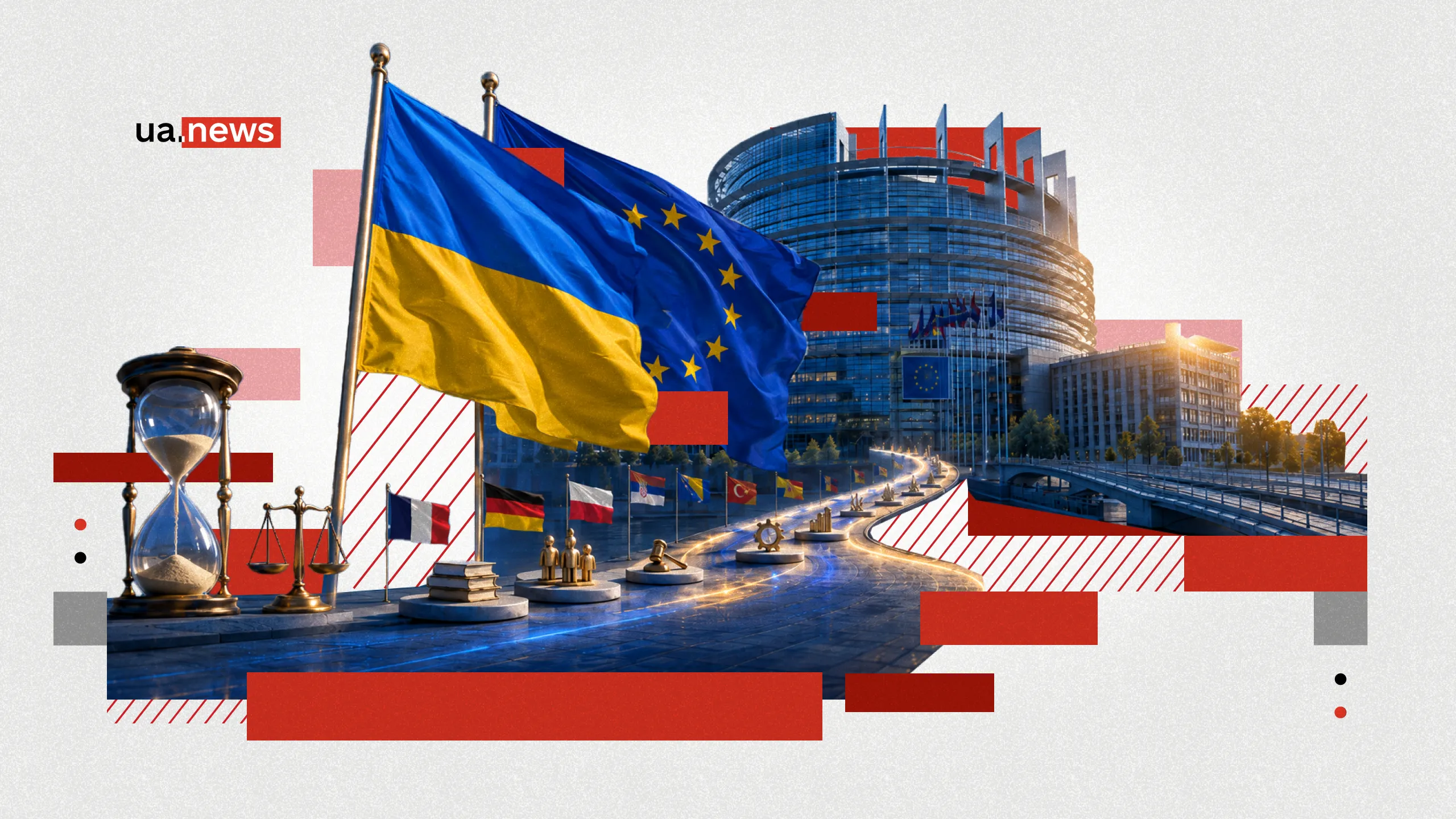
On June 15, 2026, Ukraine and the European Union officially began accession negotiations by opening the first cluster—“Fundamentals of the EU Accession Process.” This is a historic moment, as it launches a full-fledged negotiation process regarding the country’s future membership in the European Union. President Zelenskyy later stated that Ukraine expects to open five more negotiation clusters in the coming weeks.
This is a very ambitious goal, especially given how such processes typically unfold—and they move, to put it mildly, very, very slowly. Why does it take some countries decades to join the EU? How does the accession process actually work, and why should Ukraine demand special conditions for itself? UA.News political analyst Mykyta Trachuk looked into the matter.
The Copenhagen Criteria: How Accession Actually Works
Joining the EU is not just a purely political decision made over a glass of champagne at some summit in Brussels (though that is also a very important and fundamental point). It is also a long-term, grueling, and extremely bureaucratic process that begins with the candidate country’s compliance with the so-called “Copenhagen Criteria,” adopted back in 1993. There are three main categories in total, and each one is capable of dashing a country’s dreams of membership even without an outright veto from individual countries.
The first criterion is political. It requires the country to have stable institutions that guarantee democracy, the rule of law, respect for human rights, and the protection of minorities. In practice, this means a complete overhaul of the judicial system, independent anti-corruption bodies, transparent electoral legislation, media freedom, and genuine—rather than merely declarative—protection of minority rights. No authoritarian encroachments, no censorship, no “puppet” courts, and so on. For some candidates, this became an insurmountable barrier, because it is one thing to write laws, and quite another to make them work in a country where corruption is part of the social contract and authoritarianism is a common political phenomenon.
The second criterion is economic. The country must have a functioning market economy capable of withstanding competitive pressure and market forces within the EU. This is where things get interesting, because European manufacturers have absolutely no desire to see new competitors enter their market. They carefully protect their own sectors—from agriculture to metallurgy—and demand strict regulation of trade integration. That is precisely why, incidentally, warnings have been repeatedly voiced regarding Ukraine: our agricultural sector and metallurgy are too competitive to simply open the doors of the common market to them. No one has abolished protectionism in the EU—it’s just neatly packaged in various technical regulations.
The third criterion is administrative, also known as the “membership criterion.” It refers to a country’s ability to assume the obligations arising from membership, including adherence to the objectives of the political, economic, and monetary union. In simple terms, this refers to the implementation of the entire body of European legislation—the so-called acquis communautaire. And that amounts to tens of thousands (!) of pages of directives, regulations, and decisions that govern literally everything: from safety standards for children’s toys to carbon dioxide emission limits.
This process is called screening, and it is divided into 33 (!!) negotiation chapters, grouped into six clusters. Each chapter involves months, if not years, of negotiations, expert reviews, reports, and political agreements. No chapter is closed until all member states say “yes.”
And this brings us to the main point: EU accession is always a political decision. The Union’s most influential member states—Germany, France, the Netherlands, and others—set the tone, while the rest simply fall in line de facto. If Berlin or Paris decide that expansion to, say, Ukraine isn’t needed right now (and that’s exactly what they decide!), no chapter will actually open, no matter how flawlessly the candidate country has done its homework.

The Waiting List: Who Has Been Waiting for Membership for Decades—and Why
To understand just how protracted this process can be, one need only look at the current list of candidates.
The absolute record-holder is Turkey, which submitted its application back in 1987. It received candidate status in 1999, began negotiations in 2005, but they reached an impasse in 2016 and have made virtually no progress since then. Ankara wanted to join the EU back when it was still purely an economic community. The stumbling blocks have been the Cyprus issue, Erdogan’s authoritarianism, systemic human rights problems, and… the population. 85 million Muslims within the EU would completely shift the balance of power. Europe is openly afraid of this—which is why Turkey has remained a “perpetual candidate” for decades.
North Macedonia submitted its application in 2004, received candidate status in 2005, but membership negotiations did not begin until 2022. The country wanted to join the EU so badly that it even agreed to rename itself, adding the prefix “North” at Greece’s request. But as soon as the Greek veto was lifted, France blocked the way. And in 2020, Bulgaria joined in, demanding that Macedonian history textbooks be rewritten and that the Bulgarian roots of the Macedonian language be recognized. As a result, North Macedonia itself has now begun to block its own accession by resisting these blatantly absurd demands, and Euroskepticism is rapidly growing in this small Balkan country.
Albania and Montenegro have also been waiting in line for years. Albania has not joined the EU due to its reputation as a pan-European hub for organized crime and problems with its judicial system. Montenegro is considered a far more realistic candidate—but even it is “stalled,” formally due to corruption and smuggling. Serbia is balancing between the EU, China, and Russia, refusing to recognize Kosovo’s independence, which Brussels considers a key condition. Bosnia and Herzegovina (a country with a very complex structure, which was effectively “stitched together” from three quasi-states in 1995) is in a state of permanent political conflict, which is halting its progress toward EU membership. As for Georgia, it has officially suspended negotiations until 2028, having also passed a law on “foreign agents” modeled after the Russian one, which became the cause of the conflict with Brussels.
All of the above examples reveal the systemic reasons why candidate countries get stuck in the European “waiting room.” First, there is the need to completely rewrite domestic laws to meet European standards—a colossal technical undertaking that in itself takes years. Second, the economic fears of “Old Europe,” which does not want to share its markets, subsidies, or money. Third, the EU’s intention to maintain a balance in the European Parliament without a shift toward Eastern or Southern Europe. Fourth, the reluctance to admit countries with territorial conflicts and high levels of corruption.
The EU does not want to expand in its current form, as this would negatively affect both decision-making within the Union and the budget. However, keeping countries in limbo appears to be a cynical but entirely pragmatic strategy. In this way, Brussels secures a controlled zone near its borders without, in fact, having any obligations regarding security or financial support. And the illusion of choice keeps some countries from falling into the sphere of influence of China, Russia, or even Turkey. Realpolitik at its finest—entirely in the spirit of the Old World.

Why Ukraine Must Demand Special Conditions
The standard scenario, in which countries remain stuck in candidate status for decades, is unacceptable for Ukraine. And it’s not just a matter of the political leadership’s ambitions or desire to report a victory. The fact is that Ukraine finds itself in a unique situation, one without precedent in the history of EU enlargement. Kyiv is waging a full-scale war against a state that openly seeks to destroy not only Ukraine but the entire security order in Europe.
In such a situation, dragging out negotiations for decades is not merely bureaucratic caution but a strategic mistake. That is precisely why Ukraine must insist on the fastest possible accession and, quite likely, even request a special regime for itself. Any accession criteria could take a century to meet if there is no political decision on integration. It is precisely this political decision that we must work toward, convincing our partners of its necessity. A wonderful example is Bulgaria, which, at the time of its accession to the EU in 2007, differed from Ukraine—if at all—only for the worse. It was accepted on credit, and it continued to reform for decades afterward, under constant monitoring by Brussels. The post-accession monitoring mechanism exists, works, and can be applied to Ukraine. Because “fighting corruption” and “reforming the courts” could go on until the Second Coming—it is, quite literally, a never-ending process.
Back in the day, the Soviet authorities promised to build communism by 1980. It was a beautiful promise, but one completely detached from reality, which for decades fed society the illusion of a bright future. When 1980 finally arrived—communism, of course, had never been built; instead, the country was left with stagnation, lines for sausage, and a deep crisis of faith in the system.

If our European partners continue to dangle the promise of membership before Ukraine, dragging out negotiations for years under any pretext, we risk repeating the same scenario, where EU membership—just like communism—will never actually materialize. Only the price of this illusion will be measured not in lines for sausage, but in human lives, lost territories, and the disillusionment of entire generations.
A special regime for Ukraine could include accelerated screening of legislation with political approval of key clusters at the summit level, rather than at the working group level, temporary access to cohesion funds for infrastructure reconstruction even before formal accession, as well as a clear timeline with fixed dates, rather than vague references to a “European perspective.” The alternative is to languish indefinitely in the gray zone between Russia and the EU, which will ultimately end in a new war, new casualties, and new crises.
So, to sum up, the opening of the first cluster is indeed a reason for cautious optimism, but that optimism must be demanding. Ukraine cannot afford the luxury of remaining in the European “waiting room” for as long as other candidates do. The stakes are simply too high.


