
Head of Finnish Intelligence Warns of Risk of European Dependence — Politico
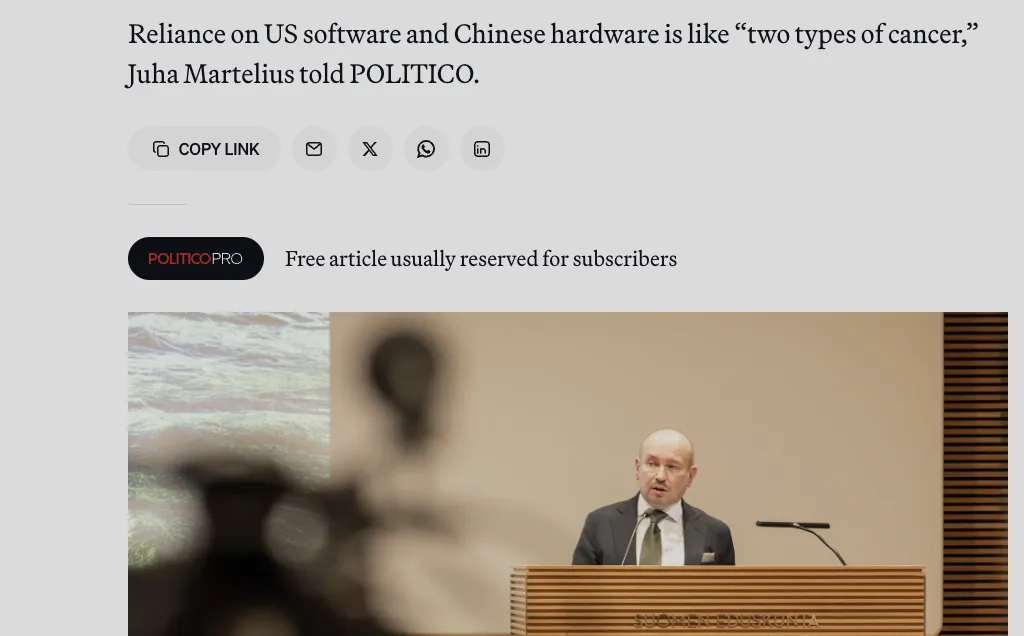
Juha Martelius, head of Finland’s Security and Intelligence Service, stated on May 18 that Europe may never fully rid itself of its dependence on foreign technology. According to him, dependence on American software and Chinese equipment poses a serious strategic challenge to the region’s security, which he described as “two types of risks.”
He made these remarks in a comment to Politico.
He said the continent is too dependent on software from the United States and equipment from China. Comparing this situation to an illness, Martelius noted that the European continent is like a body afflicted with two types of cancer that cannot be surgically removed, but which it will have to live with.
This statement came amid renewed calls from European leaders to strengthen strategic autonomy in the defense, digital, and technology sectors. In the coming weeks, the European Commission is set to present a Technology Sovereignty Package, which could restrict the use of American cloud providers by EU government agencies for processing confidential data.
In its annual report, the Finnish intelligence service also warned that the adoption of foreign cloud services threatens the digital independence of nations. Martelius cited the example of Finland, which abandoned the idea of storing election data in the cloud because foreign companies should not have access to information critical to national security.
Assessing the EU’s internal potential, the intelligence chief noted that Finland has cutting-edge research in quantum and space science, but, like the rest of Europe, suffers from a lack of capital. He expressed doubt about Europe’s ability to create its own cloud services that would match the efficiency of American hyperscalers.
In addition, Martelius questioned Europe’s ability to win a war against Russia without using foreign technology, emphasizing that this is currently impossible, and that European countries will have to decide whether they are prepared to rely solely on their own capabilities in the future or continue to depend on assistance from their U.S. allies.
Read also:


