
Iran is rebuilding underground missile bases following strikes by the U.S. and Israel — CNN
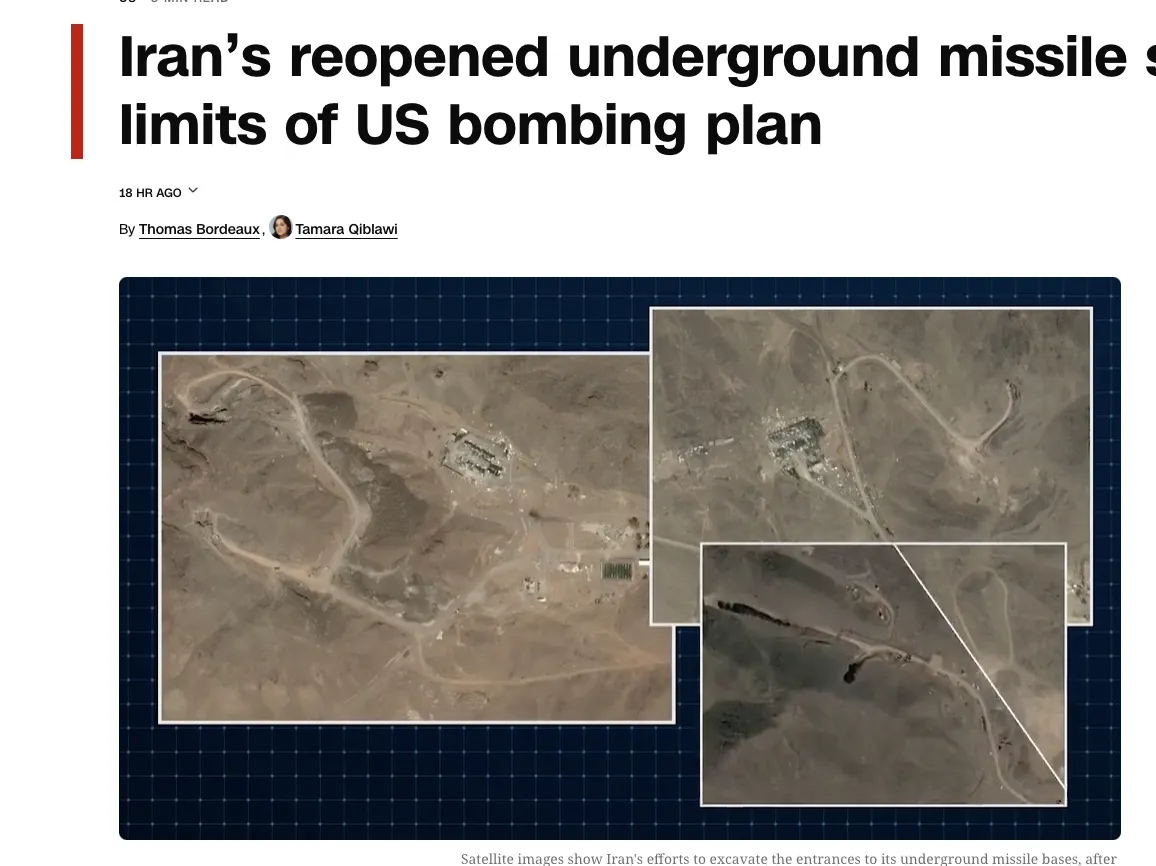
Iran is actively restoring underground missile bases that were struck by the U.S. and Israel. Iranian engineering units have managed to clear 50 of the 69 blocked tunnel entrances at 18 military bases, bringing them back into operation.
This is reported in a CNN investigation based on satellite imagery.
Journalists analyzed images of 18 Iranian underground missile complexes and found that of the 69 tunnel entrances that the Americans and Israelis had blocked with explosions in recent months, Tehran has already cleared 50. In addition to the entrances themselves, roads leading to the bases—which had also been destroyed—have been restored; most of the craters have been filled in, and at two sites, the pavement has even been repaved.
The most telling image comes from the base in Dezful: of the five blocked entrances as of May 12, four are already open, with only one remaining under the rubble. Near the complex in Isfahan, next to two entrances, the satellite counted at least 18 fresh craters—that’s how much ammunition was used to seal the tunnels. In mid-May, a dump truck was already operating near them, hauling soil to fill in the craters. At another base near the city of Qom, a satellite recorded at least a dozen construction vehicles simultaneously excavating one of the entrances.
A standard problem for the Pentagon, analysts say, is the asymmetry of costs. A strike on a tunnel costs millions of dollars and requires specialized munitions. Excavation costs only the fuel for a bulldozer.
“You have to use very complex and very expensive weapons to inflict such damage, while the restoration is done at the most basic level—it’s just bulldozers,” Timur Kadyshev, a senior researcher at the Institute for Peace Research and Security Policy at the University of Hamburg, explained to CNN.
The Iranians have been preparing for such a war for over 20 years, the expert added. The depth of some underground facilities reaches hundreds of meters of bedrock—the U.S. and Israel were unable to penetrate it with a direct strike, so the strikes targeted entrances and access roads. This proved insufficient.
According to experts’ estimates, Iran’s underground arsenals still hold about 1,000 missiles—and this number has likely been little affected by the strikes, as the munitions are stored at a depth inaccessible to aerial bombs.
“Nothing prevents the launchers from being reloaded with the substantial stockpile of missiles that the Iranians still possess,” noted Sam Lair, a researcher at the James Martin Center for Nonproliferation Studies. In his view, the U.S. achieved tactical success—temporarily “silencing” Iran’s missile forces. However, without a clear strategic objective for the war, this success risks turning into a “strategic failure.”
Strikes on production facilities also failed to produce a lasting effect. The U.S. and Israel struck factories producing electronics, rocket fuel, and missile casings, but satellite imagery shows that Tehran has already rebuilt some of them. An American official who spoke with CNN acknowledged: “The Iranians have exceeded all the recovery timelines projected by the intelligence community.”
The Pentagon did not respond to CNN’s specific questions about the images. Department spokesperson Sean Parnell limited himself to stating that “the U.S. military is the most powerful in the world and has everything necessary to act at the time and place chosen by the president.”
Iran and the U.S. recently reached a preliminary agreement to resume shipping in the Strait of Hormuz, but according to CNN sources, months of negotiations remain before a full resolution is reached. If hostilities flare up again, Tehran will have the means to fight—it has launchers, missiles, and crews.
Separately, analysts point to the problem of U.S. air defense: U.S. stocks of interceptor missiles are dwindling catastrophically, and it was these very missiles that shot down Iranian missiles during the war.
Read also:
U.S. Accelerates Reduction of Military Presence in Europe — Welt
The oldest U.S. aircraft carrier has set off on its final overseas deployment — Forbes


