
China and Russia have developed a plan to counter Starlink satellites
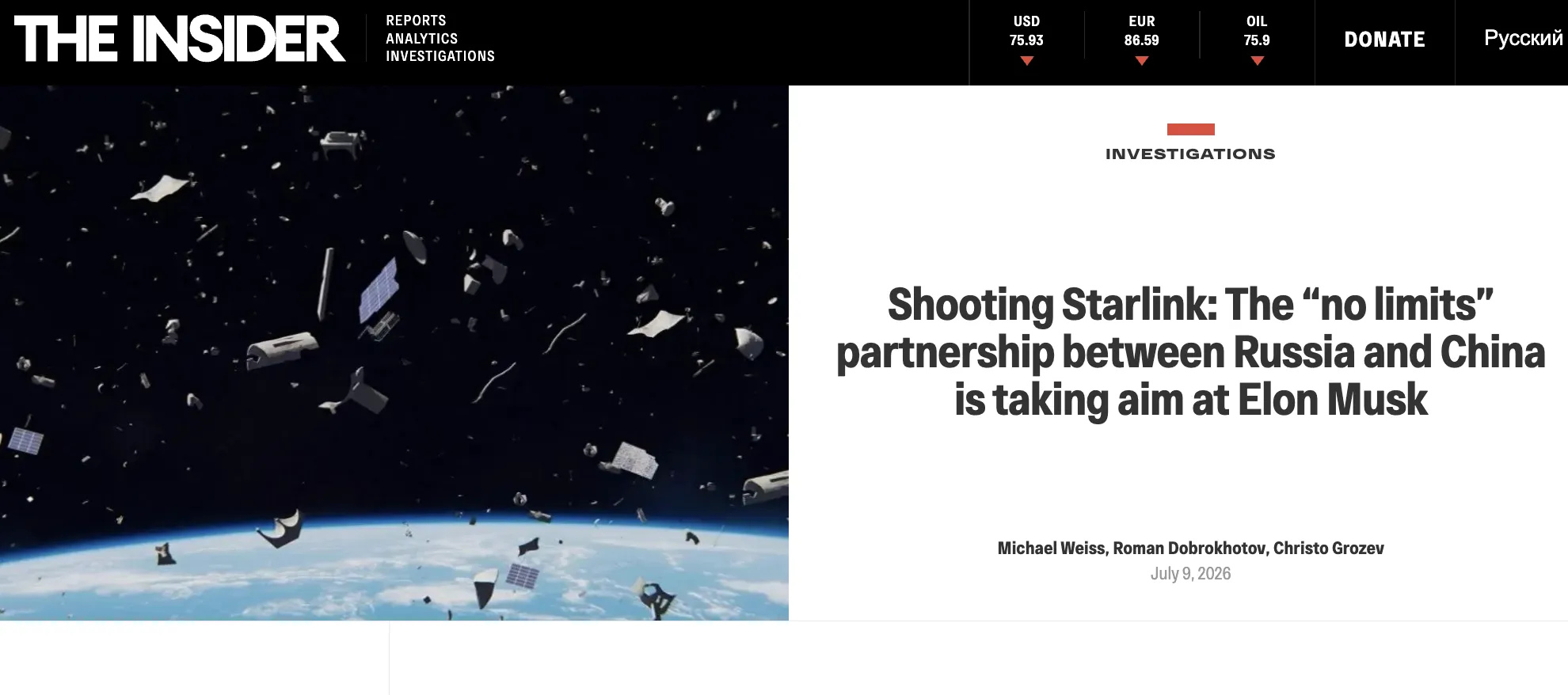
China and Russia are working on joint approaches to neutralizing the Starlink satellite network, which plays a vital role in modern military and civilian communications.
Back in November 2023, China and Russia agreed on a joint program to counter Elon Musk’s Starlink satellite network—ranging from diplomatic pressure to the physical destruction of satellites in orbit. At the same time, the parties agreed to develop a joint air and missile defense system and to exchange technologies in the fields of drones, armored vehicles, and aviation.
Journalists obtained presentations from the secret Third Sino-Russian Forum on Military-Technical Cooperation in Guangzhou, as well as the protocol of negotiations signed in Moscow. According to Mykhailo Fedorov, then-Minister of Digital Transformation and now Ukraine’s Minister of Defense, as early as the fall of 2023, Starlink had effectively become the backbone of the battlefield’s communications infrastructure: “Starlink is currently the lifeblood of our entire communications infrastructure,” he stated that September.
It was at this very time that Chinese engineers from the CASC corporation presented a three-tiered plan to counter the network. The first tier involves joint diplomatic pressure on international regulatory bodies under the pretext of the risk of collisions in orbit. The second involves blocking Starlink’s access to frequency bands and orbital positions, as well as creating a joint signal-jamming system. The third level involves the physical destruction of satellites: first through cyberattacks on user terminals, and then using inexpensive weapons capable of taking out the satellites faster than SpaceX can launch replacements. NATO intelligence had previously reported on similar developments, noting Russia’s work on area-of-effect anti-satellite weapons.
Five months before the forum in Guangzhou, a Chinese military delegation led by a colonel from the Central Military Commission spent nine days in Moscow in talks with the manufacturer Almaz-Antey. The result was a ten-page working summary, signed on June 5, 2023, regarding the joint development of an integrated air and missile defense system to intercept hypersonic missiles in the terminal phase of their flight.
The technical specifications agreed upon in Moscow call for the interception of medium-range missiles at distances of up to 4,000 km, targets with lateral acceleration of up to 25 g, and hypersonic missiles at altitudes of up to 40 km. With these parameters, the system would surpass even Russia’s newest S-500 complex. The first phase of the program covers the joint development of dual-use missile technologies and the integrated management of ground-based, airborne, and electronic warfare assets.
Technology Exchange: Drones, Armored Vehicles, and Aviation
The documents also outline the partnership formula—Russian combat experience in exchange for Chinese technology. Beijing is offering Moscow expertise in artificial intelligence and mass production to develop a new generation of loitering “swarm” munitions, while Russia is sharing data from the front lines. According to Ukrainian military intelligence, the V2U drone currently used by Russian troops operates on Chinese artificial intelligence modules, lidars, batteries, and storage devices.
Some presentations focused on the development of next-generation armored vehicles, drawing on experience gained from the destruction of Russian vehicles in Ukraine, as well as aviation technologies—here, according to a former U.S. Air Force officer, the situation has taken a 180-degree turn for the first time: it is not China that is buying Russian developments, but rather China itself that is offering assistance to Moscow.
The reports caused concern in European capitals. The German foreign minister emphasized that the scale of China’s support for Russia runs counter to Europe’s key security interests. Analysts from the U.S. and the U.K. believe that the joint air defense system could be designed to intercept new American ground-based hypersonic missiles early in their flight, with implementation expected around 2030. The next—and sixth—secret forum on military-technical cooperation between Russia and China is scheduled for late 2026 in St. Petersburg.
Source: The Insider
See also:
Russia Deploys Electronic Warfare Systems to Block Starlink – Reuters
On June 15, the 422nd Unmanned Systems Regiment of the 17th Army Corps and the SBU’s “A” Special Operations Center successfully struck such a station in the southern sector.
In occupied Kerch, a Russian “Volna Kupol Garant” electronic warfare system, which was used to jam Starlink satellite communications, was destroyed.


