
Chinese scientists have discovered 32 species of organisms at depths of up to 11 km in the Pacific Ocean
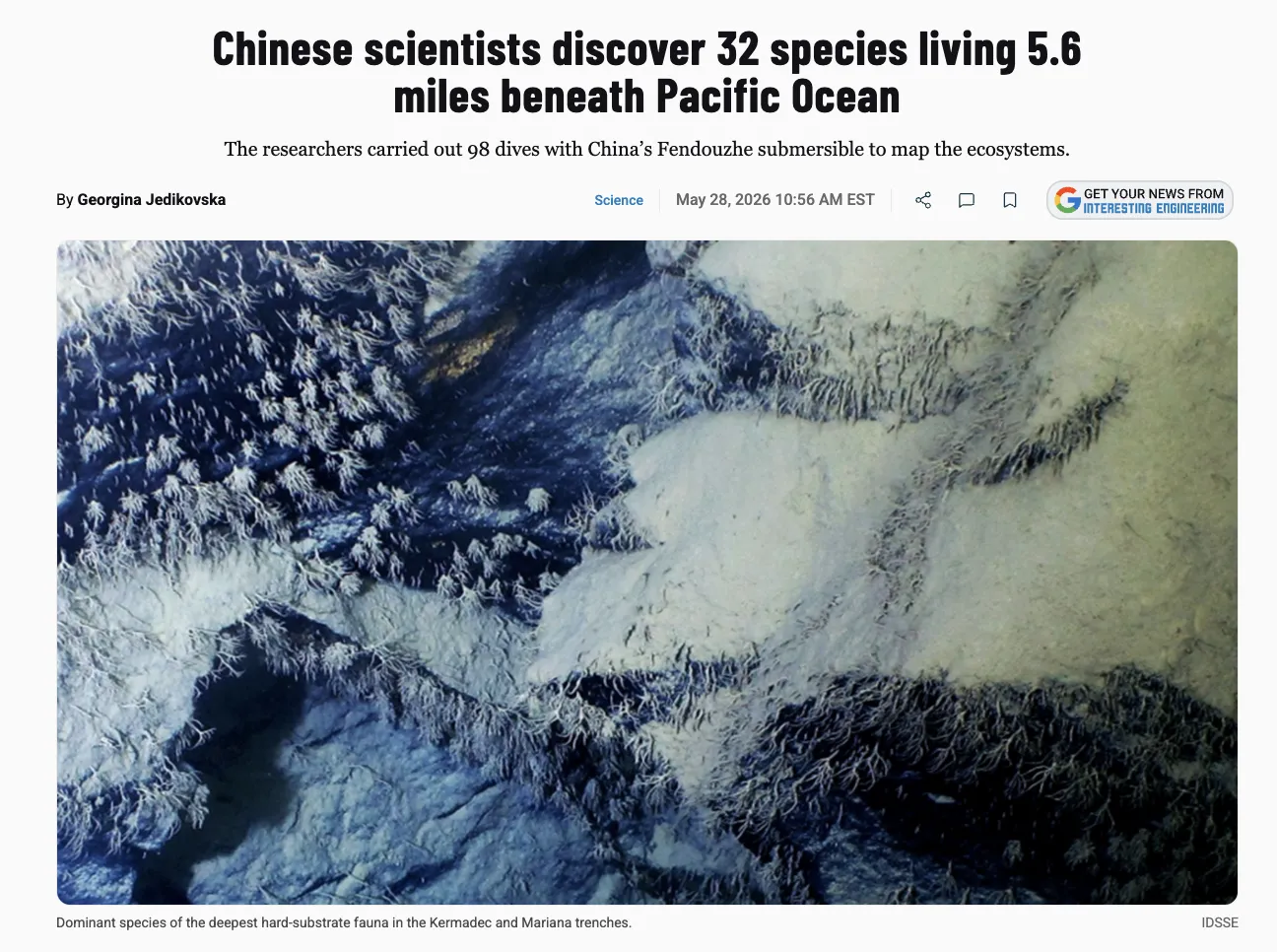
During expeditions at depths ranging from 6 to nearly 11 kilometers, Chinese researchers discovered 32 species of living organisms, most of which were previously unknown to science.
This is reported by Interesting Engineering.
The research was conducted by scientists from the Institute of Deep-Sea Science and Engineering at the Chinese Academy of Sciences as part of the Global Abyssal Zone Research Program. The goal of the project is to better understand life in the deepest parts of the ocean.
The hadal zone extends to depths of 6 to 11 kilometers and consists mainly of remote oceanic trenches and basins. It was previously believed that life there was virtually impossible due to the immense pressure, darkness, and low temperatures.
From 2020 to 2024, researchers conducted 98 dives in the manned submersible Fendouzhe in seven deep-sea regions, including the Mariana and Kermadec Trench. The submersible is designed for three people and is capable of diving to depths of over 10 kilometers.
During the expeditions, scientists discovered developed ecosystems of microscopic organisms living on exposed rocky surfaces in near-freezing darkness. A total of 32 species across six types of living organisms were recorded, most of which were new to science.
According to Professor Peng Xiaotong of the Institute of Deep-Sea Science and Engineering, the most unexpected discovery was four new, very small species measuring just a few millimeters. They were found in large numbers and dominated the organisms inhabiting the rocky areas of the Kermadec Trench.
Among the discoveries are a new family of single-chambered foraminifera, Plumettidae, and a new family of bryozoans, Pierrellidae. The most common inhabitants turned out to be agglutinated foraminifera, which researchers call “stone feathers.”
These organisms can be thread-like, tubular, or dome-shaped and form dense colonies. On a rock surface measuring about one square decimeter, scientists counted up to 4,300 individuals.
Due to their small size and simple structure, scientists were unable to accurately classify these organisms for a long time. Their nature was finally determined using genetic and metagenomic analysis.
The study also changed our understanding of how inhabitants of ocean trenches survive. Previously, scientists assumed that they obtained energy through chemosynthesis, like organisms near hydrothermal vents.
However, partially digested pine pollen was found inside the organisms. This indicates that they feed on organic debris that sinks to the ocean floor.
The topography of the trenches also supports the ecosystem. The V-shaped walls direct organic matter downward, while underwater currents clear exposed rocks of sediment. This allows organisms to attach to vertical rock surfaces and capture nutrient particles carried by the currents.
Similar communities have also been found in the Aleutian, Kuril-Kamchatka, Atacama, Puysegur, and Mussau trenches. This may indicate the prevalence of such ecosystems in many of the deepest regions of the world’s oceans.
According to the researchers, these organisms may account for 2% to 11% of the total eukaryotic biomass in the hadal zone and play an important role in carbon sequestration at great depths.
The expedition also set new depth records for several groups of marine organisms. In particular, the deepest recorded bryozoan was found at a depth of 9,981 meters, and a scyphozoan jellyfish colony at a depth of 9,982 meters.
Previously, the Japanese probe Hayabusa-2 delivered organic compounds from the asteroid Ryugu. And NASA researchers detected organic compounds, including sugar molecules, in samples brought back from the asteroid Bennu.
The Curiosity rover has identified more than 20 types of organic molecules, including a nitrogen-containing compound structurally similar to the building blocks of DNA.


