
A new discovery in Kenya has changed our understanding of an ancient human relative
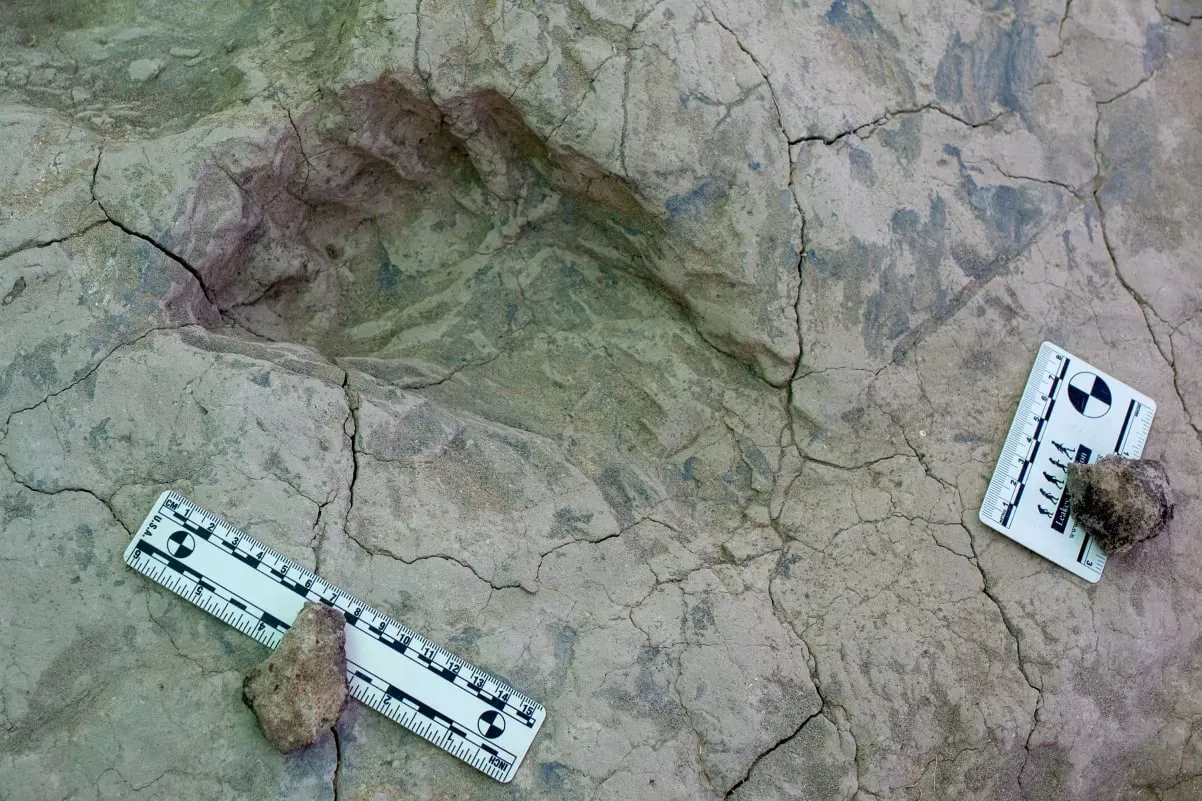
Scientists have revised their understanding of Paranthropus boisei, known as the “Nutcracker Man.” A new analysis of fossil footprints found in Kenya suggests that this extinct human relative may have been significantly taller and heavier than previously thought.
In addition, the footprints suggest that members of this species likely traveled in groups. This may indicate more complex social behavior among ancient hominins.
The study’s findings were published in the journal *Proceedings of the National Academy of Sciences* (PNAS).
Paranthropus boisei lived in East Africa approximately 2.3 to 1.2 million years ago. It earned the nickname “Nutcracker Man” because of its large molars and powerful chewing muscles.
Previously, based on the remains found, scientists believed that males of this species were approximately 131 centimeters tall and weighed about 49 kilograms. However, new calculations based on the dimensions of 21 recently discovered footprints showed that some individuals of Paranthropus boisei could have reached 1.8 meters in height and weighed up to 75 kilograms.
The researchers also analyzed the arrangement of the footprints and concluded that they were left by eight individuals who were passing through the Kobi-Fora Formation near Lake Turkana at the same time. According to the study’s authors, this may indicate that they were traveling in a group.
“This site has captured a remarkable moment that allows us to see the anatomy, locomotion, behavior, and habitat of ancient humans,” said lead author Kevin Hatala.
According to him, the fossilized tracks offer a rare opportunity to see not only the physical structure of ancient humans but also their behavior.
Hatala speculated that the group may have consisted solely of adult males due to the danger posed by large animals, particularly hippos.
The footprints, which are about 1.4 million years old, are well-preserved. Their depth reaches up to 12 centimeters in some places. Scientists believe they were formed in soft mud in the shallow waters near a lake.
The first seven footprints were discovered as far back as 1978. During excavations in 2016 and 2023, archaeologists uncovered another 14 human footprints, as well as footprints of hippos and antelopes.
Paranthropus boisei was not the only species living near Lake Turkana during that period. For hundreds of thousands of years, this species coexisted with Homo erectus.
In a previous study published in 2024, Hatali’s team reported the discovery of footprints from two different species of early humans, left just a few days apart. The researchers speculated that they belonged to Homo erectus and Paranthropus boisei.
“We cannot say how these two species interacted with each other in this marshy terrain, but we know that they were here at the same time,” the study stated.
Unlike Homo erectus, which already had body proportions similar to those of modern humans and was well-adapted to walking upright, Paranthropus boisei retained more features characteristic of earlier hominid primates.
At the same time, the footprints of Paranthropus boisei closely resemble those of Homo erectus and modern humans, although they have several important differences.
Previous studies have shown that footprints left during the Early Pleistocene have a lower arch than those of modern humans.
According to Hatali, this does not necessarily mean that the foot was flatter, but it indicates a different way the foot made contact with the ground while walking.
In addition, the big toe in these footprints is positioned at a greater angle relative to the other toes.
“Both of these features differ from what we typically see in modern humans. That is why we hypothesized that such footprints most likely belong to Paranthropus boisei,” the researcher explained.
To ensure that the characteristics of the footprints were not solely due to the type of soil, the team conducted a series of experiments on various surfaces and used re-moistened mud similar to that in which the fossil footprints were preserved.
“In our experiments, we used a wide range of different surface types and conducted a series of tests with re-moistened silt of the same type in which these Early Pleistocene tracks were preserved,” noted Hatala.
Scientists first discovered the remains of Paranthropus boisei back in the 1950s, but determining the actual size of this species was difficult due to a lack of bones that could be unequivocally attributed to it. Previously, larger bones were usually attributed to Homo erectus, while smaller ones were attributed to Paranthropus.
“Perhaps these two species were much closer in body size than we previously thought,” Khatala suggested.
Scientists note that the fossilized footprints are unique because, unlike bones or teeth, they capture a specific moment in the lives of ancient humans.
Source: CNN.
Zelenskyy appointed Ukraine’s ambassador to Somalia.
In Tanzania, the newspaper MwanaHALISI has been suspended for six months.
Zelenskyy has appointed Ukraine’s ambassador to Somalia.


