
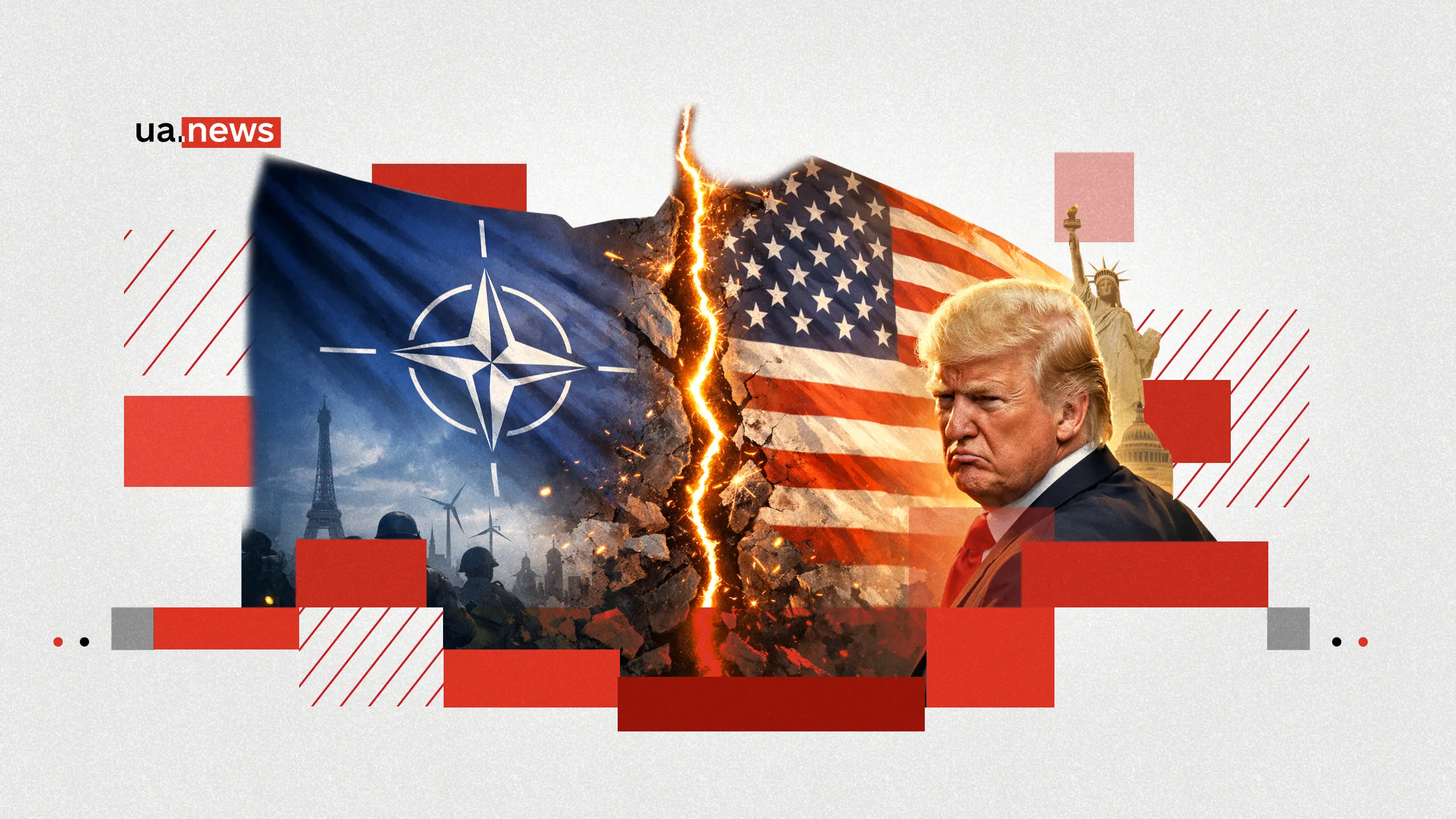
The world has long grown accustomed to the fact that U.S. President Donald Trump does not hold back in public rhetoric. However, recently he made a statement that made the entire Western bloc uneasy: he said he is “absolutely seriously” considering withdrawing the U.S. from NATO.
The formal reason for these words seems to be personal offense: Europeans refused to support a U.S.-Israel operation against Iran. In response, Trump called the Alliance a “paper tiger” and stated that America could entirely end its membership. NATO Secretary General Mark Rutte is now urgently traveling to Washington, and European capitals are gripped by quiet panic — which they try not to show publicly, but which is evident in every statement.
What is happening is not just another high-profile media stunt by the American leader, but a serious symptom of a deep crisis in the Western security system. So, could the U.S. leave NATO? What would happen to the Alliance if such a scenario were realized in practice? What lessons should Ukraine draw? Political analyst Mykyta Trachuk of UA.News explored the issue.
Legal Aspect: Can the U.S. Leave NATO?
The North Atlantic Treaty, signed in 1949 in Washington, contains Article 13. It clearly states that any member state may withdraw from the Alliance by sending an official notice of denunciation of all agreements to the U.S., as the treaty’s key depositary. After one year, membership ends. However, no country has ever used this article. France and Greece once left NATO’s military structure but did not withdraw from the treaty itself. Thus, there are no precedents, but the mechanism is entirely clear and simple.
If the U.S. itself wanted to leave, a curious legal quirk would arise. Technically, America would have to send an official notice of withdrawal to itself. Formally, this could be done through an internal order to the Secretary of State. Politically, it would seem somewhat absurd — though still perfectly legal.
A more serious obstacle is U.S. domestic law. During Biden’s presidency in 2024, Congress added specific provisions to the defense budget law. According to these, no president can withdraw the U.S. from NATO without the approval of two-thirds of the Senate or without a separate law passed by both houses. At first glance, this seems to block any potential Trump attempt, as Congress is unlikely to support such a move. But it’s not that simple.
In U.S. legal practice, there has long been debate: does the president have exclusive authority to withdraw from international treaties, or is Congress’s consent required? During Trump’s first term, the White House legal team produced a memo arguing that the president could do this independently. That document has never been revoked. Additionally, there is a workaround. Trump could avoid formally leaving NATO and simply render the organization ineffective: withdraw U.S. troops (about 80,000 soldiers) from Europe, stop funding joint commands, cease participation in exercises, ignore allies’ requests for assistance, and so on. Formally, the U.S. would remain in NATO, but real participation would end.
So the answer to the question “Can the U.S. leave NATO?” is yes — it can. Although it would be a long, scandalous, and far from guaranteed process. In politics, anything physically possible is possible. The North Atlantic Treaty is just like any other international treaty, and NATO is simply a military-political bloc. Any treaty can be terminated, and any organization can be left, if there is a will to do so.
What Would Happen to NATO Without the U.S.?
Let’s imagine that America actually went completely off the rails and left the North Atlantic Alliance. What would happen then? Most likely, nothing — in the sense that NATO as we know it would cease to exist.
This organization was never truly an equal partnership of thirty-two countries. It has always been a system in which the U.S. acted as the core, the cornerstone, the guarantor, the main financial contributor, and the key military force. European allies are accustomed to the role of junior partners. For decades, they reduced defense budgets, relying on the American “umbrella.” But as it turns out, this “umbrella” can disappear at any moment.
There are three key components that make NATO the organization we know:
1. Nuclear deterrence. Several European countries host American nuclear bombs. Formally, the weapons belong to the U.S., but in case of war, they can also be deployed by allied aircraft. Without Washington, this force is essentially “dead.” If the U.S. leaves, Europe would be almost without nuclear weapons. France and the U.K. have arsenals, but these are purely tactical weapons for domestic security and insufficient for defending the entire continent.
2. Conventional military capabilities. About 80,000 U.S. troops are stationed in Europe. American aviation, air defense systems, logistics, satellite reconnaissance, etc., are integral to the continent’s defense architecture. Without them, the existing European armies — mostly “on paper” — would face severe difficulties. Even Europe’s strongest militaries (Turkey, France, the U.K., Germany, Poland) collectively fall short of the U.S. in all metrics.
3. Political unity and trust. NATO without the U.S. is a body suddenly without its brain. Such a body could move chaotically for a time, but it would no longer be a unified organism. NATO’s foundation has always been less about legal rules and more about political will centered in Washington. Without the U.S., the bloc loses its meaning for most members, turning into a true “paper tiger.” It is unrealistic to expect troops from Portugal or Italy to defend the Baltic states, Montenegro, or Luxembourg in case of aggression.
The most likely scenario if the U.S. exits is not the preservation of NATO in any recognizable form, but its collapse or transformation into one or several new regional defense alliances. For example, a Baltic-Black Sea union including Poland, the Baltic States, possibly Finland and Sweden, and hypothetically Ukraine. Or a Franco-British grouping for Western Europe, led by nuclear Paris and London.
This remains theoretical — reality could be a mix of these scenarios or produce something entirely new. However, it is almost certain that if the U.S. leaves NATO, the Alliance will cease to exist in its classical form.
Ukrainian Context: Lessons and Takeaways
For Ukraine, Trump’s statements are not just more bad news from Washington — they strike at the very foundation of foreign policy strategy. Ukraine’s desire to join NATO has long been a “sacred cow.” It is even enshrined in the Ukrainian Constitution — the only such case in history, as none of the 32 NATO members changed their constitution on the path to accession.
The idea seems simple: join NATO, gain Article 5 guarantees (which in reality guarantee little), and be safe. But it’s time to abandon fantasies and look at the reality of April 2026. The president of the U.S., the Alliance’s key player, publicly calls NATO a “paper tiger” and considers leaving. European allies are simply confused (as always) and unsure how to respond.
They did not support the U.S. in the war in Iran. In case of a European war, America might similarly not support them. The entire Alliance begins to feel like a fiction — a simulacrum of something that no longer exists in reality. Ukraine risks trying to jump onto a train headed into an abyss — into a “yesterday” that is long gone.
Of course, no one in Ukraine will publicly say, “We no longer want NATO,” or amend the Constitution to remove NATO ambitions. President Zelensky has repeatedly stated Ukraine is ready to join immediately — the question is whether NATO itself actually wants Ukraine. Clearly, membership is impossible while the war continues. But when/if the war ends — will NATO still exist as we know it? That remains unanswered.
Key lessons for Ukraine:
- Stop viewing NATO as the only possible path forward. The “choice without choice” does not exist naturally; it has been artificially imposed by shortsighted politicians. There are always alternatives, especially at the state level. This does not mean abandoning the Euro-Atlantic course (Ukraine’s place is undeniably in the West), but it does mean rethinking it pragmatically.
- Actively build or at least seriously discuss potential regional security alliances in Central and Eastern Europe. Concepts like Intermarium, the Bucharest Nine, the Lublin Triangle, the Three Seas Initiative exist and should be revitalized, moving from political declarations to real agreements, including military ones. Ukraine, as a victim of aggression, should be a leader and vanguard in this process.
- Negotiate direct bilateral collective defense agreements with key partners.
- Invest in Ukraine’s own military and defense industry as if NATO does not exist. Ukraine today has the most combat experience in Europe. Its forces have been fighting the Russian army for five consecutive years. This experience is invaluable but must be converted into technology, without relying on the “Uncle Sam” to generously provide or sell air defense missiles.
The world we knew is rapidly disappearing. What is happening is not accidental, but inevitable. There will be no “return to normal.” It is time to grow up and stop hoping someone else will solve our problems. NATO has never been and will never be a panacea or a 100% security guarantee. It is only a tool: still financially and technically strong, but not eternal. If the tool fails, it must either be quickly repaired or replaced. There is no third option.


