
NYT: The wars in Ukraine and Iran have more in common than meets the eye
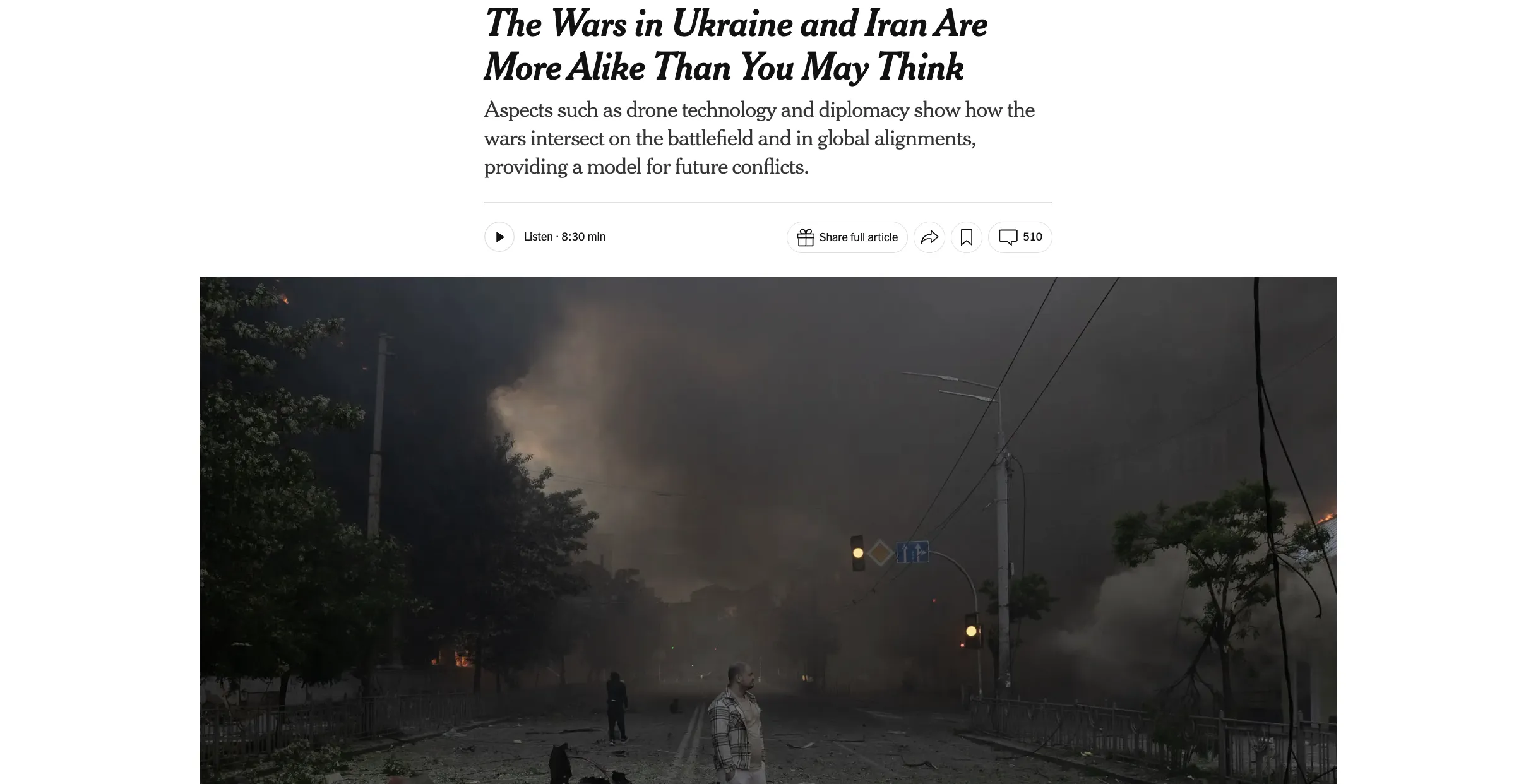
Despite the different nature of the hostilities, the wars in Ukraine and around Iran exhibit similar strategic and technological trends. As The New York Times notes, both conflicts demonstrate the growing role of precision-guided weapons, drones, infrastructure strikes, and a war of attrition.
In both cases, the states with greater military capabilities faced miscalculations: Russian leadership had counted on a quick victory when launching its operation, while U.S. President Donald Trump predicted that the campaign against Iran would last four to five weeks. Experts attribute this to the excessive expectations and arrogance of both attacking parties. Despite progress in the negotiation process regarding a peace plan, the resumption of U.S. strikes on Monday maintains uncertainty, but both conflicts are already demonstrating a fundamental transformation of modern methods of warfare.
Asymmetric defense tactics have become the primary deterrent against superior forces. Iran was able to pressure the U.S. through its allies by attacking military bases and energy infrastructure in Saudi Arabia and Kuwait with kamikaze drones, as well as by blocking traffic through the Strait of Hormuz using mines and high-speed boats. For its part, Ukraine is striking Russian oil refineries, eliminating military leadership in Moscow, and using maritime drones to neutralize the Russian Black Sea Fleet.
The conflicts have significantly accelerated the spread of advanced technologies, particularly artificial intelligence and high-precision systems. For example, to protect Prince Sultan Air Base in Saudi Arabia, the U.S. deployed AI-based drone detection systems that were originally developed in Ukraine to defend against Russian airstrikes. Meanwhile, in Lebanon, the Hezbollah group has begun attacking Israeli forces with explosive UAVs controlled via fiber-optic cable, a tactic that mirrors those widely used on the Ukrainian front. Overall, the integration of multi-layered sensors, guided missiles, and low-cost drones is democratizing access to high-precision weapons, making them available not only to large armies but also to small states or non-state actors, as is already being observed in Mali.
The tactics of air attacks in the Persian Gulf are based on the experience of the synchronized use of ballistic missiles and swarms of drones, first tested by Russia in Ukraine. Iran, which supplied Moscow with Shahed-type kamikaze drones in 2022, is now using the same models in the Middle East. In return, Russia is providing military support to Tehran by transporting UAV components across the Caspian Sea.
Additionally, cooperation in the field of electronic warfare has been documented: Iranian vessels in the Strait of Hormuz are using Russian methods of spoofing satellite coordinates to evade U.S. Navy monitoring, mimicking the practices of Russia’s “shadow fleet.” Also in March, Russian anti-jamming equipment was discovered in an Iranian drone targeting a British base in Cyprus. Against this backdrop, European countries are concerned about a possible expansion of Russian arms supplies to Tehran should peace talks collapse.
The war in the Middle East benefits the Kremlin, as it has delayed a peaceful settlement in Ukraine and diverted U.S. attention and resources. The conflict has also strained Washington’s relations with European allies, who view U.S. actions as illegal, and triggered a global energy crisis, forcing a number of countries to purchase cheaper Russian oil and gas.
However, the crisis has opened up new diplomatic opportunities for Ukraine, which has signed security agreements with Qatar, Saudi Arabia, and the UAE. Kyiv is offering these countries its expertise in UAV development and military training in exchange for financial investments in Ukraine’s defense industry, air defense systems, and diplomatic support, which is undermining the Gulf states’ former neutrality toward Russia.
Since the U.S. virtually halted arms supplies to Ukraine last year, Europe has become its main financial and military donor. In particular, the EU recently allocated a €90 billion loan to support Kyiv.
However, Europe’s long-term ability to assist Ukraine depends on the stability of its own economy, which is under threat due to shortages of goods and fuel caused by the blockade of the Strait of Hormuz. For European security, the Iranian conflict has become a critical factor, as instability in the Middle East directly undermines the EU’s ability to support its main strategic priority—the Ukrainian front.
On the eve of the announcement, U.S. President Donald Trump stated that significant progress had been made in negotiations with Tehran, noting that as part of a potential agreement, Iran could transfer its highly enriched uranium to the United States.
Iran’s Supreme Leader has bannedthe transfer of enriched uranium.


