
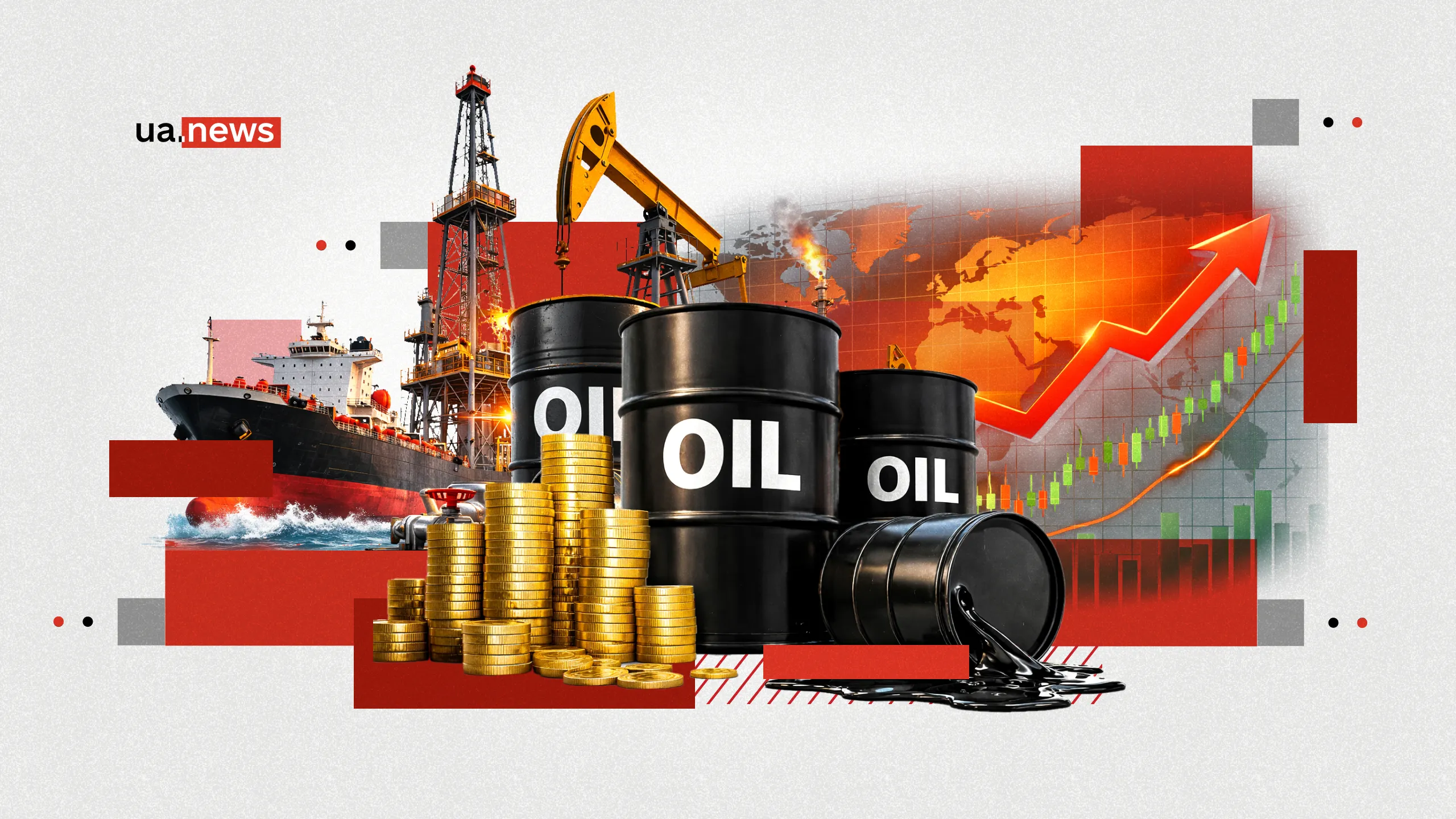
On Monday, 9 March, global markets experienced another shock. The price of Brent crude opened at nearly $119 per barrel on the London exchange. For comparison: in January, it hovered around $60, and no one expected that in less than two months we would see such numbers.
Analysts suggest that if the Strait of Hormuz remains closed, prices could surge as high as $215 per barrel — a level unprecedented in history, even accounting for inflation. Interestingly, Russian Urals crude on the Indian market has already surpassed Brent prices.
So what is happening in the oil market right now? Who stands to gain, and who bears the cost? What can Ukraine expect? Political commentator Mykyta Trachuk, together with experts, analyzed the situation.
The Price of War: why oil is skyrocketing
For the second week in a row, the Middle East is aflame. US and Israeli airstrikes hit Iranian territory, while Tehran responds with missile attacks across the region — from Lebanon to the UAE and Saudi Arabia. On the third day of the conflict, what markets had feared for decades happened: the Strait of Hormuz effectively stopped functioning.
Why is this narrow waterway between the Persian and Oman Gulfs so important? About 20% of the world’s oil and liquefied gas passes through it daily. Saudi Arabia, the UAE, Kuwait, Iraq, Qatar — all their oil exports rely on Hormuz. Its closure is a major shock to the oil market, affecting the global economy.

Interestingly, Iran has not officially closed the strait. It only threatened to attack any ship attempting to enter and carried out its threat a few times. That was enough: shipowners are unwilling to risk tankers or crews. Insurance companies either refuse coverage or raise premiums to unprecedented levels. Hundreds of tankers now sit idle in the Persian Gulf, unwilling to enter the dangerous waters. Major shipping companies have already rerouted vessels around Africa via the Cape of Good Hope. This solves the transport problem but adds weeks to transit times, which also drives prices higher.
The problem extends beyond transportation. Production infrastructure has also been hit. Iraq, OPEC’s second-largest producer, reports a nearly 60% drop in output. Saudi Arabia, the UAE, and Iran are either cutting production or shutting down fields entirely because storage tanks are full and tankers are idle.
The global energy sector faces a dangerous challenge, potentially more severe than in 2022. This region supplies all of Asia and much of Europe. Investment banks warn that fuel prices — gasoline, diesel, aviation fuel — could reach historic highs if the situation in the strait does not normalize soon. For now, traders are speculating upward, and each new strike in the region adds to the per-barrel cost.
Who Benefits and Who Pays: the geo-economic picture
In any crisis, there are winners and losers. The current situation is no exception.
Main beneficiary: Russia. The higher global oil prices, the more exporters earn. For the Kremlin, which has been funding the war against Ukraine mainly with oil revenues for five years, this price spike is a windfall. The Russian economy has struggled under sanctions, the budget deficit has grown, and the government has had to raise taxes. Suddenly, this sudden fortune appears. Even though Urals crude is sold at a discount due to sanctions and the price cap, its value rises with global benchmarks. Every extra dollar per barrel brings billions of rubles to Russia’s budget.
Second beneficiary: The United States. America is a major oil exporter, so high world prices mean extra profits for US producers. The US also holds strategic petroleum reserves, and market maneuvering can yield significant returns. Although gasoline for ordinary Americans has risen by 16% during the war, the administration is reportedly considering coordinated reserve releases to lower prices.
Other winners include unaffected exporting countries — Venezuela and some African nations (Nigeria, Libya) — which can profit from high prices. US shale producers are also increasing output. But everyone knows the situation could change rapidly.
Losers: The list is longer. China — the world’s largest oil importer — suffers as its economy slows, and expensive oil further hits industry and logistics. Up to 18% of China’s oil previously came from Iran. India, Japan, and South Korea also face higher import costs.
Europe, still dependent on Russian energy despite 2022 efforts, now pays double. Diesel and gasoline prices are rising, industrial production is cut due to expensive energy, and inflation — already hard to control — surges again.
Oil Crisis and Ukraine
For Ukraine, this crisis is a severe blow at a time of exhaustion. Five years of full-scale war, a strained economy, heavy mobilization, and daily shelling — now compounded by a skyrocketing fuel price.
Experts, including government representatives, forecast gasoline and diesel shortages as early as April. As of 9 March, the average price of A-95 gasoline reached 70 UAH per liter and continues rising. Autogas has increased about 20%. Analysts warn that by the end of the week, diesel could rise to 80 UAH per liter. This is only the beginning: imported fuel follows world prices.
The most critical issue is the upcoming sowing season. Farmers need hundreds of thousands of tons of diesel to reach the fields. Without it, autumn harvests are at risk. For a country feeding millions globally and earning from grain exports, this is strategic survival.
The government promises inspections and price controls, but the market dictates reality. Traders buy at world prices and will not sell at a loss. The hryvnia is unstable. For ordinary Ukrainians, this means higher costs, rising inflation, and wages that fail to keep pace.

Oil price outlook
Predicting oil prices now is extremely difficult due to multiple variables and high geopolitical risks. However, scenarios can be outlined:
Optimistic: The conflict ends quickly. Prices could fall back to $80–90 and continue declining, possibly returning to $60 by early next year. Increasingly unlikely.
Moderate: The war drags on for months. Iran remains active, the US resolute. Prices stabilize at $100–120 per barrel — the forecast most analysts currently support.
Pessimistic: The Strait of Hormuz is blocked long-term. Iranian strikes disrupt key infrastructure in Saudi Arabia, Qatar, the UAE, etc. Oil could reach $150–215 per barrel, a global economic catastrophe. Excessively high prices reduce demand, industry cuts production, and prices often drop sharply, as in the mid-1980s Iran-Iraq war.
Expert opinion
Economist Yuriy Havrilechko compares the current situation to 1973 in terms of oil price trends. He expects oil to rise to $130–150 per barrel, driven not by a physical shortage but by panic and ripple effects across production and logistics.
“Fear is factored into the price — fear of supply disruption. Several factors drive this: tanker and infrastructure attacks, production cuts in targeted countries, insurance refusals. If the war ends in a month or two, prices spike to 150 then drop by at least half. If it lasts six months to a year, the price peaks at 150–170 then gradually falls to 110–130. If the conflict escalates further, $150–200 could become the new equilibrium. Each extra $10–20 per barrel currently adds 0.5–1% to global inflation; after $150, $30–40 per barrel adds similar inflationary effects,” says Havrilechko.
For the global economy, slowdowns will affect all, including the EU and China. US military spending may partially offset oil price shocks through increased production of weapons, ammunition, food, and other supplies.
“For Ukraine, the negatives are far greater: higher fuel, logistics, electricity, production costs, storage, and spring fieldwork costs. Russia gains more resources for war through increased oil profits. There’s also a risk the EU may ease some sanctions on Russian gas and oil,” Havrilechko adds.
In summary, the middle scenario seems most likely: prices remain high but not catastrophic during the active conflict phase, then gradually decline. For Ukraine, this means preparing for another difficult year — high fuel prices, expensive imports, inflation, all amidst a war with no end in sight.




