
A revolutionary drone from the U.S. has broken the sound barrier for the first time
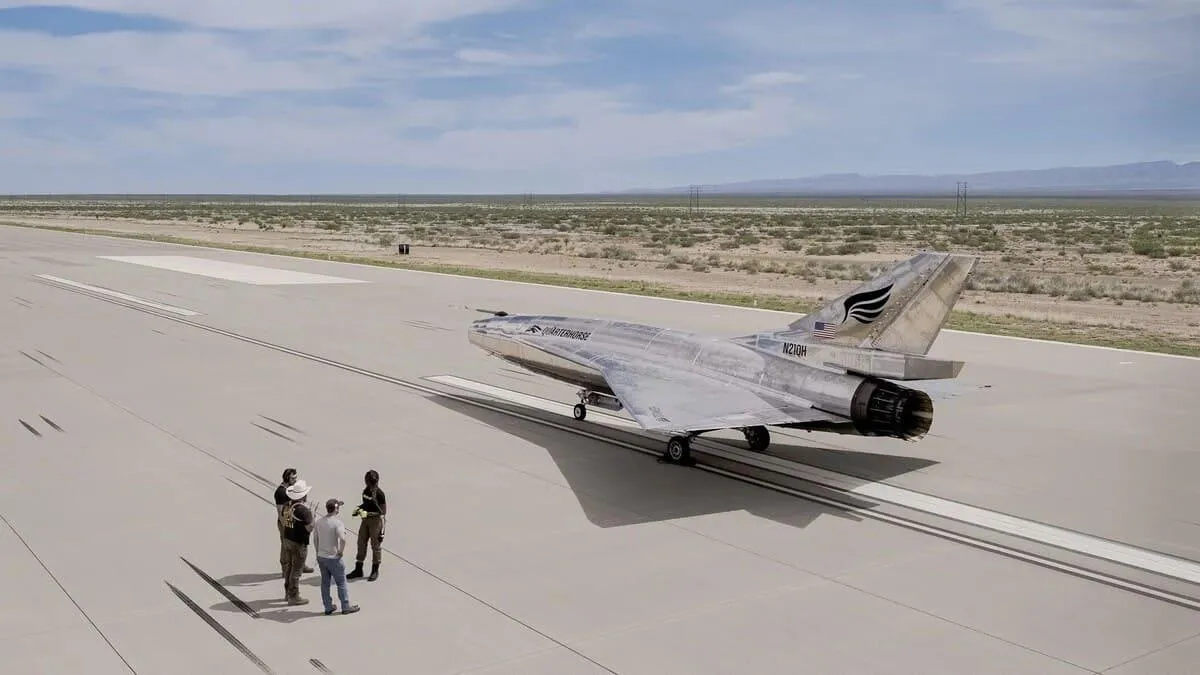
A new experimental unmanned aircraft has been tested in the U.S., marking the first time such a craft has flown at supersonic speeds. The aircraft is based on test technologies that could serve as the foundation for the development of a hypersonic passenger jet in the future. The American company Hermeus reported that its Quarterhorse Mk 2.1 drone, which is the size of an F-16 fighter jet, successfully completed its first supersonic flight
FlightGlobal reports on this.
The flight was launched from Spaceport America over the airspace of the White Sands Missile Range, located in the state of New Mexico. The Quarterhorse Mk 2.1 reached a speed of 1.21 Mach (approximately 1,480 kilometers per hour).
This was the Quarterhorse Mk 2.1’s third flight and took place less than three months after the unmanned jet’s first test flight in early March. The Mk 2.1’s first and second flights were conducted at subsonic speeds.
"This flight demonstrates a pace of work that is extremely rare in modern aviation," said Hermeus co-founder and CEO A. J. Piplica. "Our country’s ability to rapidly develop new asymmetric military capabilities at scale depends on teams that can quickly solve complex technical challenges."
Hermeus has repeatedly stated that rapid iteration in the aircraft design and production process is a key element of the company’s business strategy.
The Quarterhorse line serves as a kind of laboratory: technologies for promising military systems are developed on its basis, and in the future—for a hypersonic passenger aircraft.
Hermeus notes that the current pace of engineering work and testing allows the company to expect the creation of a fully-fledged hypersonic aircraft by 2030.
Within the Mk 2 series, Hermeus plans to develop three variants, each of which will advance the company closer to its goal. The Mk 2.1 has already broken the sound barrier, while its successors, the Mk 2.2 and Mk 2.3, will achieve even higher speeds. The Mk 2.2 is already in production.
The Quarterhorse family of aircraft is designed for autonomous takeoff and landing, unlike many other experimental aircraft.
Advanced engine technology is a key focus for the company. While the Mk 2.1 is equipped with a standard Pratt & Whitney F100 engine, subsequent aircraft will utilize more advanced solutions.
Hermeus is currently developing the Chimera hybrid powerplant. This is a combined-cycle engine that powers the UAV.
At low speeds, the engine operates in turbojet mode.
As the temperature and speed of the incoming air increase, Chimera uses a pre-cooling system to lower the temperature of the air entering the turbojet engine, allowing for additional power before transitioning to the ramjet mode.
The ability to “switch” between these two modes allows the Quarterhorse to take off from a conventional runway and then accelerate to high Mach speeds.
The U.S.has deployed Ukrainian anti-UAV technologies in the Middle East — Reuters.
U.S. stocks of precision-guided missiles are rapidly dwindling
Diplomatic efforts to end the conflict between the U.S. and Iran are at risk of collapse due to the American leader’s public actions.
Trump expressed his willingness to meet personally with Iran’s new leadership


