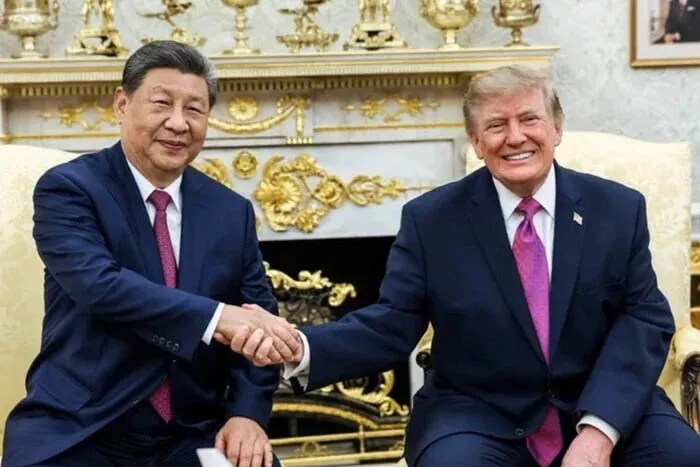
U.S. President Donald Trump and Chinese leader Xi Jinping did not achieve a significant breakthrough during their talks in Washington. One of the key outcomes of the meeting was merely a two-month extension of the trade truce.
At the same time, the parties left the issues of rare earth metals, artificial intelligence, and Taiwan unresolved.
The publication highlights the contrast between the scale of the festivities and the results of the talks. Trump personally greeted Xi Jinping upon his arrival in Washington. According to The Economist, no U.S. president in the past 64 years has met a foreign leader directly at the airport.
The lavish reception, according to the publication, demonstrates Trump’s desire to maintain stable relations with Xi. At the same time, the substantive part of the talks turned out to be much more modest.
The main practical outcome of the summit was the extension of the trade truce between the U.S. and China, which was set to expire in November. Beijing wanted to extend it until the end of Trump’s presidential term, but the parties agreed only to an additional two months. U.S. Treasury Secretary Scott Bessent stated that Washington plans to use this time for further economic negotiations with China.
Rare earth elements remain one of the main points of contention. China has used restrictions on their export as a response to U.S. tariffs. At the same time, the volume of shipments to the U.S. remains below the level recorded before the trade truce.
No significant progress has been made on the issue of artificial intelligence either. Some U.S. experts had expected that Trump and Xi might agree on rules to regulate the most powerful AI models or, at the very least, on mechanisms to mitigate risks. However, the parties did not announce any specific agreements.
The Economist also noted the limited role of security and defense issues in the negotiations. Trump’s approach to China during his second presidential term has softened in a number of areas, particularly regarding semiconductor exports and U.S. commitments to Taiwan.
The fate of a major arms package for Taiwan was particularly telling. The U.S. put it on hold amid negotiations with Beijing. This involves a $14 billion arms sale, which remains on hold following the May meeting between Trump and Xi. Trump himself had previously described this package as a useful bargaining chip.
The Taiwan issue itself also remains unresolved. During the meeting, Xi called on Washington to oppose Taiwan’s independence, while the U.S. side did not publicly announce a fundamental change in its position.
Despite the lack of major agreements, both countries are currently interested in maintaining a period of relative stability. Rush Doshi, a former official in the Joe Biden administration, believes that China aims to use the coming years to strengthen its position in its competition with the United States.
Ryan Hass, an expert at the Brookings Institution quoted by The Economist, noted that only about 30 minutes were devoted to substantive talks in the Oval Office. “It seems that the main purpose of this visit is precisely the ceremony itself,” he noted.
At the same time, the frequency of contact between Trump and Xi may be significant in itself. Over the course of the year, the leaders of the U.S. and China may hold several meetings, which creates an additional incentive for both sides to prevent a new sharp escalation in relations.