
Sybiga called Sweden's decision regarding the Caffa an important precedent in the fight against Russia's shadow fleet
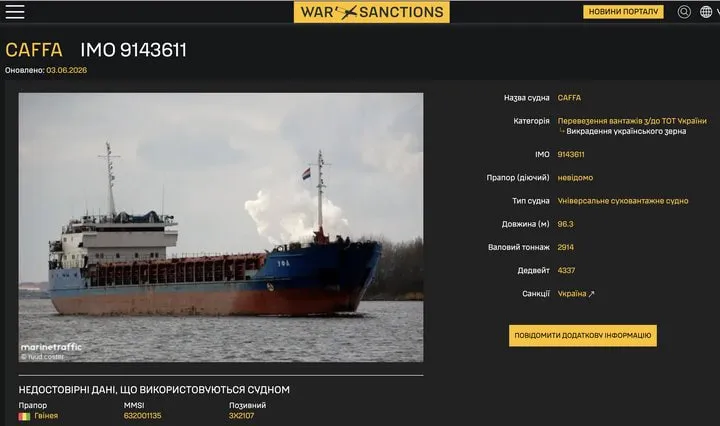
The Swedish court’s ruling regarding the Caffa, a vessel linked to the illegal export of grain from occupied Sevastopol, sent an important signal in the fight against Russia’s shadow fleet. Ukrainian Foreign Minister Andriy Sibiga emphasized that this case sets a new precedent for holding participants in such schemes accountable.
“I welcome the Swedish Supreme Court’s decision to uphold the arrest and transfer to Ukraine of the Caffa, a vessel belonging to the Russian shadow fleet. This landmark decision sets an important precedent, demonstrating that decisive action by law enforcement agencies and the prosecutor’s office, combined with an independent and impartial judicial system, can translate the principle of accountability into tangible results. We continue to work to counter Russia’s shadow fleet and its ability to fund its war,” Sibiga wrote.
The Ministry of Foreign Affairs noted that the Caffa case demonstrates the possibility not only of imposing sanctions against vessels that help Russia circumvent restrictions, but also of conducting international investigations, making arrests, and subsequently transferring such assets to Ukraine.
“The vessel changed its owners, management, and flag and arrived in occupied Sevastopol at the end of June. We spotted it there and took note of the flag because, at that time, it had just been registered under that flag, but it was already listed in the database as ‘Guinea False,’” explains Kateryna Yaresko, a journalist with the SeaKrime project at the Myrotvorets Center.
Ukrainian law enforcement agencies had previously established that the vessel had called at occupied Sevastopol and may have been used to illegally transport Ukrainian grain. After gathering evidence, Ukraine submitted a request to the Swedish authorities to arrest the vessel.
The SBU emphasized that the decision in the Caffa case serves as a warning to other participants in Russia’s shadow fleet schemes—such vessels may become the subject of international criminal proceedings and lose the ability to be used to finance Russia’s war against Ukraine.
“Materials from the criminal investigation confirming the circumstances established by the Ukrainian investigation were sent to the competent authorities of the Kingdom of Sweden. This included information regarding the vessel’s activities, its routes, the use of closed Crimean ports, as well as the justification for the need to take procedural actions,” said an investigator with the SBU’s Main Directorate in the Autonomous Republic of Crimea.
Ukrainian Foreign Minister Andriy Sibiga wrote about this on August 5 on social media platform X.
A Swedish court ruled to transfer the sanctioned vessel Caffa.
President Volodymyr Zelenskyy signed a law expanding the rights of military personnel released on parole to serve in the Armed Forces of Ukraine. The document provides them with additional social guarantees, the right to transfer, and new grounds for discharge from service.


