
Global food prices have reached their highest level in nearly four years
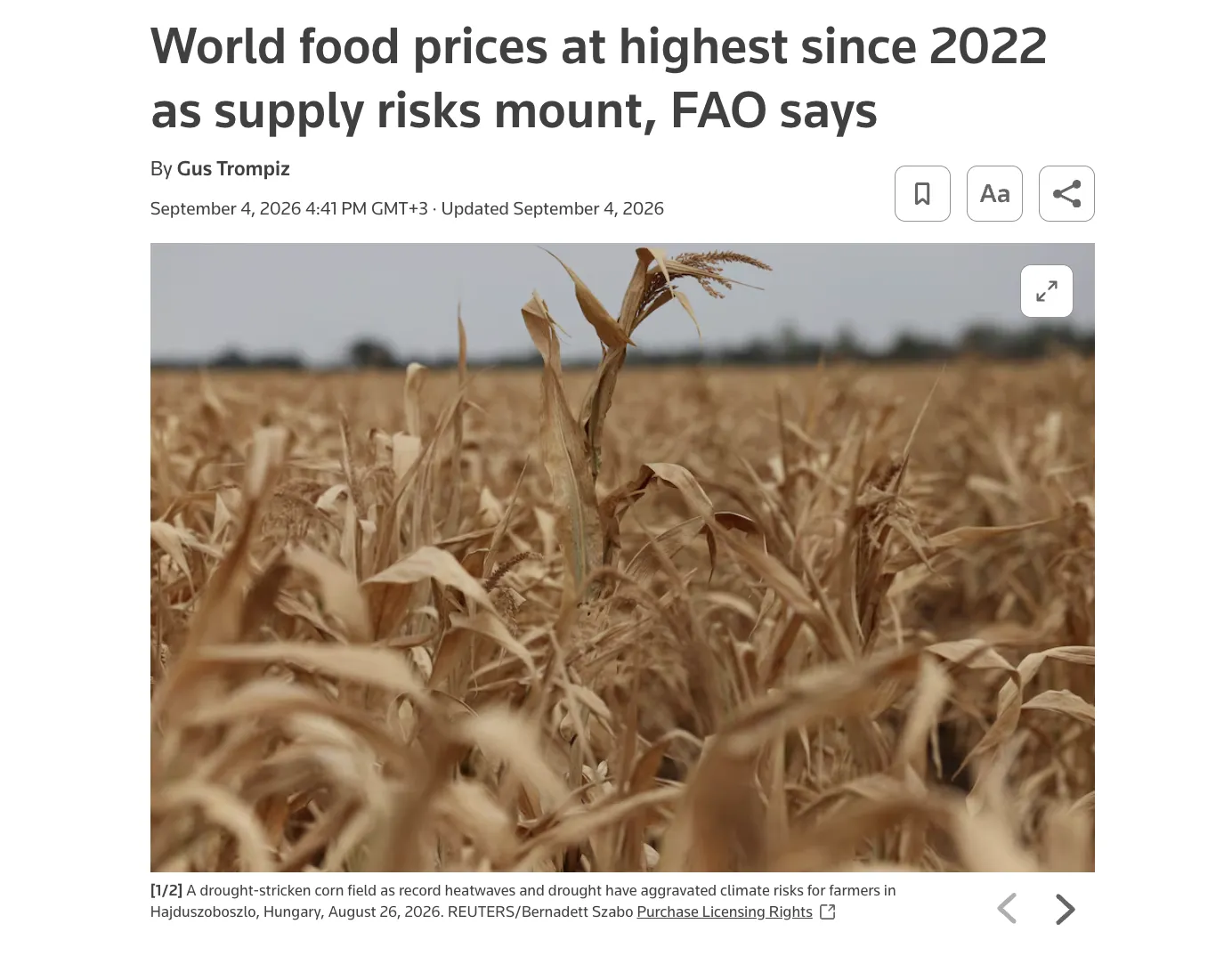
In August, global food prices rose to their highest level since November 2022. The price increases affected all major food groups, with sugar seeing the sharpest monthly rise.
The FAO Food Price Index, which tracks the cost of a basket of major food commodities on the global market each month, averaged 133.3 points in August—1.9% higher than the revised July figure and 2.5% higher than a year ago. This is the highest level since November 2022, although it is still nearly 17% below the historic peak in March 2022, recorded immediately after the start of Russia’s full-scale invasion of Ukraine.
Growth was observed across all five commodity groups:
- grains – up 2.2%;
- vegetable oils – up 0.6%;
- meat – up 1%;
- dairy products – up 2.3%;
- sugar – up 11.9%.
The sugar price index jumped 11.9% over the month, reaching its highest level since June 2025. The reason is worsening forecasts for the sugar beet harvest in the European Union due to prolonged heat and drought, as well as an expected decline in sugar production in Brazil. Additional pressure is coming from the threat of El Niño—a natural warming of Pacific Ocean waters that is affecting harvests in Asia. Meanwhile, India has announced duty-free imports of raw sugar, which has heightened expectations of rising global demand.
Wheat prices rose 2.6% over the month and are already 15% higher than a year ago. Traders are factoring into prices the risks associated with disruptions to Black Sea exports and crop damage caused by the hot summer in Europe.
Corn prices rose by 2.5%—the price was influenced by concerns over harvests in the U.S. and the EU, high demand from biofuel and feed producers, as well as supply disruptions caused by the closure of the Strait of Hormuz and difficulties with Ukrainian exports. Overall, the grain index rose by 2.2%—reaching its highest level since May 2024. Meanwhile, within Ukraine, prices for some grain crops are, on the contrary, falling—trends in the domestic and global markets are currently moving in opposite directions.
Vegetable oils rose in price by 0.6%—to their highest level since June 2022— primarily due to palm and soybean oils, driven by high demand and concerns about the impact of El Niño on harvests in Southeast Asia. Sunflower and rapeseed oils, on the other hand, became slightly cheaper. Dairy products rose 2.3% due to a drought in the EU that reduced milk production—prices for milk powder and cheese saw the largest increases. The meat index rose 1%, with pork, poultry, and lamb all becoming more expensive. Beef, on the other hand, became cheaper—changes to China’s import quotas intensified competition between beef exporters from Brazil and Australia for other markets.
“The August price increase signals the return of a risk premium to food markets: climate shocks, geopolitical tensions, and disruptions in trade logistics are simultaneously putting pressure on supplies,” noted FAO Chief Economist Máximo Torero.
FAO has lowered its global harvest
forecast In a separate report, the organization lowered its forecast for global grain production in 2026 to 2.98 billion metric tons—2% less than last year, and the largest annual decline since 2018, although the harvest could still be the second-largest on record. The forecast for wheat production was raised to 810.7 million metric tons (3.8% less than in 2025), while the forecast for corn was lowered to 1.309 billion metric tons due to poorer harvest prospects in France and Poland. Rice production may decline by 1.9% to 553.1 million metric tons.
Global grain stocks at the end of the 2026/2027 season were revised downward by 1.1% to 947.2 million metric tons, which is only slightly higher than the level of the previous season. According to the FAO, the downward revision of the forecast for feed grain stocks outweighed the upward revision for wheat—the latter linked to expected stock buildup in Russia and Ukraine due to limited export capacity.
This information was reported based on data from the Food and Agriculture Organization of the United Nations (FAO) and Reuters.
As a reminder, as of September 7, 2026, gas station chains in Ukraine updated their fuel prices. The average price of A-95 is 83.18 UAH per liter, and diesel fuel is 93.82 UAH.
As a reminder, as of September 1, 2026, the largest gas station chains in Ukraine updated their fuel prices. The average price of A-95 gasoline is about 80.63 UAH per liter, and diesel fuel is 91.77 UAH per liter; currently, the OKKO, WOG, and SOCAR chains are selling the most expensive fuel.


