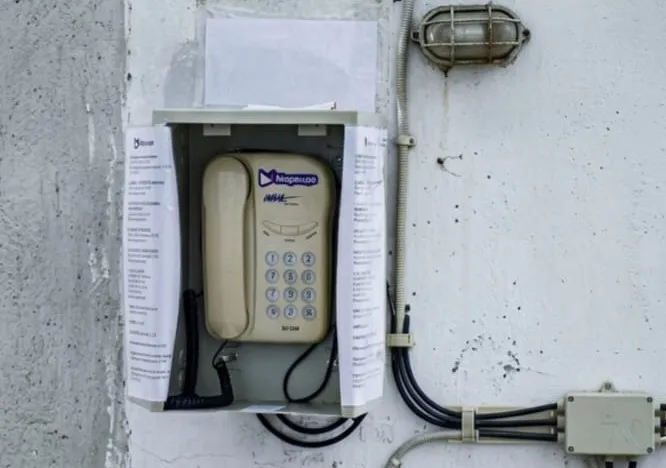
In occupied Crimea, due to problems with communications and electricity, residents are increasingly forced to revert to long-forgotten ways of life. In Yevpatoria and Dzhankoy, push-button phones for calling emergency services have begun to be installed, and in some cities, people cannot pay with cards due to the lack of stable ATM service.
The problems that the occupying authorities are unable to resolve are having an increasingly significant impact on the daily lives of Crimeans. People are complaining about the lack of cell service, power outages, and having to resort to cash-only transactions. In Yevpatoria and Dzhankoy, push-button phones have begun to appear on the streets, which can be used to call an ambulance or the fire department. In effect, this marks a return to a practice that was common decades ago.
Edie, a resident of Yevpatoria, said that her young grandson didn’t even realize right away what the device was. “We were out walking with him yesterday; he saw it and got curious. I told him that when I was a kid, these were the only phones we had. He said, ‘Oh, cool, but I don’t get it—how did you play on them? And how did you send messages?’ And then he asked, ‘So, grandma, should we order a pizza?’” the woman said.
Meanwhile, residents of Armiansk faced another problem. After 17 days without electricity, people received bills for internet and cable TV, but the amounts on the bills remained the same as before. Mykhailo, a resident of Armiansk, said he tried to get his bill recalculated but was turned down. “I’ve been out of work for a month now, my wife is on maternity leave with our daughter, we barely have enough for food, and now it turns out we have to pay another 1,500 for internet and cable. Are you kidding me?” the man exclaimed indignantly.
According to him, the company explained that as long as the state of emergency is in effect, there will be no adjustments. Cash has become another problem for residents of northern Crimea. Even if there’s money in a bank account, that doesn’t mean it can be accessed. Due to power outages, many stores and pharmacies accept only cash. In Krasnoperekopsk, there are only a few ATMs left that can operate without a stable power supply, so the cash at them runs out quickly. “I got a toothache in the evening, so I went to the pharmacy for painkillers—but they only took cash. The ATM nearby wasn’t working. I drove off to look for one. By the time I found one, I’d used up 7 liters of gas. How are people in the villages supposed to get by when the nearest ATM is 40 kilometers away?” said Alisa, a resident of Krasnoperekopsk.
Crimeans say they’re increasingly forced to resort to paper money. Back at the beginning of the year, the occupying authorities claimed that over 95% of banking transactions on the peninsula were conducted electronically. Now, up-to-date statistics aren’t being published. Irina, a resident of Kerch, said that she used to hardly ever use cash, but now the situation has changed. “I used to keep maybe up to a thousand rubles in cash in my wallet. We have a small, informal market ‘in the neighborhood’—vegetables from the garden, homemade cheese, and eggs—and that’s the only place where I used to pay with cash. Now I have to pay with ‘plastic’ for almost everything,” she said.
According to her, some people even have trouble withdrawing their own money because ATMs are unreliable. As a result, residents of occupied Crimea face several problems at once—from a lack of reliable communication to difficulties with banking services. Despite the occupying authorities’ claims of “development” in the region, everyday problems are increasingly forcing people to return to the realities of the past. This was reported by Ceemat.
On the night of July 20, a series of explosions rocked the temporarily occupied Crimea. Following a drone attack near Alushta, a fire broke out at the “Pryvitne” power substation.
As a reminder, in Domodedovo, near Moscow, a fire broke out at the “Southern Gate” logistics complex following a nighttime drone attack on July 20.
Over the past day, the Russian army lostanother 1,600 troops, two tanks, eight armored fighting vehicles, 82 artillery systems, three multiple launch rocket systems, and six air defense systems.