

Today, an ordinary job advertisement abroad can end not only with the loss of money. In the worst case, a person may find themselves behind locked doors, without a passport or any way to return home — and instead of the promised job, they are forced to deceive dozens of other people every day through social media, messengers and fake investment platforms.
July 28 the UN International Organization for Migration reported a sharp rise in human trafficking linked to so-called scam compounds — closed complexes where people are forced to engage in online fraud.
According to the organization’s estimates, in major centers in Myanmar, Cambodia and Laos alone up to 300,000 people may be staying or working. And this has long ceased to concern only residents of Southeast Asia. According to the IOM, victims have been recruited from more than 80 countries, while the organization itself has already assisted survivors from about 30 states.
The scheme often begins in the most ordinary way. A person sees a vacancy on social media for a manager, support operator, sales specialist or customer service employee. They are promised a high salary, relocation to another country, accommodation and a job at an international company. People with good English and higher education are especially valued — precisely because they can communicate more effectively with future fraud victims.
After arrival, the situation can change completely. People have their documents taken away, their movement is restricted, an artificial “debt” is created for tickets, accommodation or paperwork, and they are forced to work for a criminal network. According to information from the UN and INTERPOL, those who refuse to work or fail to meet imposed targets may be beaten, held in isolation, tortured or subjected to sexual violence.
This is how one of the most paradoxical forms of modern human trafficking emerged: a victim of exploitation becomes a tool for deceiving another victim.
UA.News explains how online scam factories operate, why educated people voluntarily travel for “work” and end up in de facto slavery, and how criminal networks make money from romance scams, cryptocurrency and fake investments.
From casinos to online scam factories
Modern scam compounds did not appear out of nowhere.
Their rapid spread across Southeast Asia began roughly in the early 2020s. The UN Office of the High Commissioner for Human Rights notes that serious reports about such operations began arriving on a large scale from 2021.
Part of the infrastructure grew around casinos, gambling businesses and semi-legal economic zones in Cambodia, Myanmar and other countries in the region. When the traditional gambling industry began facing restrictions, the COVID-19 pandemic and closed borders, some buildings, staff and technical infrastructure began to be repurposed for online fraud.

In more recent materials UNODC also describes cases in which casinos and hotels in Southeast Asia effectively turned into cybercrime centers where trafficking victims were forced under supervision to carry out fraudulent operations.
The scale of the problem became clear fairly quickly.
As early as 2023, the UN cited estimates suggesting that in Myanmar alone, the number of people subjected to forced labor for online scammers could amount to at least 120,000 people, while in Cambodia there could be another roughly 100,000.
However, over the next few years, the problem ceased to be exclusively Asian.
In June 2025 INTERPOL reportedthat trafficking victims exploited for work in scam centres had already been identified among citizens of 66 countries on every continent. Around 74% of known victims were still being transported to Southeast Asia, but new centers began appearing in the Middle East, Central America and West Africa.
By early 2026, the scale was confirmed not only by analytical estimates but also by police raids. During the international Liberterra III operation coordinated by INTERPOL, law enforcement officers protected more than 4,400 potential victims of human trafficking and arrested 3,744 suspects in 119 countries.
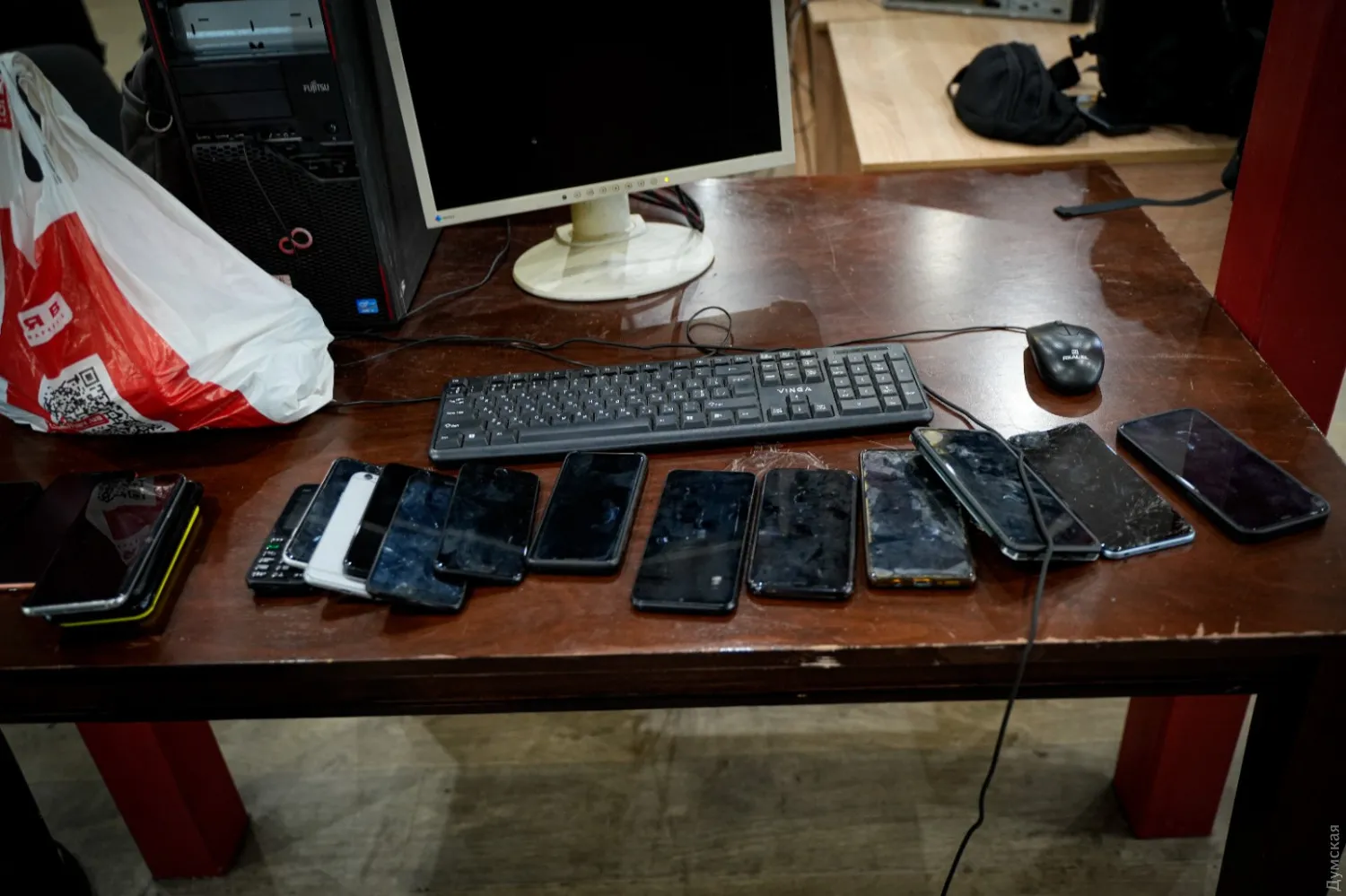
During just one raid in Myanmar, law enforcement officers found about 450 people in a scam compound. More than 18,800 mobile phones and over 300 computers were seized at the site.
These figures show that this is no longer about small groups of telephone scammers, but about a genuine industrial-scale production of deception.
How a person ends up in a scam compound
One reason this system is so effective is that its victims often do not realize until the very last moment that they are being sold.
The traditional image of human trafficking involves kidnapping, physical coercion or illegal transportation across a border. In scam centres, however, the first stage can look like an entirely normal recruitment process.
A person is sent a job offer through Facebook, LinkedIn, Telegram, WhatsApp or other platforms. They may go through several interviews, be shown a company website, have documents prepared and even have their flight paid for.

INTERPOL notesthat criminals deliberately seek people with a good education, language skills and experience in sales or communications — because the effectiveness of future fraud depends on these qualities.
After arriving, a person may find themselves in a completely different country or city from the one they were promised. They are taken to a closed compound, their passport is confiscated, and they are told they must now “work off” the costs of travel and accommodation.
Such a debt can continue to grow.
Fines are added for poor performance, food, accommodation, “disciplinary violations” or escape attempts.
In February 2026 the UN Human Rights Office again called the issue one of the most complex modern forms of human trafficking. The report stresses that victims face not only violence while working but also problems after release — from debt and psychological trauma to criminal prosecution for fraud they committed under coercion.
That is why a scam compound is not simply a fraudulent call center. It is a system in which one person is deceived in order to force them to professionally deceive another.
How “pig butchering” works: victims can be groomed for months
One of the main sources of income for scam compounds has become so-called pig butchering scams — long-term fraud schemes built less on technical hacking than on trust and psychological manipulation.
The FBI calls such schemes one of the most widespread and destructive forms of cryptocurrency investment fraud. Scammers meet people on social media, dating apps or messengers, or even start a conversation with an apparently accidental message sent to the wrong number. They then gradually build a friendship, business relationship or romance.
At the first stage, the potential victim may not be asked for money at all. The goal is to make the contact feel normal and build trust.
A person may receive daily messages about work, family, travel or future plans. The other person takes an interest in their life, remembers details, offers support during difficulties and only after some time seemingly casually begins talking about investments.
For example, they may say that they themselves earn money from cryptocurrency or gold trading and can show how it works.
The potential victim is directed to an investment platform or app that may look almost indistinguishable from a legitimate financial service. At first, the person is encouraged to deposit a relatively small amount.
A profit appears on the screen. Sometimes scammers even allow the person to withdraw a small portion of the funds to fully convince them that the platform works.
After that, the stakes begin to rise.
The victim is persuaded to invest several thousand more dollars, then tens of thousands. They may be offered “special deals,” loans or bonuses for increasing the deposit.
In reality, no investments exist. The FBI explainsthat the money is controlled by scammers, while the profit shown in an app or on a website is merely numbers on a screen. When a person tries to withdraw large sums, they are told they must pay a tax, a fee or make another deposit.
A victim can be “worked” in this way for weeks or months.
The term itself pig butchering — “slaughtering the pig” — comes from the analogy of an animal being fattened for a long time before being slaughtered. However, law enforcement agencies are increasingly trying not to use this label for the victims themselves, because it shifts part of the blame onto a person who was in fact subjected to professional manipulation.
Behind a romantic profile may be someone who is themselves being held by force
This is where the story of scam compounds becomes far more complex than ordinary online fraud. A social media profile portraying a successful entrepreneur, investor or attractive woman may be operated not by one particular scammer but by an entire team.
One employee searches for potential victims. Another starts the conversation. A third steps in when it is time to move toward investments.
Different people may be responsible for a fake website, cryptocurrency transfers, creating photographs or building the profile’s backstory.
At the same time, some of these “scammers” may themselves be victims of human trafficking.
In its 2025 Internet Crime Report, the FBI explicitly statesthat a significant share of cryptocurrency investment fraud is organized by criminal groups in Southeast Asia that use trafficking victims as forced labor.
This creates, in effect, a double chain of deception. At one end is a person who believes they have found love, a friend or a financial mentor. At the other end is an operator who may be sitting in a closed compound without documents and carrying out a plan set by criminals.
Between them is an organized structure controlling accounts, money, cryptocurrency wallets and internet infrastructure.
How much the online scam industry earns
The financial scale helps explain why such centers continue to appear even after police raids.
According to FBI data, in 2025 alone Americans reported nearly $21 billion in losses from cybercrime.
Around $17.7 billion of that amount was directly attributable to fraud carried out using digital technologies.
Investment scams were the single largest source of losses — nearly 49% of all reported fraud losses.
Cryptocurrency statistics were particularly revealing. In 2025, the FBI received more than 181,000 complaints related to cryptocurrency. Reported losses exceeded $11 billion.
Cryptocurrency investment fraud alone caused victims approximately $7.2 billion in losses.
And these are only U.S. figures, and only cases that people reported to law enforcement. The FBI separately stresses that the true scale may be larger because some victims are ashamed to go to the police or do not realize until very late that they have been defrauded.
The U.S. Operation Level Up shows how difficult it can sometimes be to convince a person that they are being scammed.
As part of the operation, the FBI tries to proactively identify peoplewho are currently transferring money to scammers and warn them before they lose everything.
As of December 2025, agents had contacted 8,103 potential victims of cryptocurrency investment schemes. And 77% of them did not know they were being scammed at the time the FBI called.
According to the bureau’s estimates, this helped prevent more than $511 million in losses.
In some cases, people were already preparing to sell their homes, take out large loans or withdraw retirement savings to make another “investment” payment.
Why victims give scammers all their savings
At first glance, it may seem strange that a person can transfer hundreds of thousands of dollars to someone they have never met in person. But that is precisely what distinguishes these schemes from primitive phishing.
A scammer does not ask for money in the first message. They build a relationship. The victim may be shown photographs, documents, videos, a story about the scammer’s “own business,” and even be drawn into discussions about a shared future.
At the same time, scammers try to learn as much as possible about the victim’s financial situation — where they work, whether they own property, have retirement savings, a business or cash reserves.
After that, the amount of the next “investment” is no longer chosen at random.
In February 2025, the FBI described casesin which, after being warned by law enforcement, one potential victim admitted they were about to transfer another $1 million to scammers, another planned to sell a house and invest $500,000, while a third had already withdrawn $500,000 from retirement savings.
That is precisely why these scams are so profitable.
Instead of trying to steal $100 from thousands of people, criminals can spend months working on dozens of promising victims and eventually take hundreds of thousands or even millions of dollars from a single person.
Artificial intelligence makes scam factories even more effective

Traditional psychological manipulation is now being supplemented by another tool — artificial intelligence.
In March 2026, INTERPOL published a new global assessment of financial fraud threats and warned that criminal groups are increasingly using generative and agentic AI.
According to the organization’s assessment, scam schemes using AI may be 4.5 times more profitable than traditional ones.
AI gives criminals several advantages at once. It allows them to quickly create convincing photographs and profiles of nonexistent people, write messages in different languages, generate conversation scripts, clone voices and create videos featuring people who never actually existed.
Even the language barrier is gradually losing significance.
Whereas fraud targeting, for example, Americans, Germans or French people once required employees with the relevant language skills, AI can now handle a significant part of the translation and response preparation.
The FBI reportedthat in 2025 it singled out artificial intelligence as a separate category in its annual internet crime statistics for the first time. During the year, Americans filed more than 22,000 complaints involving the use of AI in fraud, with reported losses totaling nearly $893 million.
Criminals use fake profiles, voice cloning, forged documents and realistic videos depicting public figures or loved ones.
INTERPOL also warns about the next stage — agentic AI, meaning systems capable not only of writing a message but of autonomously carrying out parts of a fraudulent campaign.
Such systems could potentially gather information about a person on their own, identify the most promising targets, prepare messages and maintain conversations.
For scam compounds, this means a fundamental change in the economics.
If one operator could previously handle only a limited number of people, automation could allow one worker to control dozens of parallel conversations.
Artificial intelligence therefore will not necessarily replace people in such centers.
It may instead make each person forced into this work significantly more productive.
As a result, one of the most technologically advanced innovations of our time is paradoxically becoming a tool for scaling one of the oldest forms of crime — human trafficking.
How scam centers launder billions
Successfully deceiving a victim is not enough. For a criminal network, it is equally important to move the stolen funds quickly in a way that makes them difficult to block or recover.
That is why scam compounds are closely linked to money-laundering infrastructure.
A 2025 UNODC report states that such centers use underground banking systems, networks of intermediaries and virtual assets. Money can be transferred repeatedly between accounts and cryptocurrency wallets, moved through different jurisdictions and mixed with legitimate financial flows.
Criminal groups no longer necessarily have to build the entire financial system themselves. INTERPOL notes that major scam networks are increasingly working with specialized money-laundering groups, effectively purchasing the service in much the same way an ordinary company hires an outside contractor.
Cryptocurrency is particularly convenient because of the speed of international transfers. But it does not make money completely invisible. Law enforcement agencies are increasingly learning to trace such transactions and freeze assets before they pass through dozens of wallets.
A telling example was the international First Light 2026 operation, whose results INTERPOL announced on July 9. Law enforcement agencies from 97 countries and territories arrested 5,811 people and intercepted about $293 million in illicit assets. The operation specifically targeted social engineering, investment, romance and other forms of online fraud, as well as related money laundering.
Law enforcement agencies used, among other tools, the I-GRIP mechanism, which enables countries to rapidly exchange information and attempt to stop a suspicious transfer before the money disappears for good.
But this is a constant race against time. Scammers need only a few minutes to split money across different accounts and cryptocurrency wallets. Police may need days or weeks for an international investigation.
Scammer or slave: who should be prosecuted after release
Perhaps the most difficult question arises after police enter a scam compound. Law enforcement officers may find hundreds of people sitting at computers, using accounts that were involved in defrauding foreigners of millions of dollars.
Formally, they took part in a crime. But some of them may have been lured into the center through deception, had their documents taken away and worked for years under threat of violence.
Where, then, is the line between perpetrator and victim?

The UN Human Rights Office in February 2026 separately urged states to follow the non-punishment principle — not to punish trafficking victims for unlawful acts they were compelled to commit as a result of exploitation.
The problem is that in practice this principle is far from consistently applied.
A new OHCHR document, Breaking the Cycle, published in June 2026, states that among surveyed survivors who had been released, nearly 70% after leaving scam compounds faced punishment instead of protection.
People may be detained for violating migration laws, illegally crossing a border or participating in fraud.
This creates an extremely difficult legal situation. If a person was beaten and threatened with death, the coercion is obvious. But what if they were allowed to use a phone? What if they received a small salary? What if, after a year, they became a team leader themselves?
Or what if they were initially a victim but later began recruiting others? In real life, the line between coercion and voluntary participation may be far more complicated than it appears during a police raid.
That is why the UN insists on individual identification of victims instead of automatically treating everyone found in a scam compound as a criminal.
In a sense, scam compounds demonstrate how quickly traditional organized crime has adapted to the digital economy.
In the past, exploiting a person required a plantation, a factory, a construction site or a brothel. Today, a laptop, a smartphone and internet access are enough.
A person can be transported across several borders, placed in front of a computer and forced to communicate every day with dozens of people on the other side of the world.
The victim physically remains in Myanmar or Cambodia, but their “workplace” is simultaneously in the United States, Germany, the United Kingdom or any other country where the person they are trying to deceive lives.
And technological progress is, for now, working for both sides. Law enforcement agencies are gaining better systems for transaction analysis and cryptocurrency wallet blocking.
Scammers, meanwhile, are gaining artificial intelligence, deepfakes, automatic translation, hundreds of fake profiles and the ability to target people in dozens of countries at the same time.


