
Oil prices fell more than 6% following a lull in hostilities between the U.S. and Iran — Reuters
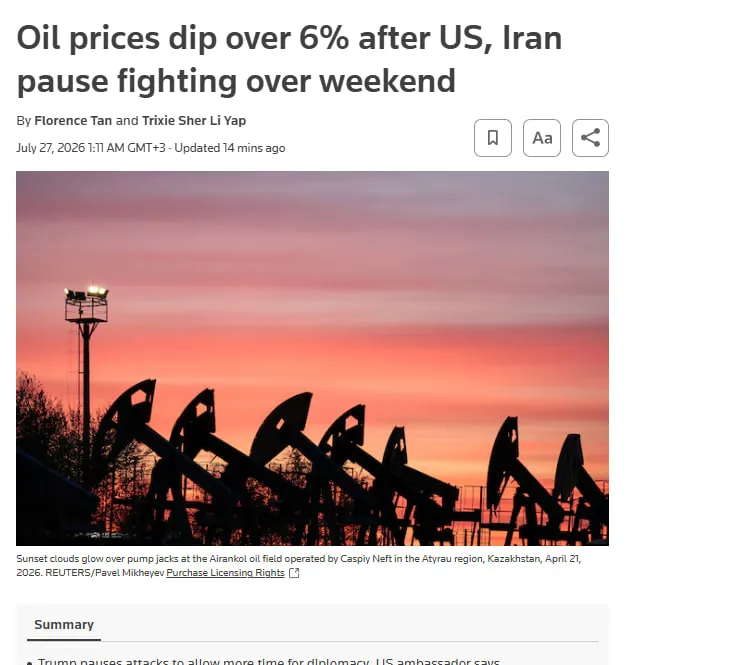
Global oil prices fell sharply on July 27 after the United States and Iran suspended their two-week-long exchange of strikes. Market expectations of a diplomatic resolution to the conflict have grown, which could help de-escalate the situation in the Middle East and gradually restore shipping through the Strait of Hormuz.
Brent crude futures fell by $6.20, or 6.4%, to $90.58 per barrel. During trading, prices briefly dipped below the psychological threshold of $90.
U.S. West Texas Intermediate (WTI) crude also fell sharply in price—by $5.80, or 6.5%, to $83.51 per barrel.
Both oil benchmarks are trading at their lowest levels in nearly a week following a three-week rally triggered by the escalation of tensions in the Middle East.
ING analysts note that the absence of new military action was the first real sign of a possible de-escalation of the conflict.
“Oil prices fell sharply at the start of trading as the U.S. and Iran refrained from further military action. The price dynamics clearly demonstrate how much the market needs positive news,” the bank’s experts noted.
At the same time, despite the temporary halt to attacks, the situation with maritime shipping remains tense. According to data from Kpler, fewer than ten cargo ships passed through the Strait of Hormuz each day over the weekend.
Sol Kavonik, an analyst at MST Marquee, believes that the return of shipping to normal levels will be gradual. According to him, most shipping companies are in no hurry to resume routes, awaiting greater certainty regarding the safety of transit through the region.
Experts emphasize that, despite the current drop in prices, the market remains vulnerable to new geopolitical upheavals.
UOB analysts note that risks to global oil supplies persist due to instability in the Middle East, as well as Russia’s war against Ukraine. In particular, Ukrainian drone attacks on Russian ships and oil refineries may continue to affect supply volumes.
According to experts, if disruptions to crude oil supplies continue, this will keep energy prices high and maintain the risk of accelerating global inflation.
This was reported by Reuters.
As a reminder, the EU has authorized the confiscation and sale of Russian oil from tankers that violate sanctions.
The EU is suspending adjustments to the price cap on Russian oil.


